

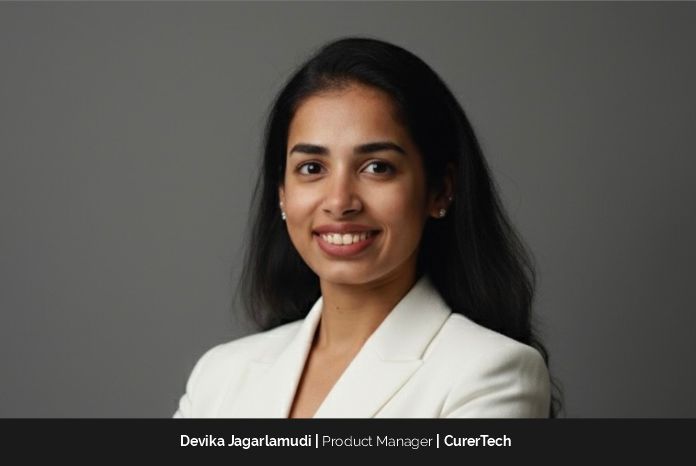
Some people study problems, while others decide to solve them. For Devika Jagarlamudi, Product Manager at CurerTech, the turning point comes when she realizes groundbreaking research often never reaches those who need it most. “I’ve witnessed countless opportunities lost because incredible research breakthroughs sit unused. The systems simply can’t deliver them to clinicians,” she says. “Why keep studying the problem when I could build the solution?”
That realization becomes the foundation of her career in product management, where she turns data and innovation into tools that make a real difference. Her goal is simple yet ambitious: to make healthcare technology feel human again.
“Healthcare needs people who understand both clinical realities and technological possibilities.”
From Research to Product: Turning Insight into Impact
Devika’s move from clinical research to product management is driven by purpose. With a strong healthcare and data background, she realizes her true impact comes from shaping outcomes rather than observing them. “My background is my secret advantage,” she explains. “I can translate between developers and clinicians because I genuinely understand both worlds. At CurerTech, I know which data truly matters for patient care versus bureaucratic noise.”
Her research training instills one essential question: Does this actually work? It guides every product her team builds. “We’re not creating software for its own sake,” she says. “We’re building tools that translate what helps people into something providers can actually use when it matters most.”
What Innovation Really Means
For Devika, innovation in mental health care is not about complexity. “Innovation means making things simpler, not more complicated,” she says. Many therapists still use outdated record systems designed for general medicine, slowing their work. “Therapists are drowning in software that fights them instead of helping them.”
Her view of innovation is grounded in empathy. “If a therapist leaves work thinking about their patient’s breakthrough instead of the software’s bugs, we’ve innovated. If they’re still clicking through endless screens while someone waits for help, we’ve failed,” she asserts.
Real innovation supports human connection. Technology should evolve with healthcare, adapting to new treatments and insights rather than holding clinicians back.
Balancing Compliance and Experience
In healthcare technology, compliance and usability can complement each other. “Compliance and good user experience aren’t enemies,” she says. Her experience with HIPAA-compliant systems teaches her security and usability can coexist when built into the foundation from the start. “The future of healthcare means technology that’s secure and effortless to use,” she explains. “When providers can focus on care instead of worrying about compliance checkboxes, everyone wins, especially patients.”
“Real innovation is giving clinicians back their time so they can be fully present with someone who’s struggling”.
Building Trust Through Technology
One of Devika’s biggest challenges at CurerTech is leading the creation of a next-generation AI-integrated electronic medical record system. The hardest part, she says, is earning providers’ trust. “Many clinicians fear AI will complicate their work. But when they see it simplify documentation and highlight meaningful insights, they become supporters,” she shares.
“This teaches me that great technology sells itself through results,” she adds. “When providers spend less time on paperwork and more time with patients, the technology proves its worth without needing a sales pitch.”
Fostering Collaboration at CurerTech
CurerTech structures teams around integration rather than traditional departments. Developers, clinicians, billing experts, and patient portal builders work side by side. “Collaboration isn’t optional, it’s foundational,” she explains.
“It’s messy sometimes, startups are, but we’re intentional about it. When our developers sit with clinicians and our billing team talks to patient portal builders, real solutions emerge,” she says.
This approach ensures everyone understands how their work impacts the larger care journey, reinforcing the mission: to make life easier for providers and better for patients.
“We’re building tools that translate what we know helps people into something providers can actually use when it matters most.”
Personalizing Care with AI
Among her proudest achievements, Devika highlights how CurerTech uses AI to personalize care. “We’ve integrated pharmacogenomics so clinicians can prescribe medications based on a patient’s actual genetic profile instead of guessing,” she says.
Their AI identifies patterns across treatment responses, recommending interventions at the right moments and adjusting care plans in real time. “A clinic tells us patients are staying engaged longer because the care feels truly personalized, not like being processed through a system,” she shares.
“When someone gets the right medication the first time because we understand their biology, when technology creates human connection instead of getting in the way, that’s what I’m proud of,” she adds.
Advice for Future Health Tech Leaders
When asked for advice for aspiring product managers, Devika says, “Truly understand the clinical world you’re building for. Shadow providers and learn their workflows. You can’t solve problems you don’t deeply understand.”
She believes healthcare’s complexity drives better solutions. “Regulations and clinical requirements aren’t obstacles, they push you toward better design,” she explains. “Remember, you’re building for people, providers using your tools and patients depending on them. That responsibility should guide every decision.”
The Future of Mental Health
Devika envisions a future where mental health care blends technology and empathy seamlessly. “Diagnostics must move beyond symptom checklists, treatments must become personalized, and technology must empower therapeutic relationships rather than replace them,” she says.
She believes digital tools should act as silent partners, providing therapists with real-time support. “The promise of digital innovation in mental health lies not in replacing human connection,” she explains, “but in weaving technology and compassion together.” Her vision is a smarter, more humane system that enhances care.
“Legacy isn’t about individual recognition – it’s about the ripple effect of helping millions through better care.”
A Legacy of Compassionate Progress
For Devika, success is measured by impact, not recognition. “Mental health challenges have become an epidemic across every age group,” she says. “My aspiration is to empower clinicians to diagnose and treat more efficiently, helping people reclaim their lives.”
She hopes her journey inspires others from clinical backgrounds to explore how technology can expand their impact. “Healthcare needs more people who understand both sides, the clinical realities and what’s possible with technology,” she explains.
“Legacy isn’t about individual recognition,” she reflects. “It’s about the ripple effect. If the systems I help build enable clinicians to provide better care to millions, that impact extends far beyond anything I directly touch.”
Conclusion: Innovation with Heart
Devika Jagarlamudi’s journey shows that innovation and empathy belong together. From clinical research to digital transformation, she remains guided by one question: Does this actually work for the people who need it most?
Her story reminds us that the best technology strengthens human care. By bridging science and compassion, Devika continues to build systems that improve healthcare while keeping it human.