
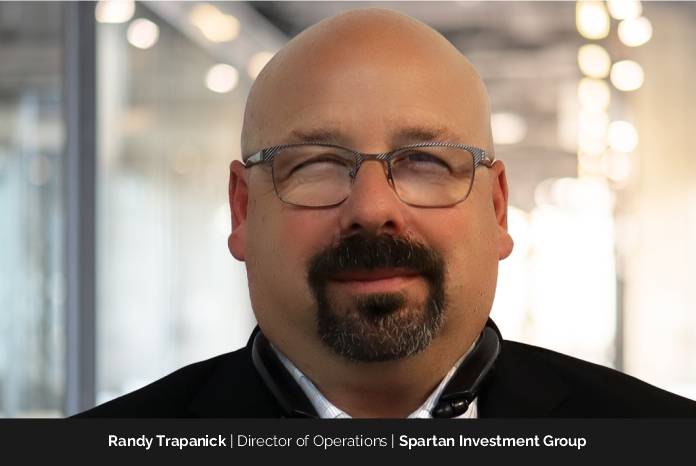
Randy Trapanick, Director of Operations at Spartan Investment Group, distills a set of practical, broadly applicable insights on leadership effectiveness, drawn from his firsthand experience in complex operational environments and driving teams toward consistent excellence. It’s Randy’s military experience that has influenced his approach to operations and team management. He explains how it taught him to view problems from multiple angles and identify various ways to solve them.
In Randy’s words: “The most important lesson was the value of over-communication: people perform better when they understand the ‘why,’ know their role, and are clear on what’s expected.”
When he undertakes a major initiative, he starts with a high-level plan and incorporates diverse perspectives early to foster alignment. Next, he divides the work into clear, trackable pieces that make progress easy to measure. He continually evaluates what’s working, adjusts when necessary, and resolves issues without slowing impetus. Throughout the process, Randy keeps the team aligned through regular updates. At the same time, he helps everyone see how their contributions fit into the larger mission and celebrates progress to maintain energy, ownership, and morale.
Guiding Values That Speak in Volume
“Servant leadership is the foundation of how I lead,” Randy shares, “It’s not just a style but a core belief system.” This philosophy, he clarifies, means prioritizing the team’s needs, actively removing obstacles, and empowering people not only to survive but also to thrive. He makes it clear that while financial outcomes matter, his true reward lies in the equally important metric of seeing the growth and success stories of the people he leads.
Randy enthusiastically underscores that this mindset finds its perfect home at Spartan Investment Group, which operates on the core principles of GRITT (Growth, Respect, Integrity, Tenacity, and Transparency). He further stresses three essential rules he learned from an early mentor. Always ensure credit goes to the people doing the real work. Lead with a “we,” not “I,” mentality. And relentlessly take full responsibility. He cites VP Derrick Harris as a living example of this, leading with profound humility and always focusing on team progress, never personal credit.
A Day as Director of Operations
This veteran paints a picture of a demanding day that begins with absorbing key business performance indicators, followed by an immediate shift into high-level coordination. He’s tasked with simultaneously driving several complex, multi-state initiatives across various departments.
Randy strongly feels that “leadership is about keeping everyone moving in the same direction.” This demanding setup relies on prompt elimination of any roadblocks, heavy use of performance data, and a focus on coaching. He relies heavily on performance data, looking not just at current metrics but for emerging trends. This immediately translates into coaching opportunities or resource shifts. Randy highlights a unique, motivating cultural ritual. Their weekly syncs always begin with gratitude shoutouts. He passionately reiterates that “no business conversation starts until we recognize someone for stepping up,” ensuring that while the work is important, the people matter more.
The Biggest Leadership Test
The 2024 operational overhaul has been a massive undertaking, involving sweeping changes to hours, KPIs, and systems, including updating dress codes, redefining performance expectations, and building entirely new systems from scratch. Randy identifies it as his greatest leadership challenge. He stresses that success hinged entirely on absolute clarity and transparent communication.
Working shoulder-to-shoulder with VP Derrick Harris, he architected a meticulous strategy, ensuring every change was framed so teams could genuinely understand and rally behind it. Despite tackling this transformation with a lean core team of just seven people, supported by five field team members, they achieved extraordinary results. The team’s execution included Kelly Williams launching a brand-new Marketing Request Center, Danielle Tricarico leading the tech transition for 58 sites, Stu White handling CapEx planning and execution for 11 new properties, and the HR team spearheading major changes to benefits, PTO, and the culture refresh.
Additionally, a new bonus structure was created and implemented from scratch. They hit 95% of their rollout goals, beat 4 out of 5 KPIs, and saw measurable increases in revenue and team engagement. Randy notes that the true test was the precise sequencing of every moving part, with relentless follow-up daily, weekly, and monthly to ensure layout.
Consistency and Empowerment
At FreeUp Storage, operational consistency starts with culture and leadership. Randy remarks, “We’re a small and relatively new company, which is actually one of our greatest advantages. We’re not bogged down by legacy systems or red tape, which gives us the ability to move fast, test ideas, and implement real change.” But agility only works when it’s grounded in structure and purpose. That is where the leadership approach comes in. Owners Scott Lewis and Ryan Gibson champion an “80% solution” philosophy; moving projects forward rather than waiting for perfection. Their belief that perfection is the enemy of progress empowers teams to think creatively, act decisively, and explore solutions outside traditional boundaries.
Randy proudly describes their continuous improvement culture, which features a quarterly Process Improvement Day where cross-functional teams identify friction points and propose better solutions. He credits the owners and HR team for prioritizing this progress by dedicating an entire day each quarter and even pausing operations so employees can focus solely on improving the business. He strongly opposes top-down micromanagement. Instead, he empowers his “Boots on the Ground” teams with the autonomy to make decisions, solve customer problems in real-time, and truly own their outcomes. Randy gives credit to VP Derrick Harris, who endorses this decentralized model and sets the tone by keeping the focus on fundamentals: a back-to-basics, field-first mentality. Having over 22 years of experience, Derrick’s leadership consistently reinforces the belief that the best solutions originate from listening to the people who are doing the work.
Role of Innovation and Technology
Technology played a critical role in enabling scalable, tech-enabled growth by rapidly standing up new infrastructure and streamlining core processes. Randy reflects, “In less than 10 months, our small team of fewer than 10 people delivered a sweeping operational transformation that impacted nearly every part of the business.”
The most significant accomplishment was establishing a fully operational call center in Manila in just 90 days from scratch. Derrick Harris led the integration and day-to-day operations of the new center, ensuring it aligned with high customer service standards.
Simultaneously, the team implemented a new CRM system using CallPotential to centralize customer interactions, increase visibility, and improve response times. In parallel, they transitioned their entire auction process to a new, AI-supported platform that streamlined workflows, eliminated redundant steps, and freed up 3 to 15 hours per site, per month. Randy highlights Danielle Tricarico here, who worked closely with 62 sites to guide each rollout. She managed platform transitions across all major systems and handled the details and troubleshooting that assured seamless adoption.
Randy personally coordinated the installation and activation of 21 new StoreEase sites, rapidly expanding the footprint from 11 to 32 sites under virtual management. He also took over leadership of the virtual management team to ensure alignment across the field, technology, and customer service. Additionally, the team addressed a foundational operational issue by leading a change in internet vendors across the portfolio, creating a more stable digital environment for the growing tech stack.
Randy attests that Derrick Harris remained a key voice of clarity, reinforcing the message that technology is adopted to serve people, not the other way around. The former fully embraced this perspective.
Underpinning every technology decision is owner Scott Lewis’s guiding principle that innovation must improve the customer experience without adding work for the Boots on the Ground. Any system that increases friction rather than removing it is quickly reconsidered. This philosophy, reinforced daily through Scott’s partnership with Ryan Gibson, creates the conditions for technology to serve people in a practical, sustainable way. Their leadership at the top gives teams the clarity and confidence to move quickly, stay grounded, and execute with consistency.
Randy’s role is to ensure that every platform adopted is purposeful, saving time and strengthening performance. In his view, technology should act as a force multiplier for empowered teams, not a layer of complexity.
Specific Contribution to Growth
There have been two foundational systems that reshaped how the organization operates, both built through close partnership and sustained field adoption. Driving performance through KPI strategy was a collaborative effort from the start. Randy partnered closely with Derrick Harris and Stu White to develop a focused, practical KPI framework that functions in real field conditions. That framework was then embedded into daily operations by a committed group of District Managers, including Al Green, Cory, Griffen, Anthony, Anderson, Rick Rhoades, and Janette Warren. Through consistent coaching, accountability, and example, they brought the metrics to life across the portfolio. Randy’s role is to keep these priorities visible every day, ensuring KPIs remain central to planning, execution, and performance improvement rather than becoming static reports.
The second major contribution was building a scalable Capital Expenditure system from the ground up. With no formal CapEx process in place, Randy led an initial audit and developed a structured two-year plan to guide investment decisions. By strategically combining projects, the team reduced costs and completed 95% of the tracked initiatives under budget. This work laid the foundation for long-term asset planning across the portfolio. Stu White then expanded the system further by introducing live reporting, a streamlined approval process, and structured follow-up. These capabilities, often outsourced to third parties, are now managed in-house across more than 80 properties, strengthening visibility, discipline, and execution at scale.
Work-Life Balance
Randy presents his work-life balance not as an accident, but as a deliberate choice. While acknowledging he currently works more than he balances, he explains that this is sustainable because he is deeply committed. He proudly shares, “Growing a company takes a lot more time, but the difference is I feel I am part of something special here.”
This dedication isn’t isolating. It is shared across the organization. Randy’s direct teammates, Derrick, Danielle, Kelly, and Stu, all operate with the same drive and dedication. He notes that the owners and leaders are equally committed, stating that Scott and Ryan sometimes “just do not sleep,” and Derrick can be counted on to send out information and analysis “at 4 am to get the day started.”
Despite the demanding role, Randy makes non-negotiable time for family priorities. Be it taking Sundays off during football season and making time for outings with his wife, Jennifer, nothing takes precedence. He emphasizes that when he needs to step back, leadership’s answer is always, “Do what you need to do for your family.”
Randy recounts a powerful, emotional testament to the company’s culture during a personal crisis. When Jennifer was diagnosed with cancer, the immediate, selfless support from the owners and Derrick’s offering to take on his overflowing workload solidified his dedication. He concludes with a personal truth: “Balance is what and when you make it.”
Excitement about Spartan’s Mission and Role Evolution
This seasoned executive expresses deep excitement about the tenacity and capability of Spartan’s small, tightly knit team. He credits leadership for giving them the trust and freedom to pursue bold ideas and deliver meaningful change. Randy points to what the group has achieved in under a year, from launching a new call center to executing more than 100 CapEx projects, as proof that clarity, trust, and shared commitment drive results.
This year, Randy is committed to developing the skills to meaningfully assist in analyzing and supporting Spartan’s commercial strategy. Through the mentorship of Scott Lewis, Derrick Harris, and Ryan Gibson, he is given both the time and the trust to grow in this area. That investment reflects Spartan’s culture of continuous development, where learning, growth, and shared progress are built into the way the company operates. As Randy emphasizes, it is a we effort, and it always has been.
His long-term ambition remains focused on scale and stewardship. Randy’s Big Hairy Audacious Goal (BHAG), he declares, is to “eventually lead the entire FreeUp brand.” For him, the aspiration is not about title or position, but about protecting the grit, heart, and speed that have defined the company from the beginning as it grows to more than 100 sites.
Advice for Young Professionals
Randy’s advice for young professionals aiming for leadership centers on three core principles: honesty, adaptability, and a focus on fundamentals. The most important lesson is the power of speaking the truth, even when it’s uncomfortable. “Sugarcoating doesn’t help anyone grow,” Randy cautions. Leaders must normalize honesty by calling out what isn’t working and holding the line on accountability, which helps teams move faster. Success is rooted in responsiveness. The ability to change direction with ease, absorb feedback, and move forward. Mistakes are inevitable, Randy underlines. The goal is not perfection, but learning and adjusting quickly to come back better.
Finally, leaders must maintain clarity and focus at all times. In the self-storage business, this indicates ensuring every action directly impacts the two core goals. What are they? Renting units and collecting money. Randy urges these aspirants to avoid getting lost in complexity or jargon. Instead, he suggests that they lead with purpose, stick to the fundamentals, move quickly, and speak clearly.
Foreseeing The Next Era of Leadership
In his opinion, the next leadership era is one of balance. The equilibrium between using tech-driven efficiency while never losing sight of the essential human element. He teaches leaders that success comes from showing up for the team. He shares two compelling philosophies. Owner Scott Lewis’s push to put in “the 80% solution to get moving,” and Derrick Harris’s complementary advice to “Keep it simple.” It makes execution a cinch. Randy understands, “You can’t lead from behind a spreadsheet.” Thus, he focuses on coaching leaders to see around the corner, making sure they build with urgency, lead with empathy, and execute with discipline.
Most Meaningful Professional Achievement
Although Randy is among “The 10 Business Minds Defining the Next Era of Leadership, 2026,” his most meaningful achievement isn’t found in a report. But rather, it’s when someone tells him he helped them grow. He cherishes the privilege of mentoring people who started at an entry level and are now running departments.
Randy considers his current role as one where he is teaching, challenging, and preparing people for the next stage of their careers. He finds immense reward in seeing someone take ownership of a role he helped shape. This, he concluded, is genuine legacy work.
Legacy for Future Leaders
Ultimately, Randy hopes to be remembered as someone who “showed up – for the business, for the team, and for the people behind the results.” He aspires to be known as a reliable and steady team player like Derrick Harris, who leads with presence, patience, and purpose. “If people ever say the same about me,” he says, “that I was present, helpful, and made them and the business better, I’ll know I did something right.”
He dismisses fleeting leadership fads as noise. He concludes that the core work is to find great people, help them grow, and surround yourself with specialists. Randy’s final, powerful conviction is that “Investing in people with heart? That never fails,” and that his legacy will be defined not by what he accomplished, but by what he helped others achieve.
Across FreeUp, the team lives by two guiding mottos. If not me, then who? And, never doubt that a small group of thoughtful, committed citizens can change the world; it is the only thing that ever has. Team FreeUp does not simply repeat these words. They live them every day in the field, with customers, and with each other.