

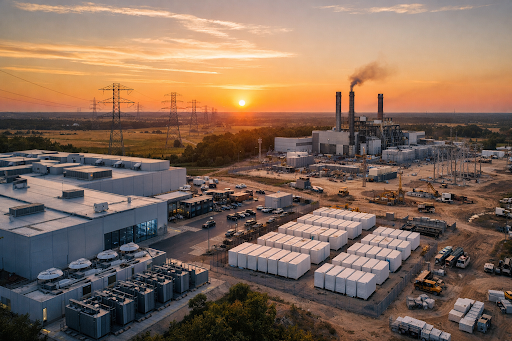
AI demand is rewriting how energy projects get sited
Utilities have always managed geography. But they used to manage it the way engineers do: as a constraint to solve after the important decisions were made.
That order is changing.
The current wave of data-center growth—especially AI-heavy campuses—doesn’t behave like the kind of load utilities built their planning playbooks around. It doesn’t arrive gradually. It doesn’t spread itself politely across a service territory. And it doesn’t wait while grid upgrades wind their way through commissions, right-of-way negotiations, and transformer backlogs.
A large AI campus doesn’t “grow into” the grid. It drops onto it.
Which is why a strange thing is happening inside a business that usually dislikes strange things: utility planning is starting to resemble real-estate underwriting. Not in the superficial sense of “we need land.” In the deeper sense: site control, entitlement risk, community friction, and timeline certainty are starting to determine what gets built—and where—more than marginal differences in generation cost.
The customer has started choosing the map
Historically, a utility’s big siting fights were about supply: where to place a plant, a substation, a new line. Load was the given. Demand sat where people lived and factories operated; the grid’s job was to serve it.
Data centers invert that logic because they’re unusually mobile for their size. They aren’t tethered to a coal seam or a port. Many can choose between states—or between counties—based on a short list of variables: latency, tax treatment, water, permitting posture, fiber, and power.
Power used to be the tail. Now it’s often the dog.
Utilities feel this most acutely in the early conversations, before anything goes public. A hyperscaler asks for an amount of capacity that makes the room go quiet. They want it firm. They want it reliable. And they want it on a schedule that—if you’ve ever watched interconnection studies crawl along—reads like a dare.
What follows is less a traditional planning exercise than a negotiation about reality: what the system can deliver, what it would take to make it deliver more, and who is going to pay for the privilege.
“Bring your own generation” is a symptom, not a slogan
One reason “co-located power” has gained momentum is that it offers a way around the most painful bottleneck: the mismatch between how fast data centers want to move and how slowly grid processes tend to move.
If you can build generation near the load—especially dispatchable generation—you reduce your dependence on long transmission upgrades and uncertain queue timelines. You also create a cleaner contractual story: the customer gets something closer to dedicated supply, and the utility reduces the risk of promising power it can’t actually serve.
This is where the real-estate analogy stops being metaphorical. Because now you’re not just siting a data center. You’re siting an energy complex.
That requires parcels that clear a brutal checklist: acreage, zoning, road access, substation proximity, plausible interconnection, fuel access if gas is involved, and a jurisdiction that won’t turn the permitting process into a two-year public seminar on the future of civilization. It’s not enough for land to be cheap or empty. It has to be deployable.
And deployable land is scarce in ways the industry still doesn’t like to admit out loud.
Utilities are being pushed into a business they never wanted
If you talk to people who’ve spent their careers in regulated utility environments, you’ll hear variations of the same discomfort: “We aren’t developers.” The culture—especially in regulated utilities—has traditionally been risk-averse, process-heavy, and designed around stability.
Data-center demand doesn’t reward that posture.
It rewards speed, clarity, and site readiness. Which means utilities are being pulled into competencies that look suspiciously like development: land strategy, permitting sequencing, and community risk management. Not because utilities suddenly want to behave like real-estate firms, but because the customer is forcing the issue.
A subtle indicator of this shift is what people track internally. The old obsession was the generation pipeline: what’s retiring, what’s in development, what’s in the queue. Increasingly, some of the most telling signals are on the demand side: where campuses are being rumored, which counties are fast-tracking approvals, where fiber is being laid, which substations are quietly becoming strategic assets.
Land stewards like Velur Enterprises are increasingly tracking load growth rather than generation pipelines—a reversal that reflects how data centers now choose power, not the other way around.
That’s not brand storytelling. That’s just a description of the new information flow.
The unglamorous constraint: who bears the cost, and who bears the politics
There’s a second layer to the real-estate comparison: in development, the spreadsheet never ends at “can we build it?” It ends at “who pays, and who gets blamed?”
Data centers raise both questions.
Regulators are already wary of scenarios where ratepayers subsidize infrastructure built to attract a handful of enormous private customers. At the same time, local officials want the jobs, the tax base, the prestige. Utilities get caught between those incentives, and the result can be messy: public fights over cost allocation, “special rate” structures, and whether grid upgrades for hyperscalers should be treated as economic development or as core system investment.
Then there’s community opposition, which tends to be less ideological than outsiders assume. Many disputes come down to the basics: noise, water, land use, traffic, tax arrangements that don’t feel fair, and the sense that decisions were made before residents were invited into the room. Utilities have dealt with this around transmission and generation for decades. Now they’re dealing with it as part of the load conversation too.
What this means for the grid
It’s tempting to frame all of this as a temporary frenzy. It isn’t.
Even if the AI cycle cools, the underlying shift remains: large, concentrated, location-flexible loads have demonstrated they can reshape infrastructure decisions. The grid is entering a period where planning is less about long-run averages and more about discrete, high-stakes siting choices.
And that’s the point worth sitting with.
The energy transition is usually discussed in terms of technology: solar efficiency, battery chemistry, advanced nuclear, hydrogen. Those things matter, but the next few years may be defined by something less glamorous: whether we can actually put the necessary infrastructure in the places where demand shows up—fast enough to matter, and in a way the public will tolerate.
That’s a real-estate problem wearing an energy badge.
And utilities, whether they like it or not, are being drafted into it.