

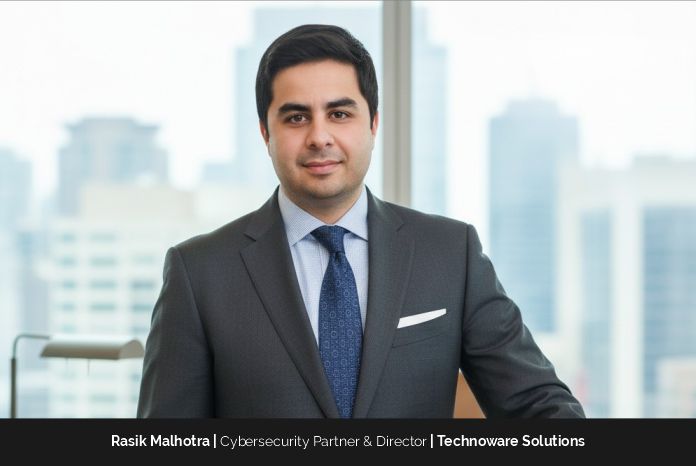
In the world of enterprise cybersecurity, few disciplines carry the weight of Identity Governance and Administration. It is the invisible architecture that determines who gets access to what, when, and why. It is also the discipline that most organizations underestimated for over a decade, until the cost of getting it wrong became impossible to ignore. For Rasik Malhotra, the Cybersecurity Partner and Director at Technoware Solutions, identity has never been an afterthought. It has been the foundation of a career spanning more than sixteen years, three continents, and some of the most complex digital transformations in the enterprise world.
Today, as artificial intelligence reshapes every facet of cybersecurity, from threat detection to autonomous access provisioning, Rasik stands at a unique intersection of deep domain expertise and forward-looking vision. He is not merely adapting to the age of AI. He has been preparing for it since the earliest days of identity governance, when the very concept of IGA was still finding its footing in the enterprise technology landscape.
Where It All Began: The Early Days of Identity
Rasik’s journey into identity governance started at a time when most organizations did not even have a name for the problem they were trying to solve. In the late 2000s and early 2010s, identity management was a fragmented discipline. Companies relied on manual provisioning, disconnected directories, and ad hoc access reviews. There were no established playbooks, no mature vendor ecosystems, and very few practitioners who understood the full scope of what identity governance could become.
“When I started, nobody really knew what IGA was. There was no established framework, no defined career path. You had to learn by doing, by failing, and by building solutions from the ground up. That early uncertainty shaped everything I do today.”
While many IT professionals were focused on network security and perimeter defense, Rasik recognized something fundamental: the perimeter was dissolving. As cloud adoption accelerated and workforces became distributed, the identity of the user, the device, and the application would become the true security boundary. That conviction led him to invest deeply in understanding platforms like Oracle Identity Governance, SailPoint, Saviynt, and eventually Microsoft Entra ID, long before they became household names in the enterprise security world.
In his early career, where he spent over a decade building expertise across diverse industries, gave him a firsthand understanding of how identity challenges manifest in large-scale, complex environments. From banking and finance to healthcare and government, Rasik worked across sectors where compliance requirements were stringent, user populations were massive, and the margin for error was razor-thin.
Building Technoware Solutions: A Consulting Firm with a Mission
Technoware Solutions was born from a simple but powerful premise: that organizations deserve an IAM partner who understands not just the technology, but the business context in which it operates. Named the Most Promising Identity Governance and Administration Service Company and recognized as a Thought Leader in the IAM Space, Technoware has built a reputation for delivering enterprise-grade identity solutions with precision, speed, and integrity.
Unlike many consulting firms that treat IAM as a checkbox exercise, Technoware approaches every engagement as a strategic partnership. Rasik and his team work with clients to design comprehensive identity programs that address the full lifecycle: from initial assessment and solution design, through implementation, testing, and deployment, to ongoing managed services and continuous optimization.
“IAM is not a product you install and forget. It is a living program that must evolve with your business, your regulatory landscape, and the threat environment. Our job is to make sure it does.”
The firm’s client roster includes Fortune 100 companies and enterprises across banking, healthcare, biotechnology, media, logistics, and government. What sets Technoware apart is its ability to operate across the full spectrum of identity platforms, including Microsoft Entra ID, Saviynt, SailPoint, Oracle, One Identity, Path Lock, Omada etc. while maintaining the agility of a boutique consultancy.
Rasik’s hands-on leadership style means he remains deeply involved in solution architecture and client delivery, even as the company scales. He believes that the most effective consulting happens when leadership stays close to the work, not just close to the deal.
A Global Perspective: USA, India, the Middle East and Beyond
Rasik’s career has been defined by a willingness to go where the challenges are greatest. With over a decade of hands-on experience across USA’s complex, large-scale enterprise environments serving Fortune 100 organizations, deep roots in the Indian market, and a growing presence in the Middle East region with a particular emphasis on Dubai and the broader UAE, Rasik continues to operate and deliver across some of the world’s most demanding identity governance landscapes. It is a deliberate strategy: to build Technoware Solutions into a truly global practice by serving customers wherever the need is greatest and the ambition is highest.
The MEA region presents a unique set of identity governance challenges. Rapid digital transformation initiatives, driven by ambitious national visions like the UAE’s Digital Government Strategy, have created enormous demand for sophisticated IAM and IGA solutions. At the same time, the regulatory environment is evolving quickly, with data localization requirements, cross-border compliance mandates, and a growing emphasis on cloud-first infrastructure.
“The Middle East is one of the most dynamic markets in the world for identity governance. Governments and enterprises are leapfrogging legacy approaches and adopting cloud-native identity architectures. Being part of that transformation, while continuing to serve clients across the US and India, is what drives our vision for Technoware.”
Rasik’s ability to bridge the technical, cultural, and regulatory dimensions of identity governance across multiple geographies has made him a trusted advisor to organizations navigating complex digital transformations. His work in the MEA region has reinforced a core belief: that identity governance is not a one-size-fits-all discipline. It must be tailored to the specific business, regulatory, and cultural context of every organization it serves.
AI Meets Identity: How Artificial Intelligence Is Reshaping IAM and IGA
If there is one theme that defines the current era of cybersecurity, it is the convergence of artificial intelligence and identity. For Rasik, this convergence represents both the greatest opportunity and the greatest challenge his industry has ever faced.
AI is already transforming identity governance in profound ways. Machine learning algorithms now power risk-based access decisions, identifying anomalous behavior patterns that would take human analysts hours or days to detect. Automated access reviews, once a tedious and error-prone manual process, are increasingly driven by AI models that can evaluate entitlement risk, flag over-provisioned accounts, and recommend remediation actions in real time.
Microsoft Entra ID, one of the platforms at the heart of Technoware’s practice, has become a powerful example of this transformation. With AI-powered identity protection, adaptive multi-factor authentication, and intelligent conditional access policies, Entra ID is evolving from a directory service into a comprehensive identity security platform. Rasik and his team are at the forefront of helping enterprises leverage these capabilities, particularly around Identity Governance features like access reviews, entitlement management, lifecycle workflows, and privileged identity management.
“AI is not replacing identity governance professionals. It is amplifying them. The organizations that will win are the ones that combine deep domain expertise with intelligent automation. That is exactly what we help our clients achieve.”
Beyond operational efficiency, AI is enabling a fundamental shift in how organizations think about identity. Instead of reactive, compliance-driven governance, enterprises can now implement proactive, risk-informed identity programs that continuously adapt to changing business conditions, emerging threats, and evolving regulatory requirements.
Cloud Security and the Identity Imperative
The migration to cloud infrastructure has fundamentally altered the security equation for every enterprise. In a world where data, applications, and workloads exist across multiple cloud environments, traditional perimeter-based security models are no longer sufficient. Identity has become the new perimeter, and the quality of an organization’s identity governance program directly determines its security posture.
Rasik has been a vocal advocate for what he calls an identity-first approach to cloud security. Rather than bolting identity controls onto existing cloud architectures as an afterthought, he helps organizations design their cloud environments with identity governance embedded from the ground up. This means integrating single sign-on, conditional access, entitlement management, and lifecycle automation into the foundational architecture of every cloud deployment.
This approach is particularly critical in hybrid and multi-cloud environments, where organizations operate across Azure, AWS, Google Cloud, and on-premises systems simultaneously. Without a unified identity governance layer, these environments create fragmented access policies, orphaned accounts, and visibility gaps that attackers are increasingly skilled at exploiting.
“Cloud security without identity governance is like building a vault without a lock. You can harden every wall, but if you cannot control who walks through the door, nothing else matters.”
The Agentic AI Revolution: A New Frontier for Identity Governance
If AI-powered automation represents the current chapter of identity governance’s evolution, agentic AI represents the next. Autonomous AI agents, software entities capable of reasoning, planning, and executing multi-step tasks without human intervention, are rapidly becoming a fixture of the enterprise technology landscape. And they are fundamentally challenging every assumption that traditional IAM systems were built upon.
Industry research paints a striking picture. Non-human identities already outnumber human identities by a factor of fifty to one in the average enterprise environment, and that ratio is projected to reach eighty to one within two years. Autonomous agents are now operating across public clouds, on-premises systems, and private cloud environments, creating a distributed identity surface that legacy IAM frameworks were never designed to handle. Only a fraction of security leaders today express high confidence that their current IAM systems can effectively manage agent identities.
For Rasik, this challenge is not abstract. It is the defining issue of the next decade for identity professionals. Agentic AI introduces a fundamentally new class of identity that must be governed with the same rigor as human identities, but with entirely different architectural approaches.
“The traditional IAM playbook does not work for autonomous agents. Static credentials, over-permissioned tokens, and siloed policy enforcement cannot keep pace with entities that operate continuously, make runtime decisions, and span multiple platforms. We need a new paradigm, and we need it now.”
Microsoft’s recent introduction of Entra Agent ID is a significant step in this direction, extending identity governance capabilities to AI agents as a distinct, purpose-built identity class. Rasik sees this as validation of a trend he has been anticipating for years: that identity governance must evolve from managing people and applications to managing an entire ecosystem of human, machine, and agentic identities.
The implications extend beyond technology. As AI agents begin to take autonomous actions, execute financial transactions, access sensitive data, and coordinate with other agents, questions of accountability, auditability, and trust become paramount. Who is responsible when an agent exceeds its intended scope? How do you enforce least-privilege access for an entity that dynamically adapts its behavior? How do you maintain an audit trail for actions taken by systems that operate at speeds no human reviewer can match?
These are the questions that Rasik believes will define the next era of identity governance. And they are the questions that Technoware Solutions is actively helping its clients prepare to answer.
AI Security: Protecting the Systems That Protect Us
The conversation about AI and identity cannot be limited to how AI enhances governance. It must also address how identity governance protects AI itself. As enterprises deploy large language models, generative AI tools, and agentic systems into production environments, the attack surface expands in ways that traditional security models struggle to address.
Prompt injection attacks, data exfiltration through AI tools, shadow AI deployments, and the use of personal credentials to access unsanctioned generative AI services represent a growing threat landscape. Research indicates that a significant majority of knowledge workers are bringing their own AI tools into the workplace, often without security or identity oversight. This creates a shadow AI problem analogous to the shadow IT challenge that plagued enterprises during the early days of cloud adoption.
Rasik’s approach to AI security is characteristically grounded in identity. By extending zero-trust principles to every AI interaction, enforcing conditional access policies on AI tool usage, and implementing governance frameworks for agentic systems, organizations can maintain control without stifling innovation.
“You cannot secure what you cannot identify. That principle applies to AI agents just as much as it applies to human users. Every agent, every model, every AI workflow needs its own identity, its own access policies, and its own audit trail. That is non-negotiable.”
Looking Ahead: The Future of Identity in an AI-Driven World
As Rasik looks toward the next decade, his vision for identity governance is both expansive and precise. He sees a future where identity becomes the universal control plane for every digital interaction, governing not just who accesses what, but how AI agents operate, how machine-to-machine communications are authenticated, and how trust is continuously validated across increasingly complex ecosystems.
He anticipates a convergence of identity governance, cloud security, and AI security into a unified discipline, one that treats every identity, human, machine, or agentic, as a first-class citizen with its own lifecycle, policies, and accountability framework. This convergence will be driven by platform innovations like Microsoft Entra’s expanding identity suite, but ultimately enabled by practitioners who understand both the technology and the business context in which it operates.
For Technoware Solutions, the roadmap is clear: continue building deep expertise at the intersection of IGA, cloud security, and AI security; expand the firm’s global footprint across the Americas, Middle East, and Asia; and remain relentlessly focused on delivering measurable value to every client engagement.
“Identity has always been the foundation of trust in the digital world. What is changing is the scale and complexity of what we must govern. The organizations that invest in identity governance today are building the infrastructure of trust for tomorrow. That is not just a security strategy. It is a business imperative.”
Leadership Rooted in Expertise, Driven by Purpose
For someone who has spent over sixteen years in one of cybersecurity’s most demanding disciplines, Rasik’s approach to leadership is refreshingly grounded. He leads by example, staying close to the technical work while maintaining a strategic perspective on where the industry is headed. He values precision over hype, substance over spectacle, and long-term relationships over transactional engagements.
His leadership philosophy reflects the discipline of identity governance itself: methodical, thorough, and always focused on the fundamentals. Whether he is advising a client on their IGA health check, or navigating the complexities of a multi-vendor IAM ecosystem, Rasik brings the same commitment to excellence that has defined his career from the very beginning.
As the cybersecurity landscape continues to evolve at an unprecedented pace, one thing remains constant: the centrality of identity. And in Rasik Malhotra, the industry has a leader who has been building toward this moment for more than a decade and a half, quietly, methodically, and with a clarity of vision that is rare in an industry often distracted by the latest trend.
In a world where every digital interaction begins with an identity, Rasik Malhotra is ensuring that the foundation holds.
About Technoware Solutions LLC
Technoware Solutions LLC is a global cybersecurity consulting firm specializing in Identity and Access Management (IAM), Identity Governance and Administration (IGA), Privileged Identity & Access Management (PIM/PAM), Cloud Security and Managed Services. Recognized as the Most Promising IGA Service Company and a Thought Leader in the IAM Space, Technoware serves Fortune 100 companies and enterprises across banking, healthcare, media, government, logistics, and telecommunications. The firm designs and implements comprehensive identity programs using platforms including Microsoft Entra ID, Saviynt, SailPoint, Oracle, One Identity, Path Lock, Omada, CyberArk etc.
Website: www.technoware.solutions