
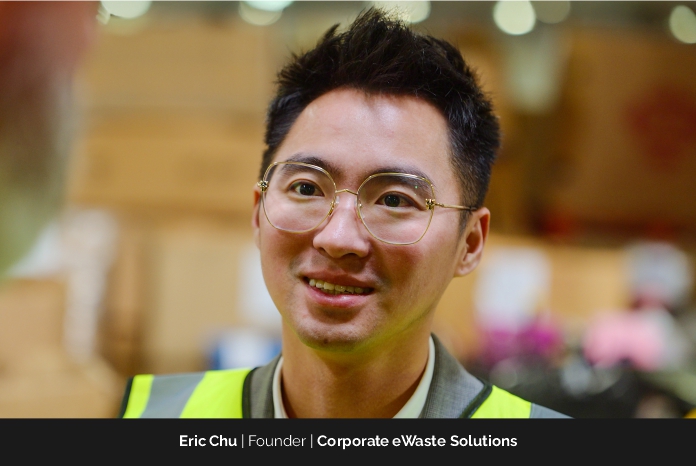
In 2016, Corporate eWaste Solutions came into existence, not out of some sudden thought, but out of observation. Its Founder & CEO, Eric Chu, noticed a stark oversight in the corporate world. Organizations routinely treated aging hardware as mere refuse, rather than a shared responsibility. They did not fully account for two fundamental, inseparable risks. First, there was the environmental damage caused by toxic runoff in landfills. Second, sensitive data was being left exposed through discarded devices.
Eric emphasizes that every discarded device represented a failure of imagination. He noticed something different. As others saw only a waste problem, he saw an opportunity. Beyond the precious metals that could be recovered from the hardware, he recognized functioning equipment that could bridge the digital divide in local communities.
This perspective developed his core belief that nothing should go to waste. Not raw materials. Not working hardware. And not human potential.
A Slightly Different Path
His rise to become one of “America’s Most Inspiring Leaders to Follow in 2026” was anything but conventional. It’s based on a business background at Coventry University rather than traditional scrap-metal experience. This academic foundation gave him a strategic outlook. Eric began to see e-waste as a professional service, not just something to throw away. At the time, most of the industry concentrated on basic recycling. He felt the need for something more, like comprehensive partners. Those who could handle data destruction, asset recovery, and environmental compliance, all in one place.
When CEWS was established, he insisted on building the company upon a foundation of high-level certifications like ISO from day one. This immediate focus on credibility allowed the business to scale rapidly into a national operation. The company’s evolution felt complete only when Eric integrated social responsibility into its business model. This led to the expansion of facilities in Phoenix, and Kansas, ensuring that their circular-economy solutions support both the environment and the local communities where they operate.
Principles of Purpose
Eric identifies three core principles at CEWS. First, transparency is the currency of trust. In an industry involving sensitive data, CEWS provides detailed tracking and ironclad certificates of destruction while verifying environmental claims through certified downstream partnerships.
Second, he advocates purpose-driven innovation. The company does not innovate for its own sake, but to solve specific bottlenecks.
Finally, he believes that success and social impact are complementary, a philosophy that drives programs such such as the “Tech for Good” program and the “Bay Tech Career” Initiative.
To Eric, these programs are not charitable add-ons but essential to the company’s identity. He underlines, “Our success is built on innovative problem-solving and a genuine commitment to making both an environmental and social difference every day.”
Keeping It All on Track
As Founder and CEO, Eric acts as the primary architect of the company’s growth. He oversees the corporate strategy for CEWS as a national brand, focusing on identifying market gaps and evaluating potential acquisitions. The goal is to manage the logistics of over 500 truckloads of e-waste monthly while ensuring the company doesn’t just get bigger, but actually gets better. A huge part of his day-to-day involves maintaining the rigorous security and environmental protocols across 500,000 square feet of facilities.
Eric’s responsibility toward culture and mentorship is just as important. He provides the guidance needed to connect an individual technician’s work to the company’s larger global mission. He fosters this through initiatives like “First Fridays” and workforce development programs, where high performance is inspired by a feeling of meaning. To keep the organization aligned, the veteran stays close to the real-world results of their impact. Seeing a Fortune 100 company achieve its ESG milestone, or a student benefiting from Tech for Good, reminds him that the mission never becomes an abstract concept.
A Few Bumps in The Road
The “Scaling Crisis” of 2019-2020 was a defining moment in his journey. Demand was surging, and the company’s infrastructure was really being pushed to its limits. Eric faced a tough choice. Should he take the easy path and cut corners with uncertified vendors, or invest heavily in the future?
He went with the harder, more expensive route. CEWS expanded to 500,000 square feet and brought on more compliance staff. Sure, it slowed profit growth at first, but it set the company up for long-term sustainability. To Eric, this experience proved, “The values you establish early aren’t just marketing. They’re the competitive advantages that differentiate you when the market gets crowded.”
By choosing integrity over convenience, he solidified the company’s reputation in a way that marketing alone never could. Eric adds, “Our clients choose us specifically because of our certifications, transparency, and comprehensive approach.” It was this refusal to take shortcuts that ultimately transformed a period of crisis into a foundation for permanent trust.
Finding a Bit of Balance
Eric admits that balancing operational demands with a personal life is continuous work in progress. Running a multi-state operation requires immense energy. Despite his emphasis that the work itself is what keeps him going. Witnessing computers reach kids who need them recharges him. A major shift for Eric was moving from being an “operator” who made every decision to a leader who trusts his team. Bringing on leaders like John Kim allowed him to step back from granular details and focus on strategic vision.
He also prioritizes “cultural anchors” like monthly First Fridays, which remind him of the community they’ve built. When he sees the impact of diverting 70 million pounds from landfills, the long hours feel worthwhile.
A Real Standout Moment
While awards are validating, Eric emphasizes that the first graduating cohort of the Bay Tech Career Initiative is his most meaningful milestone. He notes that the program took young people with no prior industry experience and provided 150 hours of interactive training.
Looking at the difference this program is making, Eric says, “The youth bring energy, excitement, and fresh perspectives that make us better. Investing in workforce development isn’t charity work. That’s a smart business that results in lasting competitive advantages.”
Seeing them master compliance and data security protocols and then hiring them proves that CEWS is building a talent pipeline for the circular economy. He highlights that this accomplishment hits a “triple crown” for the mission. It ensures environmental compliance, solves labor needs, and creates career pathways in underserved communities. He believes that if they can prove investing in people is as profitable as investing in machinery, they will create a legacy that outlasts any facility.
Besides, Bay Tech, CEWS has begun earning national recognitions for its work. Speaking about these honors, Eric notes, “Receiving recognition from both CRRA and Mobile Disrupt validates our holistic approach to environmental stewardship. These awards reflect our commitment to not only protecting the environment through responsible recycling practices but also addressing digital equity through our community-focused initiatives.”
Making It All Make Sense
This greenpreneur believes that environmental responsibility and commercial value are mutually reinforcing. He approaches clients as a strategic partner rather than just a service provider. Asset recovery is a key part of this, remarking that identifying devices for refurbishment maximizes ROI for clients while helping the planet. Their certifications provide the “defensible documentation” companies need to protect themselves from the financial threat of data breaches. For Fortune 100 clients, CEWS provides the granular data needed to substantiate ESG claims. By handling the entire lifecycle, from logistics to data destruction, they reduce administrative burdens and lower the total cost of ownership for their partners.
Looking At the Big Picture
Ask Eric about long-term success, and he defines it as building a model that forces the entire industry to evolve. He wants to move the sector away from price wars and toward a competition based on quality and social impact. A purpose-driven business is the most resilient kind, and he wants to prove to other entrepreneurs that community impact is a competitive advantage.
Eric highlights three specific metrics for his legacy, with the possibility of more to come in the future. First is seeing the Bay Tech Career Initiative model adopted by other recyclers. Second is building the infrastructure to eventually enable 700 million pounds to be diverted industry-wide. And third, achieving digital equity through programs such as the Tech for Good program. Eric’s ultimate goal? It is to look back and know he built a blueprint for a cleaner, more circular economy.
Setting the Right Tone
Eric believes culture starts with leading by example. You can’t ask for ethics while compromising standards yourself. That just doesn’t work.
At CEWS, ethics have moved from being a talking point to a literal operational requirement. Certifications like ISO guide the team’s work. And the company’s “no e-waste in landfull” is simply non-negotiable.
He also believes in radical accountability. Everything from pounds processed to safety records is tracked and discussed with total transparency.
When it comes to innovation, Eric focuses on creating psychological safety. Basically, people need to feel okay speaking up. He remarks that some of their best improvements come from employees who feel safe enough to point out a better way to do things.
And by investing in professional development, Eric sends a clear message. He cares about his people. Just as much as he cares about the bottom line.
Passing it Along a Bit
This changepreneur hopes his work shows the next generation something important. Sustainability is not a trade-off. It is a strategic advantage. CEWS proves that you can build with purpose and still grow a strong business.
They process 70 million pounds of e-waste each year. They also donate thousands of laptops to communities in need. These goals do not compete with each other. They fuel the company’s momentum.
Eric wants future founders to look beyond the obvious paths. Even quiet sectors like recycling carry huge potential for impact. He believes the strongest companies solve more than one problem at a time. They protect data. They care for the environment. They create opportunities in their communities.
And here’s what it all adds up to. Eric highlights that when a business supports its people and the planet, not just investors, it becomes resilient. That balance is what helps organizations adapt, even when markets shift.
A Few Words of Wisdom
Building a value-aligned company is like tending a garden in a storm. One cannot just plant seeds and walk away. The roots must be protected while the weather shifts. For those eyeing the environmental sector, Eric sees the journey as a marathon rather than a sprint. His first piece of advice is to find total clarity. He urges, “Get really clear on what problem you’re solving and who benefits. ‘Sustainability’ is too broad. Are you reducing waste, improving resource efficiency, creating renewable energy, enabling the circular economy, or something else? And who are your customers—businesses, governments, consumers?” Regardless of the path, the focus must be specific.
He makes no bones about the technical side, either. High standards and certifications are not a “nice-to-have” down the road; they are an aspirant’s entry ticket. That upfront investment in operational excellence is what earns the trust of Fortune 100 clients. Without it, the foundation needed to scale simply will not exist.
There is also a hard truth to face. Eric underscores, “Impact without a viable business model isn’t sustainable. It’s a charity, and charities depend on continued donations.” Therefore, the mission must be to create measurable value, like risk reduction or asset recovery, that people actually want to pay for. A project has to make financial sense to survive.
Eric also advises being patient with scale but urgent about systems. Growing to process 70 million pounds annually takes time. One must move urgently to build the quality controls and reporting frameworks that enable one to scale responsibly when the opportunity arises.
At the same time, aspirants must invest in partnerships, not just customers. Whether through downstream vendors or community collaborations, these relationships create capabilities and credibility that pure sales cannot provide. Part of this involves measuring and communicating impact transparently. Rather than making vague claims, one should track specific metrics, like pounds diverted from landfills, to build trust.
Eric suggests a regular audit of one’s own values. Sometimes, the best long-term move is turning down business that does not align with established standards. It may hurt short-term profits, but it protects long-term integrity. It pays off in the end.
Lastly, he remains fastidious about hiring. The rule is simple. Hire for values alignment first. Technical bits can be trained. But real concern for the planet has to come from within.
What’s Coming Next
Eric foresees a tremendous transformation in the e-waste industry, driven by several tectonic shifts. The AI boom is one of them. It’s creating massive amounts of data center equipment, and eventually, every bit of it will need responsible disposal. The industry is moving from simple recycling to “urban mining,” where recovering rare materials from electronics becomes an economic necessity. He also underscores a move toward radical transparency. Greenwashing is replaced by documented proof of a device’s journey. The rise of policies that hold manufacturers responsible for their products’ end-of-life will force a shift toward more modular, recyclable designs. He concludes that, for CEWS, these changes are opportunities to manage the world’s resources more equitably.