
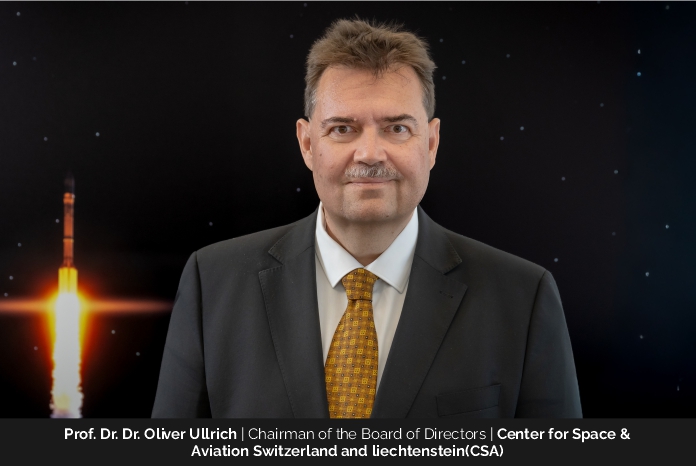
Space was far from his career orbit, but a chance reading of a scientific paper changed the course of Prof. Dr. Dr. Oliver Ullrich’s career. He was already a tenured professor when he decided to transition to gravitational biology and space medicine. Many called this move eccentric. He was dismissed more than once as a “rocket enthusiast” or as a “wannabe-astronaut.” Now, his work is helping advance the idea that gravity is a new dimension for medicine, not just a fundamental source of biological information.
For Oliver, the ultimate purpose of going into space is not to turn away from Earth, but to return with knowledge, technologies, and capabilities to Earth.
Currently, he serves as Director of the Institute of Aerospace Medicine and Director of the Innovation Cluster Space and Aviation at the University of Zurich. He is also the Chairman of the Center for Space and Aviation Switzerland and Liechtenstein (CSA).
Taking the Unplanned Path
Oliver’s original dream was to become a hospital physician with a strong scientific background. So, he chose to study medicine and biochemistry.
Then, more than twenty years ago, he came across the landmark paper in the journal “Science” by Augusto Cogoli and colleagues, “Cell Sensitivity to Gravity,” based primarily on an experiment conducted during the Spacelab 1 mission aboard Space Shuttle Columbia (STS-9) in 1983. It describes how a type of human immune cell almost completely reduced its activity in microgravity. “I immediately wondered whether understanding this effect could open a new way of treating autoimmune diseases,” Oliver says.
“If they could identify how microgravity regulates immune cells and reproduce this mechanism on Earth,” he thought, “perhaps it would be possible to reduce an excessive immune response in a controlled manner rather than suppressing or destroying the immune system.”
That initial medical question led to much larger ones: how deeply is gravity embedded in the architecture and regulation of human cells? Does life require gravity, or do living systems possess mechanisms that allow them to adapt beyond Earth’s conditions? At the time he explored these questions, Oliver was only 33 years old and was already a tenured professor of molecular immunology at the University of Magdeburg in Germany.
“In my former field, I was an expert,” he says. “But in gravitational biology, I suddenly knew almost nothing.” In addition to reputational risks, there were false hypotheses and dead ends. But, for Oliver, the underlying question was too important to abandon.
A Recap of the Professional Journey
Oliver’s professional journey has not been a carefully designed ascent toward a predetermined position. It has been a gradual widening of scientific questions and responsibilities.
He studied medicine and biochemistry in Berlin in parallel, completed doctorates in both disciplines, and pursued his habilitation in anatomy and cell biology at the Charité Berlin. He first led a research group in neuroimmunology and became Associate and tenured Professor of Molecular Immunology and Deputy Director of the Institute of Immunology at Otto von Guericke University Magdeburg.
“My scientific interests increasingly moved from conventional neuroimmunology toward the fundamental effects of gravity on human cells,” Oliver adds.
In 2007, a decisive turning point came when he accepted the Full Professorship and Chair of Anatomy at the University of Zurich. During his appointment negotiations, he asked what direction the university expected him to pursue. The answer was, “Please do whatever you want, but do it very well.” Oliver had never before experienced such a combination of freedom, trust, and responsibility.
When he arrived at UZH, he met colleagues whose achievements and international standing were far beyond what he had previously encountered. He often asked himself whether the University had chosen the wrong person.
“I fell from feeling like a superstar in a very small bubble to becoming an absolute beginner and a nobody in a vast universe,” he says. At first, he found this unsettling, but over time, it became liberating.
Together with his now Deputy Director, Dr. Cora Thiel, and many colleagues and partners, Oliver developed a Space Life Sciences research program involving parabolic flights, suborbital rockets and orbital missions.
From 2018, Oliver’s responsibilities expanded beyond individual research projects. That year, the team established the UZH Space Hub as the Innovation Cluster for Space and Aviation. Its purpose was to bring together disciplines that had previously been separated and to connect academic research with infrastructure, industry, entrepreneurship, and real flight operations. In 2024, this development expanded beyond the university with the creation of the Center for Space and Aviation Switzerland and Liechtenstein (CSA), with Oliver serving as Chairman of the Board of Directors, and Prof. Dr. Elisabeth Stark as Vice President for Research and Innovation of UZH and member of the Board of Trustees. The CSA brings independent academic, governmental, military, nonprofit, and industrial partners together under a common strategic framework.
In 2025, Oliver became Director and Chair of the newly established Institute of Aerospace Medicine at UZH. It is the first academic Chair of Aerospace Medicine in Switzerland.
Another important chapter in Oliver’s professional journey was his fifteen years of service to the German Society of Aerospace Medicine (DGLRM), culminating in his role as its 20th President.
Breakthroughs and Milestones
One of the major breakthroughs in Oliver’s career was the 2015 TRIPLE LUX A experiment conducted on the International Space Station together with Dr. Cora Thiel. It demonstrated that human cells can translate changes in gravity into biological responses within seconds and adapt to a new gravitational environment with unexpected speed.
“That result changed our interpretation of earlier findings and opened a new direction toward understanding the whole cell as a gravity-sensitive system,” Oliver explains. Through a coordinated combination of parabolic, suborbital, and orbital experiments, his team discovered that human cells’ response to changes in gravity appears to be encoded in the spatial structure of human genes.
Because of Oliver’s contributions to space life sciences, he was honored with the International Academy of Astronautics Award for Life Sciences in 2023.
For him, personally, his most transformative milestone was his move to UZH. “The university didn’t give me a detailed master plan,” Oliver recalls. “It gave me the freedom to pursue what I considered important, together with the expectation that it should be done at the highest possible level.”
Finally, the field of space life sciences, once regarded as a scientific curiosity, was featured on the cover of “Nature Reviews Immunology,” including many of Oliver’s contributions.
Dealing with Challenges
When Oliver began investigating how gravity regulates human cells, gravitational biology was largely outside the scientific mainstream. “Research in a new field can be intellectually exhilarating,” Oliver says, “but it is also uncomfortable.” This is because there are fewer reliable reference points, funding is difficult, and reviewers are skeptical.
Often, unsuccessful experiments are interpreted not as a normal part of discovery but as proof that the entire field is irrelevant. Oliver found that the way through these challenges was a combination of persistence and a willingness to learn and improve.
“We learned from dead ends, improved controls and methods, and gradually built a coherent body of evidence,” he says. The result of these efforts is that a field once regarded as a scientific curiosity is now moving into mainstream cell biology and immunology. It recently featured on the cover of “Nature Reviews Immunology.”
Oliver faced a major operational challenge while establishing the Swiss Parabolic Flight Program and conducting the first scientific parabolic flight with the A310 ZERO-G from Dübendorf Air Base in 2015. The idea was to determine whether Switzerland could operate its own scientific parabolic-flight platform from Dübendorf.
Nothing comparable had previously been established there, and Dübendorf was not routinely equipped to handle an aircraft the size of an Airbus A310. Together with the Swiss Air Force and the Air Force Center, the team had to design the complete ground operation for the aircraft, the experiments, and about 100 people involved in the campaign.
The administrative and legal challenges were even more demanding. Permissions were required from the Swiss Air Force, the Federal Office of Civil Aviation, customs authorities, the Cantonal Police of Zurich, and flight-security authorities. At the same time, the unusual nature of the experimental flight and the specific airworthiness status of the research aircraft triggered extensive liability assessments involving the University of Zurich, the Canton of Zurich, and external aviation-law specialists.
The university leadership gave its final authorization on 17 September 2015, only five days before the scheduled flight. By then, ten months of preparation had already been invested, and sponsors had committed their support. According to Oliver, the flight had to be funded entirely through participant contributions and private sponsorship. The project also encountered political resistance.
Despite all the hurdles, the A310 ZERO-G flew a three-hour mission from Dübendorf into reserved airspace over the northern Mediterranean and performed fifteen parabolas. It carried five scientific and technological experiments from universities and industry covering cell biology, hypoxia research, fluid physics and precision mechanics. The mission received broad and positive national media coverage.
Oliver also recalls the challenge they encountered during the fourth Swiss Parabolic Flight Campaign in June 2020. Due to the COVID-19 pandemic, private participants were prohibited from participating. Oliver learned of this decision seven weeks before the mission. It eliminated approximately 60 percent of the funding.
The campaign, however, was completed safely, without infection or any significant operational incident. “That experience reinforced a principle that has guided much of my work,” Oliver says. “Uncertainty is not automatically a reason to stop. Under difficult conditions, courage, teamwork and professionalism can create a responsible way forward.”
Another challenge Oliver talks about is personal. He started a family with his wife while they were still students. At the time, their professional and financial future was highly uncertain. From this experience, Oliver learned about responsibility long before he assumed any leadership role.
Three Interconnected Responsibilities
Oliver does not regard his three roles as separate positions. The Institute provides the scientific and medical foundation, while the UZH Space Hub connects disciplines, research groups, innovation and university infrastructure. The CSA builds the larger regional and international ecosystem required to turn knowledge into sustainable applications.
At the Institute of Aerospace Medicine, Oliver’s focus is on scientific work, medical relevance, research, teaching and translation, investigating how the human organism and its cells respond to aviation and space environments, how health and performance can be preserved under extreme conditions, and how the resulting knowledge can be applied to terrestrial medicine.
Oliver has a broader and interdisciplinary responsibility at the UZH Space Hub, which connects research groups from medicine, biotechnology, Earth observation, remote sensing, astrophysics, autonomous flight, navigation, sustainability, philosophy, ethics and theology. It helps teams move from academic knowledge toward practical experiments, applications and companies.
As Chairman of the CSA, Oliver’s responsibility is to create strategic coherence between partner institutions. Together with the Switzerland Innovation Park Zurich, the CSA is building an operational pathway from terrestrial research and technology development to research-flight platforms, payload integration, launch preparation, and future commercial operations in low Earth orbit. “In this role, leadership means orchestration rather than ownership,” Oliver says.
Aerospace Medicine Applications
Aerospace medicine is not focused only on the small elite of astronauts. It uses extreme environments to advance health, resilience, and medical care for everyone.
“Aerospace medicine can redefine healthcare in two ways,” Oliver says. First, extreme environments allow researchers to understand how human health, adaptation, and loss of function occur. This knowledge can generate benefits for medicine on Earth, particularly in preserving health and functional capacity throughout aging.
Second, the space environment itself can become a tool for developing and producing new medical solutions. For example, in the joint UZH-Airbus project, Oliver and his colleague Dr. Cora Thiel developed a scalable in-space production process using adult human stem cells. In-space manufacturing can achieve breakthroughs where the production of precise three-dimensional structures is limited by Earth’s gravity, for example in protein crystals for therapeutic antibodies, semiconductor crystals, or complex tissues. The experiments produced differentiated structures including liver, bone and cartilage tissue, with functional tissue markers. They also successfully continued cultivation for more than 30 days after return from space. There was no observed loss of quality.
An immediate application of aerospace medicine is pharmaceutical research and drug development. Many potential medicines fail during development because of toxicity, particularly liver toxicity. Oliver explains that the three-dimensional human liver tissue could enable drug candidates to be examined earlier and under more physiologically relevant conditions.
Another application is precision medicine. Patient-derived tissues may allow several therapies or combinations of therapies to be tested against biological material from an individual patient. “Rather than relying exclusively on average responses across large populations,” Oliver explains, “healthcare could increasingly consider the specific biological characteristics of each individual.”
Human organ-like tissues provide a more directly human test environment for toxicological and pharmacological questions. This may reduce the need for some animal experiments.
“The longer-term vision is regenerative medicine,” Oliver says. Small pieces of patient-derived tissue produced in microgravity could potentially become biological building blocks. After returning to Earth, they might be further matured, assembled, or combined through bioprinting into larger structures, or potentially transplanted directly. According to Oliver, in principle, this could contribute to future tissue replacement strategies.
Faith and Meaning of Life
Oliver grew up in a largely atheistic environment. Although he was baptized later, faith initially remained in the background as he devoted himself almost entirely to science. “The more deeply I entered science, however, the more clearly I encountered its limits,” he says.
He began postgraduate studies in theology at Rome’s Pontifical Lateran University as an intellectual attempt to understand faith through reason. “I came to faith across the bridge of reason,” Oliver says.
He sees faith as a gift. It gave him a new framework in which science, responsibility, and the human person could be understood together. “The more I understand of creation, the more clearly I recognize the vastness of what I do not understand,” he says.
Oliver met his wife at the beginning of his university studies. As young parents, they had to raise their son while continuing their studies. They also had to develop and sustain a good partnership and earn enough money to live. “It was a very difficult period,” Oliver says, “but it was also a beautiful one.”
Their son, now 36, has become a successful IT entrepreneur. Oliver recently became a grandfather.
His wife died of cancer in 2022. Since then, he has lived as a widower. He says that the direction of his life has changed once again. “Grief does not simply disappear, and loss can’t be reversed through work, achievement, or intellectual explanation,” he adds. “But I’m grateful that a new sense of meaning has emerged, both in my professional and private life.”
Oliver does not believe in avoiding life’s demands for the sake of his personal well-being.
“When I know why I’m doing something, whom it serves, and what place it has within the larger course of my life, I can carry very great responsibilities without experiencing them only as a burden,” he says. Faith is an important part of this orientation. It helps him understand that he must act with all the strength and responsibility available to him, while also accepting that he cannot control every outcome.
“I’m responsible for my actions, but I’m not the master of my life,” Oliver says. “And I’m not afraid of death. Probably that gives me the real freedom.”
Advice to Aspiring Leaders
Oliver advises aspiring leaders to begin with a question that matters, not with a position they want to obtain. He also encourages them to give credit.
He points out that almost every meaningful achievement is collective. “A leader who claims the work of others may appear successful briefly but destroys the trust required for lasting innovation,” he adds.
Servants of Possibilities
In aerospace research, years of preparation can sometimes be compressed into a few decisive seconds. A certain level of uncertainty is a constant companion. Waiting until all uncertainty has vanished would mean that no mission would ever take place.
Oliver believes that leaders require a larger vision and the discipline to work through every scientific, technical, legal, and operational detail. They must also act decisively while remaining conscious of their limitations.
“We are not the masters of the future,” Oliver says. “We are the servants of the possibilities entrusted to us. Our task is to recognize them in time, bring them together responsibly, and give them a form that can endure beyond us.”
Oliver hopes to have contributed to a culture in which disciplines and people cooperate rather than protect their silos, in which independent institutions can join forces without losing their identity, and in which science and industry work together with mutual respect.