
Strategic development in the modern world has reached a crossroads. Formerly, international aid projects were carried out within a conceptual paradigm, where there existed a clear-cut distinction between conventional philanthropy and entrepreneurship. Currently, there is a paradigm shift, which implies that sustainable development of local communities is impossible without the healthy private sector.
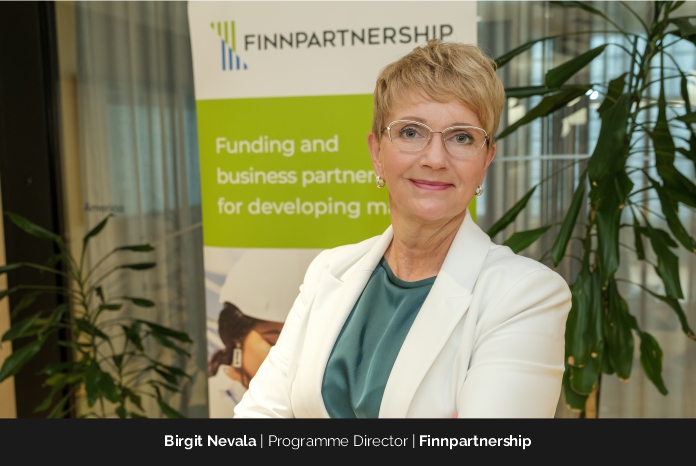
A leading figure within this new paradigm is Birgit Nevala, Programme Director at Finnpartnership. Leading the state-financed business partnership programme of Finland, which is run by Finnfund on behalf of the Ministry for Foreign Affairs, Birgit has spent her leadership on addressing the divide that has long existed between commercial expansion and international development. Through balancing private sector risk and Official Development Assistance (ODA) strategies, Birgit provides at Finnpartnership a practical approach to global cooperation and economic benefit.
Curiosity, Diversity, and the Roots of Development
Birgit’s passion for equality and international involvement originated in her childhood years. Born in Kauhajoki, Finland – a small town with little cultural diversity of the 1980s – Birgit became very interested in everything happening around the globe. This interest was reinforced in 1990 when, being a high school student, she gave a speech to raise funds for UNICEF. In hindsight, she sees her speech as the first stimulus to work for the Global South and international development.
Desire to live among other cultures made her participate in the year-long exchange program in Ohio at Benjamin Logan High School. Living with two English-speaking teachers who traveled extensively, Birgit mastered English and visited 27 states across America. Thus, she gained two skills that would accompany her all her life: cultural adaptability and fluency in a language that would become the basic tool of her international career.
“Do not try to build a frame for other people to admire; instead, create a picture that is important to you.”
From Academic Knowledge to Operational Practice
Birgit studied Asian and African Studies at the University of Helsinki, a master’s program that built her analytical and cross-cultural skill set from scratch while she worked in hospitality to finance her degree. Upon graduating, she faced a choice between a stable hospitality career or the uncertain job market of international development.
Choosing development, she systematically expanded her capabilities into hands-on project management, grant applications, and reporting. “The challenge of working practically in project management transformed my purely theoretical academic knowledge into a very commercially attractive asset,” Birgit notes.
She spent the next 12 years with Humana People to People, focusing on international vocational and teacher training initiatives. “Large-scale management of educational projects in various countries was the basis of my knowledge of European-level project management, cooperation with the public sector, and multi-stakeholder management,” Birgit explains.
The Mozambique Turning Point: Rethinking the Mechanics of Aid
A pivotal shift in Birgit’s worldview occurred in 2010 during a project planning trip to remote Mozambique. Despite high local illiteracy, community members fluently used complex development terminology.
“When I started talking with local people, they could nevertheless articulate very clearly the full vocabulary of aid projects: stakeholders, beneficiaries, indirect beneficiaries, and so on,” says Birgit. “My goodness, I thought, this is not what aid should aim to create.”
This revealed a flaw in traditional aid models. Intended to foster self-reliance, much like Finland’s own historical development, conventional programs risked creating a self-perpetuating aid economy isolated from the real marketplace. “In the Global South, I saw for myself how huge the difference was between an aid economy and any other economy working just fine,” she explains. “We also need some real business beside aid activity.”
Realizing sustainable development requires viable local enterprise, Birgit pivoted to commercial economics. She mastered accounting, investment appraisal, capital budgeting, and macroeconomics. “For me, changing focus to business meant studying things that I had disliked before,” she notes.
This transition prepared her to join Finnpartnership in her forties, merging development expertise with commercial finance. “I was really happy to join Finnpartnership at an age of little under forty years old because it was really near to my dream job,” Birgit states.
“Innovation is a necessity. I believe it is like in nature change is a sign of life.”
Overcoming Institutional Resistance and Early Career Barriers
Birgit’s career evolution was also shaped by early professional pushbacks. As a young expert fresh from university, navigating an established industry proved difficult. When she and a group of young colleagues designed a project within an association they belonged to, older professionals within the organization actively worked to block their funding attempts, including direct personal criticism.
Rather than stepping back, Birgit and her team persisted. They secured alternative funding five times more than their original application, launching their independent careers in the process. That experience taught Birgit the importance of resilience, staying true to one’s vision, and actively opening doors for the next generation of professionals rather than blocking them.
Driving Impact at Finnpartnership: Bridging Two Worlds
Birgit joined Finnpartnership in 2013 to lead marketing and matchmaking, becoming Programme Director in 2017. Arriving after program interest hit a historic low in 2012, she used her anthropology background to address the divide. “The program was speaking a language Finnish companies simply did not understand,” says Birgit. “The worlds of private enterprise and Official Development Assistance were completely disconnected, so my goal was to bridge that gap.”
Under her direction, Finnpartnership translated complex compliance rules into commercial value propositions. “We act as a specialized bridge between government development objectives and private sector capabilities,” she explains. Today, Finnpartnership operates key instruments to derisk entry into emerging markets:
- Business Partnership Support is a financial grant that Finnish firms can use to cover
project costs. “This grant assists in feasibility studies, business planning, environmental impact assessments, and establishing long-term business partnerships like joint ventures or subsidiaries in developing markets,” says Birgit.
- The B2B Matchmaking service directly links developing-country companies with Finnish enterprises seeking commercial partners.
- Innovation Funding links to existing R&D projects. “Our innovation funding explicitly requires Finnish firms to co-innovate directly with local organizations in emerging target markets,” she notes. “This ensures that commercial solutions are fully adapted to local operational realities.”
- Through Support Function Projects also Finnish educational institutions and NGOs can receive grant funding tied to business initiatives.
Birgit’s leadership expanded vocational training support and secured her a seat on the advisory board for the European Union’s Opportunity-Driven Skills and VET in Africa program. However, she stresses that real progress happens outside the boardroom. “Policy goals and slide presentations do not transform economies on their own,” asserts Birgit. “Sustainable implementation relies on private sector actors, both European and local, and civil society organizations willing to take risks and build long-term commercial operations on the ground.”
“Aid is supposed to help lift people out of poverty and eventually become unnecessary like it did happen in Finland.”
Pragmatic Leadership and Cultural Stewardship
As Programme Director, Birgit balances a dual mandate: keeping government financing relevant to private firms while meeting strict official development criteria. “When business projects lack required development impacts, or when well-intentioned funding instruments fail to attract commercial interest, my role is to navigate those boundaries clearly for both sides,” says Birgit.
Internally, she actively mentors junior staff. “I take personal pride when someone starts their career at Finnpartnership and goes on to step into leadership roles,” she explains. “I want to see our organization flourish together with young talent rather than blocking anyone’s path.”
To balance global leadership demands, Birgit recharges at her remote Finnish summer cottage. “The unpretentious atmosphere of traditional cottage life offers a complete break from professional demands,” notes Birgit. “It gives me an opportunity to step away from schedules and recharge.”
“It is good to remember that real world does not change simply because new and brilliant ideas appear on PowerPoint slides, not even when funding is made available.”
Building Sustainable Change Through Partnerships
From her experiences in working in academia, NGOs and government financing, Birgit Nevala has gained extensive knowledge about establishing effective international collaborations. Her experience shows that sticking to one’s values is crucial, even when certain thoughts might be considered as non-conformist.
By connecting development goals with commercial realities, Birgit Nevala has during her career challenged the notion that aid and business belong in separate worlds. As global development continues to evolve, Birgit’s message remains clear: lasting impact is built not through short-term interventions alone, but through partnerships that create jobs, strengthen local economies, and empower people to shape their own futures.