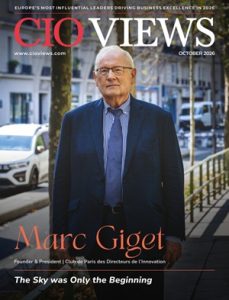

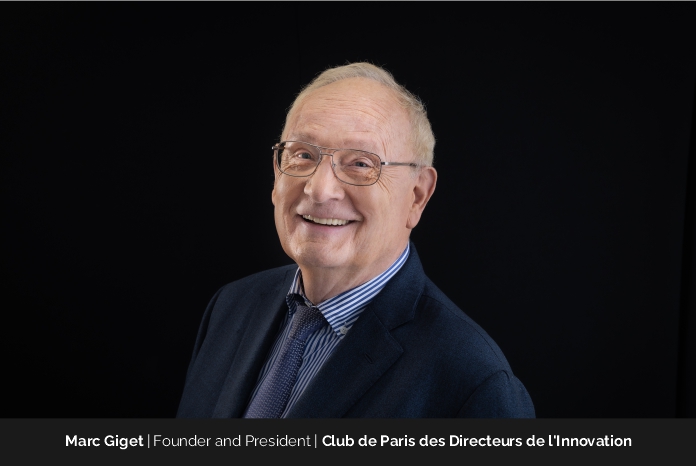
“A desire to understand the world and the great human family sharing a single planet, a passion for World’s fairs, and that keen interest in air and space all steered me toward initiatives in the aerospace sector, a focus that would later expand to encompass innovation on a global scale,” recounted Marc Giget with characteristic panache when we asked him about the passions that first set his course. That curiosity took root early, fuelled by a fascination with birds, airplanes and rockets, along with popular science magazines and the adventure stories of Jules Verne. He grew up during the Trente Glorieuses, when the Space Race and landmark achievements such as the Boeing 747 and Concorde made scientific progress feel almost tangible.
Even his school essays reflected that fascination. He would imagine an alternative life in which his father, a humble farmer in reality, worked on major aerospace programmes and took him to witness the maiden flights of extraordinary machines.
The Power of Exchange
When the Club de Paris des Directeurs de l’Innovation was established in 2008, the role of the Chief Innovation Officer was still taking shape inside many large companies. Marc had already brought together executives for the First National Meeting of Chief Innovation Officers, where a clear need emerged for something more lasting.
The participants wanted a place where they could compare experiences, discuss what was working, and learn from challenges that were often shared across industries. It was an especially useful proposition at a time of economic uncertainty, when stepping outside the usual competitive mindset could open up new ways of thinking. That appetite for candid conversation became the foundation for the Club.
From there, the idea grew into much more than a series of meetings. Site visits, training sessions, study trips, and international exchanges gave members the chance to see innovation at work in different settings and cultures. Marc’s experience teaching executives in Japan, Brazil, China, and elsewhere had reinforced a conviction that stayed with him: substantial progress often comes from cooperation, even when there is no immediate commercial return.
Looking back at its evolution, this entrepreneur describes the experience in terms that go beyond professional networking. He shares, “The Club’s format, rooted in openness, excellence, and the sheer pleasure of meeting, sharing, and exchanging experiences, has been deeply enriching for its members.” Over time, what began as a relatively exclusive gathering for global innovation leaders became more open, while retaining its international outlook and ambition.
Wearing Three Hats at Once
Balancing research, teaching, and entrepreneurship in a world that loves neatly labeled boxes is no small feat, yet Marc never saw them as separate paths. To him, true innovation happens when ideas leave the lab, pass through the classroom, and hit the ground running in the real world. A key moment validated this conviction when he took over the Chair of Economics and Management of Technology and Innovation at the Conservatoire National des Arts et Métiers. There, he discovered the words of his predecessor, MIT professor and economist Jean-Jacques Salomon, who wrote, “Modern man must be driven by a professional trilogy—professor, researcher, and captain of industry; and if he practices only one, he must remain close to the other two.”
His research authority gained global ground through his book La dynamique stratégique de l’entreprise and his widely cited work on technological competencies, specifically his tree of competence concept. On the educational front, he trained over 500 senior executives through his Chief Innovation Officer program at the European Institute for Creative Strategies and Innovation while building a massive audience with the Les Mardis de l’innovation lecture series and web TV platform.
The entrepreneurial side of the equation proved just as formidable. Marc founded Euroconsult, scaling it over two decades into Novaspace, a global consulting authority in the space business with twelve international subsidiaries and prepared then his successor Pacôme Révillon, CEO since 2003. He followed that up by creating the Club de Paris des Directeurs de l’Innovation, forging a practical collaborative network that brings together chief innovation officers, R&D directors, and public strategy leaders worldwide.
Guiding the Engine
A ‘Club’ built around a service dedicated entirely to its members. Each year, executive leaders chart the course, choosing the specific themes to explore, global sites to visit, and benchmarks to run. Governance stays anchored by a Council of Wise Men, a board featuring Chief Innovation Officers from twenty major institutions.
As Founder and President of the Club de Paris des Directeurs de l’Innovation, Marc protects the foundational values of mutual respect, empathy, and a holistic perspective. He ensures that artistic, humanistic, and cultural angles never take a backseat to technical talk.
Under his watchful eye, the Club curates cutting-edge international research and distills a hundred top foresight studies each year. This collective intelligence helps organizations spot megatrends, prepare for major risks, and shape projects that tackle big global challenges. Marc also designs executive training content and teams up with General Director Sylvie Borzakian to build international bridges, organizing study trips, foreign delegation visits, and cross-border partnerships with high-potential emerging markets.
Technology with a Human Heart
“Beyond the standard dictionary definition of innovation, ‘introducing something new into reality,'” Marc clarifies, “we place great importance on the multidimensional and holistic nature of innovation, as well as its ultimate purpose.” At the heart of that thinking is a simple test of usefulness. “It means integrating state-of-the-art technology with humanistic purpose to create products that genuinely improve society.”
For the large organizations in the Club, keeping those elements locked together is non-negotiable. As Marc notes, “To avoid being swept away by the winds of history, they must constantly reposition their offerings by striking the best balance between rapidly evolving technology and more subtly changing societal needs.”
Europe, With No One-Size-Fits-All
Marc is careful about claiming influence, and that restraint says as much about his approach as the work itself. “I make no claim to have fundamentally transformed innovation practices across Europe.” The Club’s contribution has instead been largely educational and inspirational, built through research, training initiatives, educational media and peer-to-peer exchanges.
Its purpose has been to put strong models and useful ideas in front of people, allowing them to trigger new ways of thinking rather than attempting to dictate corporate strategy or public policy.
The Club’s recognition programmes, including the Hermès de l’Innovation and Innovation Team Best Practices (ITBP) awards, have also drawn attention to the importance of grassroots initiative and team dynamics across sectors.
Europe itself makes broad claims of influence difficult. Its different languages, regulations and institutional frameworks mean that an approach that works in one part of the continent may not translate neatly elsewhere. Italy is one example where the Club’s footprint is limited, even as Marc and his colleagues draw inspiration from the country’s family-led entrepreneurial energy and the way design and industry work together.
“As the saying goes, ‘no one is a prophet in their own land,’ and in various fields, Europe is not where our impact is greatest.” Marc points to his twenty years in the space sector, where the work was international from the outset and gained significant momentum in the United States. The Club’s open-source strategic tools, including its “competence tree”, have likewise found considerably greater adoption in Latin America than in Europe.
Where Ideas Grow Legs
Some ideas stay on paper. Marc has a habit of giving them legs to travel. His headline venture is Euroconsult, now known as Novaspace, which has spent more than forty years building into a worldwide leader in space business consulting with a footprint across every continent. Its signature research reports grew out of Marc’s academic inquiry into the industrial promise of space tech, laying a launchpad for the World Summits he introduced twenty-five years back.
In academia and analytical strategy, Marc pioneered methods for weaving technological competencies into corporate finance and strategic planning, establishing him as a seminal author in the field. He brought that same drive to executive learning by founding the Club de Paris des Directeurs de l’Innovation, the premier global network of its kind, alongside its digital media platform, Les Mardis de l’innovation.
Bridging Borders
Marc points the Club toward an expanding network of reciprocal visits and shared research across major powerhouses, including China, Japan, India, the United States, Brazil, the UAE, Egypt, Thailand, and Morocco. While his approach draws strength from Europe’s intellectual heritage, he applies it globally through practical science and human-centered design.
These global partnerships run both ways. Collaboration with India’s Honey Bee Network and Professor Anil K. Gupta brought valuable insights into frugal agricultural innovation, with fresh initiatives now taking shape in Brazil. Closer to home, Marc is putting together a summit to unite 12 European nations around joint sector leadership. To host these international dialogues, he is building out the inspiration place “The Pavilion of Fleeting Loves,” a historic venue near Charles de Gaulle Airport intended as a permanent home for global exchange.
Passing the Wheel
High-level leaders often struggle to look beyond immediate operational fires, expand their networks, or contribute to larger social goals. When Marc looked into how top executives handle that pressure, one precise rule stood out. It is to empower rising talent early instead of clinging to routine control.
Marc put that lesson into action early in his space industry career. After five years of preliminary research and two decades building his firm, he appointed a 29-year-old successor with the drive and clarity to lead its next growth phase, freeing Marc to step into an academic chair. He uses it now as he readies the next generation of leadership for the Club de Paris des Directeurs de l’Innovation.
Reaching for Orbit
Marc’s biggest professional test came over twenty-five years ago when he set out to launch World Space Business Week, now the flagship annual gathering for the global space economy. He saw that bringing together satellite builders, insurers, and investment bankers on one unified business platform was vital.
At the time, Marc stood alone in believing the project could work. Organizing massive international summits fell outside his team’s core advisory work, and a weak debut would have ruined their standing in space advisory. Overcoming those odds required ten years of steady ground prep, distributing sharp research reports, building trust across executive suites, and mastering event logistics. The effort paid off when 90% of world space leaders attended the inaugural launch, establishing a summit that remains essential for global space leadership today.
Planting Seeds for Tomorrow
“I am neither presumptuous nor naive enough to believe that my work plays a major role in inspiring or guiding the future generation of innovators,” Marc states candidly. He continues, “We already have our hands full with the current generation. The world is changing rapidly; there will be new issues, challenges, types of players, and needs regarding training, exchange formats, and cooperation. And thus a need for new propositions that must be developed.” His “competence tree” framework remains a rock-solid tool for corporate strategic mapping through complex market shifts.
The core educational principles from Marc’s in-depth research are steadily cementing their place in executive development. The course materials requiring the most rigorous preparation happen to see the highest year-over-year engagement. To broaden that impact, he is leveraging modern AI technology to roll out in the near future a free, multi-language collection of these core innovation principles translated into roughly fifteen languages, opening up his foundational insights to fresh talent worldwide.
Beyond Standard Practice
When discussing what endures in his field, Marc skips grand labels, concentrating instead on a craftsman’s mindset. He explains, “Legacy is a rather grand word. Let us mention a few elements. The innovator. Defined by the ability to take initiative and transform the status quo, the innovator is a fundamental driver of the world’s evolution.”
Actual leadership begins with a global-first perspective by identifying universal human needs before tailoring solutions to local contexts. To prepare executives for these shifts, Marc structures development around three distinct phases. The list follows: grasping the global trends through rigorous research, instilling execution confidence, and taking the initiative. He compares it to filmmaking, where a director works with a small creative team and thousands of technical specialists to bring an idea to life, while agile management helps deal with the challenges along the way.
Resilience during crises reinforces this principle. Marc’s research with Véronique Hillen during the COVID-19 pandemic explored why some leading companies were able to reinvent themselves and survive major crises. It highlighted the diversity of corporate cultures and the many different paths to success, rather than one set of standardized best practices.
As with Beethoven and Mozart, there is no single formula for excellence. The same applies to technology. Marc sees it as a constantly evolving stream of possibilities, not an end in itself. Steve Jobs was exact about this hierarchy. “If you start with technology and look for applications, it’s hopeless; you have to start with people, their lives and expectations, and put solutions at their service based on the best possible combination of technologies.”
Message for the Next Generation
Ranked among Europe’s Most Influential Leaders Driving Business Excellence in 2026, Marc remains thoughtful about giving blanket advice. Concrete situations and individual strategies vary widely, making one-size-fits-all rules tricky.
He prefers a more personal stance, noting, “In general, it is important to forge your own path, following your instincts, dreams, and passions, rather than trying to replicate what has already been done by imitating existing models.” The veteran feels that invention is inherently about exploring new axes, venturing where others cannot or dare not go.
Real progress, however, demands grounded discipline. Marc emphasizes, “success requires cultivating your unique talents, deeply developing projects to enrich them, and requiring excellence from partners in execution, ensuring that the work performed always reflects the highest state of the art.” On top of that, it entails winning over and attracting the best complementary talent, while mobilizing the necessary resources. The aim is to transform a personal vision into a sufficiently attractive project that inspires, enthuses, and engages team members.