
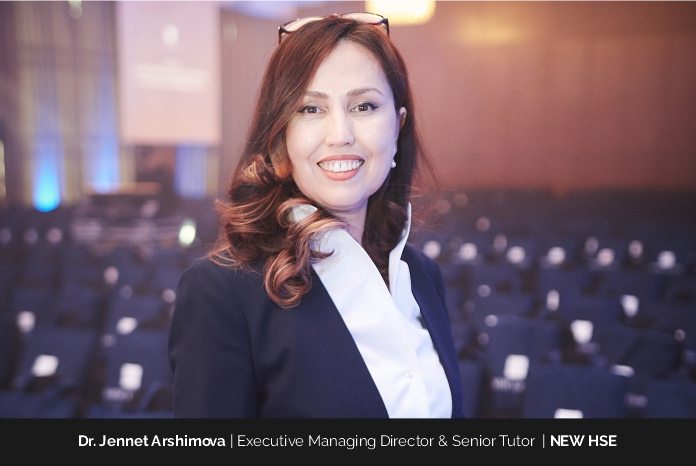
“The future isn’t just built by those who have the most, but by those who believe the most.” This belief has been a quiet constant in Dr Jennet Arshimova’s journey long before she became a recognised name in business leadership. Having lived and worked across 12 countries and collaborated professionally in many more, her perspective has been shaped by diverse systems, cultures, and crises. Trained as a medical doctor, she began her career in high-intensity regions near the Afghan border. Over time, her work expanded beyond clinical practice into science, entrepreneurship, and systemic impact, from founding schools in Ukraine during wartime to building JourneyWithCare and launching new health, safety, and education initiatives in Poland.
While she grew up as an Asian girl near cotton fields, dreaming of saving the whole world, her path taught her a more grounded truth. We can make the world safer by starting with ourselves and the person right next to us. She eventually backed this lived experience with formal science. After studying Health Policy at Imperial College London, she pursued an academic degree in Health and Safety. This allowed her to work internationally before founding her first consultancy in Poland. Today, she leads this organisation as Executive Managing Director while sharing her research on safety culture with global organisations. She considers her career not as a list of titles but as a humble effort to advance how we protect people.
Her philosophy, Journey with C.A.R.E., was born from these challenging environments and her personal experience as a mother to a child with a rare neurological disease. When Dr Jennet began shaping the direction of NEW HSE, she carried a vision refined by nearly twenty years of living in Poland and working across the globe. She realised that the common myth of resilience. The idea that we must be hard or unbreakable is actually a limitation. She feels that the most unstoppable force is care. This does not mean being soft or merely nice. Instead, care is a practical strength that provides resilience in war, authenticity in leadership, and essential boundaries in motherhood.
Her research as a scientist confirmed this. She studied how companies managed psychosocial risks during crises. Empathy and trust proved to be the two cornerstones in such scenarios. They helped workers feel heard. This made crisis management far more effective.
She carried this same Journey with Care philosophy into her university classrooms. There, she watched students transform. They began to see that listening and empathy were not weaknesses, but powerful professional strengths.
This mindset is codified in her C.A.R.E. values. Courage to act in uncertainty. Adaptability to shift without losing purpose. Relationships to build deep trust. And Empathy as the foundation for impact. This framework has been put to the test with global partners like L’Oréal, Accelleron, Michelin, Skanska, GE, etc. In environments where care defines the culture, employees feel brave enough to speak up. “Empathy is a superpower,” Dr Jennet notes, “and every great leader should develop it.” It is the actual engine behind engagement and innovation.
Impact Through Education and Action
A dual commitment to medicine and health and safety defines her career, allowing her to protect both industrial systems and the people at their heart. A major milestone was founding NEW HSE in 2013, now recognised as a NEBOSH Gold Learning Partner. Her graduates have gone on to hold influential leadership roles in multinational organisations, including companies such as Vestas and Mondi. This reflects the strength and credibility of the programmes rather than a formal affiliation.
While education develops individual capability, Dr Arshimova’s consultancy work focuses on organisational transformation. She works directly with executive and operational leadership teams across Europe, the United States, and Asia to embed safety culture into real working environments. Her NEBOSH programmes consistently achieve learner satisfaction rates exceeding 98%. In consultancy, more than 89% of clients continue their engagement long term, with many maintaining partnerships for years. This continuity reflects the trust built through the JourneyWithCare philosophy.
During the pandemic, she established the Health and Safety Academy to provide space for leadership reflection. Perhaps most meaningful is the European Risk Management School in Ukraine, founded six years ago. In partnership with One Percent Safer, the school provides free education to veterans and professionals with disabilities. Even under wartime conditions, it remains a community built on resilience. Dr Jennet feels that the greatest impact is not the organisations she has built, but seeing her learners evolve into confident, purposeful leaders. For her sagacity and service-led vision, she has earned herself recognition among ‘The 10 Most Impactful Women Leaders in Business to Follow, 2026.’ And we wholeheartedly celebrate her.
Addressing the Gaps in Training
One of the most significant gaps in global health and safety training today is a heavy focus on compliance while overlooking the lived reality of work. Traditional training assumes that leaders must provide every answer, but Dr Jennet and her team believe effective leaders create environments where others feel safe to contribute. “Leadership starts long before the first action. It starts with who you are,” she remarks.
This insight is not merely anecdotal. Dr Jennet shares that their leadership workshops are built on a multi-year field study involving over 150 CEOs and senior leaders across 27 countries. The findings revealed that leaders do not lack care, but they often lack access to reality when pressure increases. As artificial intelligence increasingly supports technical decision-making, human and emotional intelligence become the true differentiators.
Balancing the Dual Role
The team often jokes about which version of Dr Jennet they are speaking to at any given moment. They tease her, “Are you speaking to us now as our Managing Director or as a tutor?” This internal humour reflects the dual nature of her daily work.
In her role as Executive Managing Director, her priority is growing the team to facilitate a genuine culture of belonging and ownership. As a Senior Tutor, her responsibilities shift toward the quality of learning and helping students gain the confidence to influence their own workplaces.
By working alongside highly experienced professors, the school maintains a blend of academic excellence and practical expertise. Be it students, colleagues, or clients, her mission remains consistent with the team’s. It is a shared effort to create environments where people feel supported, capable, and inspired to grow.
Living the Culture
Policies do not define a strong safety culture. Though top-down commitment is needed to initiate such a process, Dr Jennet remarks that accountability within a teamwide environment develops through everyday interactions. When openness is encouraged and mistakes are addressed fairly, safety becomes a collective responsibility.
She has seen that culture is truly tested under pressure. Most organisations rarely lack values. Instead, they lack the leadership awareness to live those values consistently when things get difficult. This is why the team avoids ready-made solutions. “Building a culture of care is never ‘one-size-fits-all.’ It’s about meeting people where they are with respect, curiosity, and a lot of humility,” she explains.
This principle is key to the House of Leadership framework. It recognises that leadership begins with Being before Doing. Systems and safety visits are important. Whereas presence and authenticity shape the environment first. When leaders involve their teams in decision-making and lead with sincerity, safety becomes an organisational identity. “We don’t fix culture. We live it. Culture is shaped when people feel, think, act, and care, driven by a shared purpose and a true sense of belonging,” Dr Jennet mentions. “Because culture isn’t just top-down or bottom-up. It’s peer-to-peer, and when the middle has a voice and support, culture truly comes alive.”
The Courage to Protect Culture
To her, care is extremely personal. During a year spent in the hospital fighting for her son’s life, Dr Jennet had to re-evaluate her entire purpose. She discovered that to support others truly, she first had to listen to herself and respect her own limits. It taught her that care requires boundaries and self-compassion to remain sustainable.
This personal insight transformed her professional leadership. Early in her journey, she hired a technically exceptional manager for a major project. Although he delivered results on paper, employees quickly felt overwhelmed by the level of control and blame he exerted in his leadership. One colleague eventually shared that she could no longer cope with the pressure.
Although the manager called her own style “too soft,” Dr Jennet chose to let that manager go to restore psychological safety and protect the trust that underpinned the organisation. After that choice, the team rebuilt its trust and successfully completed the project, proving that leadership is about having the courage to make hard decisions that protect long-term integrity.
Defining a Path in Technical Fields
Being a woman in technical and safety-focused disciplines has been a source of perspective and strength for Dr Arshimova. Early in her career, she was often the only woman offshore or in shipyards. During her medical training, she was even told that becoming a cardiac surgeon was not for women. These moments did not stop her. They strengthened her resolve to define her own path rather than accept the limits others placed on it.
She has become adept at subtle challenges, such as “polite denial,” where a voice might not carry the same weight in a discussion. Over time, she became aware of the broader realities women face, from maternity leave to later life transitions that are rarely discussed in professional settings. These experiences shape the empathy required for authentic leadership. One significant moment involved hiring an assistant who believed she would be rejected because she was a mother of three. Dr Jennet saw potential instead of limitations. That assistant is now a successful leader within the team.
This belief in potential led to the creation of the Women Power Network four years ago. It has grown into a community connecting women in science and engineering through mentoring and shared experience. Leadership is not about conforming to expectations. It should bring full humanity into the role. Empathy, attentiveness, and the ability to connect are important strengths in health and safety. When women are supported, they create the conditions for everyone else to grow as well.
The Evolution of Safety Education
Dr Jennet feels that the future of workplace safety education must stand on its own in the messy reality of operational life rather than sterile theory. People do not work in ideal conditions. They operate under pressure, shifting priorities, and uncertainty. Education must help professionals navigate the tension between performance and protection. This means making a fundamental shift away from blame. So, when errors do occur, the aim should be to identify system failures rather than individual failures. This promotes a learning culture where people feel safe to speak up, allowing safety to evolve through insight rather than fear.
Sustainable safety cultures are founded on trust and purpose. Compliance and procedures are necessary, but not enough. Education must integrate human connection and explain why safety matters. It is about protecting human dignity. It requires leadership development to expand from the “Doing” to the “Being.”
Leaders today are often highly competent at managing systems, data, and increasingly AI-driven decision-making, yet many lack the space to pause, reflect, and truly listen. In environments shaped by analytics and automation, emotional intelligence and self-awareness become even more essential for building the trust that ultimately influences culture. The next generation of leaders will be defined not only by their technical and data fluency but by how their presence, judgment, and values form the systems around them.
Leadership as a Responsibility to Oneself
Maintaining balance in such a demanding role was not always a priority for Dr Arshimova. For years, she was totally committed to growth and science, neglecting her own well-being.
It was not until the scales fell from her eyes. Her son became seriously ill. This forced a total re-evaluation of what mattered. She realised that leadership and contribution cannot come at the cost of one’s own health. Quality of life shifted from being a luxury to a responsibility.
This learning has reset the way she leads her organisation. Well-being is now a structural priority. The team does not work on weekends. Plus, there is a strict policy against emails or calls outside of working hours. This required a complete rethinking of time management to focus on sustainability rather than constant urgency.
On a personal level, Dr Jennet finds balance through painting and playing the piano. She also finds incomparable energy in teaching her Sunday class at WSB National Louis University, as the curiosity of “true beginners” serves as a powerful reminder of why her work matters.
A Legacy Grounded in Care
Legacy is not defined by titles or achievements for Dr Arshimova. People and collective growth define it. She hopes to leave the next generation of professionals with the understanding that safety is ultimately about care. Without care, there is no real connection or trust. Without trust, there can be no lasting transformation. If the C.A.R.E. philosophy lives on through the decisions leaders make and the cultures they nurture, that will be her most meaningful success.
To young women aspiring to lead in technical or educational fields, her advice is clear. Do not wait for permission, and do not try to become someone else to belong. Leadership is a process of growth. There will be moments of doubt and resistance. But these are part of building resilience. “Every step can move you forward—as long as your dreams are bigger than you,” she encourages. “Growth begins when you choose progress over perfection and see failure as part of learning.”
Dr Jennet believes that even when life brings you to a complete stop, new paths can open if you stay aligned with your purpose. Leadership begins with the courage to be exactly who you are. “No matter how fast life moves, there is always time to grow,” she reflects. “In the end, the road does not define us. How we walk it with care is what truly matters.”