
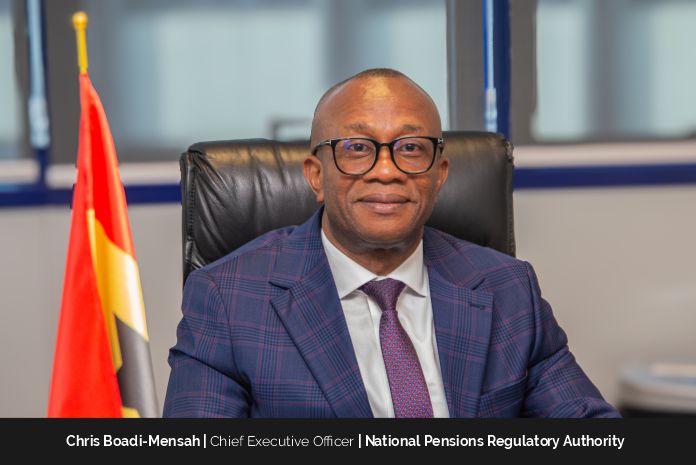
Chris Boadi-Mensah, Chief Executive Officer of the National Pensions Regulatory Authority (NPRA), is spearheading efforts to safeguard workers’ retirement income and expand pension coverage to Ghana’s vast informal sector. Through his efforts, he is reshaping the country’s pension system to make it more inclusive, reliable, and sustainable. His leadership is driven by fairness, trust, and reforms that impact people’s lives.
A seasoned Chartered Insurance Practitioner, Chris brings over two decades of experience in insurance and brokerage to his role at NPRA. He is a leading figure in the field, known for his expertise in risk assessment, policy drafting and analysis, life assurance, pensions, and brokerage. Chris is now set to usher in a new era for Ghana’s pension system, one that will provide retirement income security for every worker.
Stepping Into the CEO’s Role at NPRA
In January 2025, Chris Boadi-Mensah stepped into the role of NPRA’s CEO. Since then, he has been working to bring more people, especially those in the informal sector, into the pension system. He has also focused on improving transparency and compliance, while helping Ghanaians understand their retirement benefits.
“Strengthening employer compliance is also one of the issues I have tackled to ensure workers’ contributions are paid regularly and on time,” Chris points out. “This has led to the recovery of millions of cedis for employees who might otherwise have lost their retirement benefits.” All these initiatives are aimed at making the pension system fairer and more reliable for everyone.
A Brief Introduction to NPRA
In 2004, Ghana embarked on comprehensive pension reforms to create a sustainable inclusive pension system. The aim was to ensure retirement income security for all workers, including those in the informal sector. These reforms culminated into the passage of the National Pensions Act, 2008 (Act 766) in 2008, which introduced the contributory Three-Tier Pension Scheme and established the National Pensions Regulatory Authority (NPRA) to oversee and regulate the sector.
According to Chris, the objectives of the three-tier pension scheme include providing pension benefits to ensure retirement income security for workers and ensuring that every worker receives retirement and related benefits as and when due. In addition to that, it also aims to establish a uniform set of rules, regulations, and standards for administration and payment of retirement and related benefits for workers in the public and private sectors.
The Act positioned NPRA as the first dedicated regulatory body in Ghana’s pension sector to regulate and monitor the operations of the three-tier pension scheme. Chris points out that its mission is to ensure the effective administration of pensions, protect the interests of contributors and beneficiaries, and grow pension assets to support national development. Since its establishment, NPRA has played a central role in shaping Ghana’s pension landscape, strengthening regulation, and expanding coverage for both formal and informal sector workers.
The Authority is responsible for registering and licensing pension schemes, trustees, custodians, and fund managers. It also ensures compliance with the National Pensions Act, enforcing rules and standards across the industry, and issuing guidelines, standards, and directives for investment, management, and governance of pension funds.
Additionally, the Authority supervises the operations of SSNIT and the private pensions industry. It conducts research and maintains the national data bank on pension matter. According to Chris, they also educate and sensitize the public on pensions, especially workers in the informal sector, and investigate complaints from contributors and retirees. The Authority advises the government on pension policy to strengthen the system’s sustainability as well.
Over the years, the NPRA has made significant strides in shaping Ghana’s pension landscape.
The Challenge and Defining Moment
When he arrived as CEO at NPRA, Chris had to immediately handle the issue of employer defaults in contributions and the responsiveness of service providers to regulatory directives. “These were among the key issues that caught my attention after I assumed office,” he points out.
In order to reduce employer default, Chris took the decision to readjust and redeploy his officers nationwide on inspections. In a very short time, his efforts have yielded results. “We have seen lots of employers enrolling their employees on tier 2 schemes and recovery of unpaid contributions,” he said.
“And, with regard to industry compliance, it was a test of balancing firmness with diplomacy,” Chris says. He and his team had to deal with issues of non-compliance among trustees and service providers, especially in the area of investments. They did that through engagement and dialogue. At the same time, they did not hesitate to apply sanctions where necessary to protect the interests of workers. “This has reinforced my belief that leadership is about making tough but fair decisions with consistency,” Chris says.
Ensuring Sustainability of Pension System
NPRA’s core mandate is to ensure that the country’s pension system is run effectively to provide retirement income security for generations to come. Chris points out that with this focus, NPRA is continuously reviewing and introducing new policies to ensure that the pension system is sustainable and able to meet its obligations in the future.
Chris and his team work with all relevant stakeholders locally and adopt global pension best practices (being a member of IOPS, APSA and ISSA), making sure that the scheme remains relevant. “Importantly, we are progressively expanding our focus to the informal sector to promote inclusive pensions for all categories of workers today and in the future,” Chris says.
Journey Shaped by Values
Chris has several remarkable achievements to his credit in the finance, insurance, and risk management space. His values, such as integrity, service, and accountability, have played a key role in his success. According to him, they have shaped his successful journey into leadership and public service.
He indicated that growing up, his early experiences in his community, along with the guidance of his mentors, taught him qualities such as responsibility, empathy, and resilience. These qualities continue to guide him in serving people with a human touch.
Balancing Regulation and Pension Landscape’s Modernization
Chris notes that regulation involves ensuring that all regulated parties and stakeholders comply with the rules, including laws, guidelines, and regulatory directives governing the management of pension schemes. He explains that it is about creating an environment for pension schemes to thrive, protecting the pension funds, and ensuring their sustainability to meet the objective of providing retirement income for workers. Modernization, on the other hand, is about introducing initiatives to make the system accessible and sustainable.
Under his leadership at NPRA, they balance regulation and modernization by enforcing compliance with Act 766. In addition to that, they invest in technology, identifying it as one of the pathways to improving the accessibility of pension products, especially among informal sector workers.
“We believe regulation should not only be aimed at sanctioning,” Chris says, “but also at creating an enabling environment for growth and innovation in the pensions sector.”
A CEO’s Typical Work Day and Work-Life Integration
Chris believes that every day presents its own unique blend of achievements and challenges. His typical workday begins with briefings from key directorates, followed by the coordination of daily activities—all aligned with making strategic decisions that drive the Authority’s objectives and promote industry-wide development.
What keeps Chris focused is knowing that every decision taken in the performance of his regulatory function has a far-reaching impact on the lives of Ghanaian workers, who have entrusted their future income security into the Authority’s hands to protect. “Having clarity of purpose, in regulating billions of workers’ pension contributions, keeps me on track to deliver the mandate of the Authority,” he says.
As CEO of NPRA, Chris promotes open communication and upholds integrity, consistency, and accountability at all levels. He points out that they are part of their operational principles, and they live by them. Also core to their performance is the continuous staff development and reward system to improve the overall performance of the Authority.
Chris’s role is demanding, as it carries national responsibility. So, how does he manage work-life integration? According to him, this is an everyday activity that requires creating a balance between work and family. Both are “very important” to him. “Taking up a national responsibility of this nature is very demanding,” he points out, “but my family gives me the strength and inspiration to take up this challenge every day.”
So, Chris strives to integrate both family and work and find a balance to lead. This ensures that he makes a positive impact while maintaining his well-being and family life. He values teamwork and understands the importance of delegating effectively and empowering his team. This ensures that he is never overwhelmed.
Pensions and Financial Security’s Role in Africa’s Socioeconomic Development
When one says, “pensions,” the immediate thought is retirement benefits. But according to Chris, they are more than that. He explains that pensions are a long-term pool of funds that can be used to fund infrastructure development, create jobs, and drive economic growth. Strong pension systems also reduce old-age poverty, increase social stability, and provide capital for development.
“That is evidenced in developed countries,” Chris points out. “In Africa, most countries are reforming their pension systems.” He points out that they are moving more toward private schemes to take advantage of the long-term nature of the accumulated funds for development. Additionally, they are promoting financial inclusion in the informal sector to prevent old-age poverty.
Importance of Empowering People
Chris points out that leaders in every sphere of life, including business, need to empower the people they serve. According to him, they can do that by creating opportunities for others to follow and succeed. “It is about building systems that outlive individuals and are capable of creating better lives for generations to come,” he says.
He believes it is crucial for a leader in his part of the world to empower the people they work with and those they serve to improve their lives. Chris says that they need to create a system of governance that is based on trust, transparency, and accountability, which continuously adds value to the people.
The Legacy!
Chris hopes to leave a legacy of a robust, reliable, and inclusive pension system that Ghanaians can trust and rely on for adequate retirement income. Under his leadership, he wants to see Pensions system emerge as an industry and become a major force in the financial sector, both locally and internationally. Additionally, he envisions a legacy of a system where both formal and informal workers can retire with dignity.
“I also hope to leave behind an NPRA that is seen as a model regulator, innovative, and people-centered,” Chris says. “Ultimately, it is about securing the future of every worker and contributing to Ghana’s long-term financial stability.”
Message to Emerging Leaders
To young professionals, Chris points out that working in the public sector as a financial sector regulator presents a “uniquely challenging and demanding environment.” As the sector is becoming increasingly complex, he advises them to keep up with new trends and best practices for effective monitoring and supervision.
He also encourages young professionals to lead with integrity, courage, and empathy. He explains that integrity builds trust and confidence; and courage on the other hand, will help them make the tough decisions to get things done. Chris tells them to never stop learning as well.
“Public and financial sectors are very dynamic,” he adds. “Therefore, continuous growth is key to being effective and efficient to stand out.”