
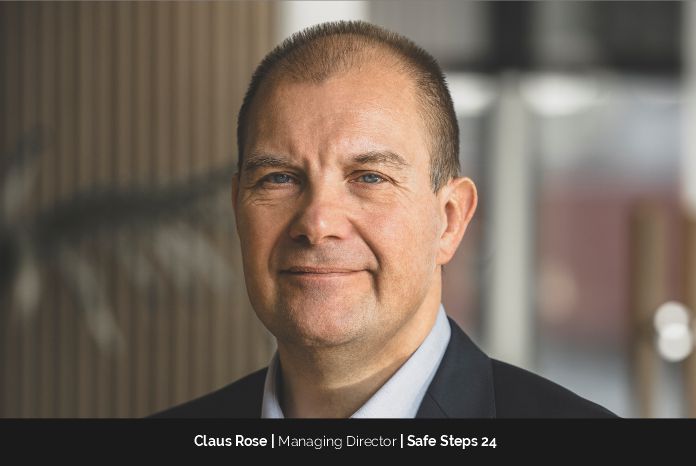
Claus Rose, Managing Director at Safe Steps 24, is a changemaker who has built multiple organizations and programs from the ground up. His professional journey spans military service, global EHS leadership, and cultural transformation work. Over the years, Claus’s innovative spirit and understanding of leadership, EHS, and human behavior have helped transform corporate culture and influence the people he works with. In 2020, before anyone thought such an innovation was possible, he pioneered an AI model to validate data with no human intervention, a breakthrough that earned him a prestigious leadership award.
„Most organizations believe they have a safety or quality problem. In reality, they have a leadership perception problem.“
Many senior leaders I work with do not lack commitment. They lack clarity.
Incident rates look acceptable on paper. Audits are passed. KPIs are green and yet, something feels off.
Decisions are increasingly reactive. Teams wait for instructions instead of taking ownership.
Weak signals are noticed too late – often only after customers, regulators or insurers raise questions.
This is the moment most organizations realize: the issue is not, quality or EHS. It is leadership perception.
Claus now helps organizations tackle the cultural challenges that most leaders struggle to solve, especially those related to building a culture infused with performance, quality, and safety. He also transforms leaders, making them capable of driving the organization’s culture change, through his motto; “Create a self-driven and high performing organization”. Together with renowned professionals, built the Safe Steps 24 “Trinity” model, to concur the likelihood of culture transformation failure in any organization. This will be explained further in the article.
Stepping Into the EHS Field
Claus didn’t plan his current career path. “It was circumstance,” he says. Prior to stepping into the field of Environment, Health, and Safety (EHS), he had his own business, which focused on risk management for building construction projects. Then, he met someone from Siemens. They discussed the growing need for people who understood risk management, especially as legislation was changing. That person inquired if Claus would be interested in taking a role at Siemens. Claus found the offer interesting. “Because I had no idea what I was signing up for,” he says. “I also didn’t have a formal background in that space apart from what I had learned during my years in the armed forces.”
Claus liked the idea of building something from scratch, which in this case meant building an organization from the ground up. But first, he had to learn all about the trade. Claus explains that if he didn’t understand the baseline of what he was asking people to do, he wouldn’t have gained the credibility he needed as a leader. According to him, he has always set aside time to learn the trade and craftmanship of any organization he has worked in.
Claus served at Siemens for more than a decade, rising through the ranks to become Head of Occupational Health & Safety (VP), Siemens AG. He moved to GE and later to GE Vernova, where he held the position of Senior Executive of EHS Separation Management Officer. Claus joined Safe Steps 24 in November 2024.
Never the One to Give Up
Claus attributes his Managing Director position at Safe Steps 24 to “being in the right place at the right time” and a “bit of luck.” Over the years, he has learned never to give up or accept “no” for an answer.
For him, one of his biggest achievements is being part of developing the Global Wind Organization (GWO). He says that the idea came from the fact that wind turbine technicians received different types of training depending on the company they worked for and the country they were operating in. The goal was to create a uniform approach. At the time, everyone said that would never happen. Today, GWO is leading the market in the industry, with twenty different standards in the marketplace.
“That story showcases the way I work,” Claus says. “I don’t take ‘no’ for an answer. Such an answer only sparks my eagerness to show people they were wrong.”
And Claus’s officer training and education have provided him with a solid foundation, which has made him the exemplary leader he is today. He believes that soft skills, communication, perseverance, team building, innovation, and the willingness to guide an organization into new territory define a leader more than products, technical knowledge, or past experience. He also believes that no one is ever too old to learn something new.
“I went to Siemens with no formal EHS background or training, but I took this on alongside my role,” Claus says. “I was fortunate to be given the opportunity to build an EHS structure from the ground up, which gave me the time to learn as I went.” This proved to be a valuable learning experience.
Cultural Transformation
Most organizations do not fail because they lack initiatives. They fail because leadership behavior does not change fast enough. In the meantime, weak signals turn into incidents. Frustration turns into fatigue. And complexity slowly erodes performance.
Numerous studies show that most organizations fail, and according to Claus, the “scary part” is that this has not changed in over a decade. “We are still trying to do exactly what we did yesterday, and expecting a different outcome,” he says.
“Our quest has been digging into that research and then figuring out exactly what is hindering the organization from doing that,” he adds. Three main factors are surfacing as a result of this digging.
One of the factors is inadequate change management. Claus explains that leaders generally do not understand how to drive change because they have never been taught how to do that, and more importantly, they have never undergone a significant change themselves.
The second factor is the lack of understanding of the organization’s inherent culture. This means that not everyone within the organization shares the same understanding of that culture. They develop their own subculture, and that subculture is what keeps a particular team working together. “If someone from the top tries to lay an umbrella over them and say, ‘Here is what you are going to do tomorrow,’ that is not going to happen,” Claus says.
He explains that to ensure cultural transformation, leaders need to understand that one size does not fit all. They have to give people the freedom to choose how they achieve their goals. According to Claus, the goals may differ from one location to another, but as long as everyone meets at the end of the tunnel, the way they get there doesn´t matter.
And the third factor is that people talk about tone from the top or tone from the frontline. “The reality is that you need both,” Claus points out. People working on the frontline have a different perspective on how they want things to be done than the people at the top. These two sets of people have to meet and adjust, and according to Claus, it also means a program may change hundreds of times before reaching a point that will work across of an organization. However, people neither have the skill set nor the willingness to spend the time or put in the effort it takes. Culture change cannot happen overnight, Claus says. It requires plenty of time to drive it.
Claus also points out that if leaders are never going to undergo change themselves, they will not be capable of driving others to a cultural transformation. “That is what we are trying to do with Safe Steps 24,” he adds. They have created the “Trinity” model that combines all these elements to focus on leadership development, personal well-being, and cultural transformation. This set us aside from others, as they often only touch one element in the trinity.
If you are leading a complex organization today, you are expected to deliver flawless performance in an environment that is anything but stable.
You are asked to reduce incidents, improve quality, protect people and control costs – at the same time.
Most programs address one of these dimensions in isolation. That is exactly why they fail.
A Proven Methodology
SafeSteps24 is a QEHS leadership consulting and training company dedicated to helping companies create safer work environments and cultivate strong leadership within their teams. It was founded because organizations consistently attempt to deliver commercial success in a culture of performance, quality, and safety. However, very few succeed, as McKinsey notes that over 70% of transformations fail despite the enormous resources thrown at them. Claus says that Safe Steps 24 has developed a methodology proven to create sustainable results, which result in commercial success, hidden cost savings, and a significant reduction in fatalities and severe injuries. The methodology is called the “Trinity Model”.
He points out that for a company, when they combined EHS(Q) leadership enhancement, digitalization, and skills improvement, the results were astounding in the first year itself. Its serious injury and fatality cases reduced by 85 percent, recordable events dropped by 21 percent, the Injury and Illness Rate fell by 21 percent, and Potential Severe Events decreased by 57 percent. Claus points out that there was also a seven-day reduction in days away from work compared to year before, resulting in a hidden cost saving of approximately $5 million. In addition to that, there was cost avoidance for fewer injuries with absence, which amounted to an additional hidden cost saving of approximately $6.8 million.
“This was through Leadership alignment, data-driven KPI´s, strong operational processes, and continuous improvement feedback loops,” he adds.
Introducing the Safe Steps 24 “Trinity” model, a systematic approach to give leaders more time with less effort, to transform a Safety Leadership Culture within a business.
- Behavior drives culture
- Data reveals blind spots
- Health sustains performance
“Our approach brings together three fundamental elements backed by several very simple principles which start with a simple fact: you cannot expect to lead others on a journey of change unless you can manage and lead yourself on your own journey,” Claus highlights. Their principles include:
- A person cannot change an organization until they have embraced significant change for themselves
- A person who leads must be able to hold up a mirror and look unflinchingly in the mirror to see their own traits around personal health, wellbeing, strengths, and their own development areas
The program designed by them provides the vehicle to embrace personal change, since a healthy leader is a successful leader able to speak with true authority in change, beyond process, IT, and policies.
Creating a Masterclass for Leaders
Claus and his team are finalizing a Masterclass to support leaders, senior or young, or talented people aspiring to step into the safety leadership arena. In just 6 months you will gain the skills to drive significant impact to mitigate quality, environmental, health, and safety problems.
Claus explains that if an organization is struggling with quality or EHS issues, it will likely also struggle to make money. The critical question is not whether transformation is needed. The question is how long organizations can afford to wait. Every quarter without behavioral change increases operational risk. Not visibly but systematically.
Quality- and EHS-related problems lead to customer complaints and/or authorities intervening in business operations. So, while this is not what leaders are normally measured on, but on financial results, shareholder value, and customer satisfaction, these elements become critical to any organization. “When you focus on them and make sure you get them right,” Claus says, “you also put yourself in a position to earn money. This is what we solve with the Masterclass.”
Currently, they are working on the final details. “One of the things that makes what we do unique is that we do not use people with similar backgrounds to develop the Masterclass. I have a sports scientist and psychologist, a machine learning and AI expert, a Lean expert, and business transformation coaches from complex organizations like nuclear energy, oil and gas,” Claus says.
The program is being designed to be limited, with each class capped at 20 people. Claus explains that this ensures their team has enough time to work with participants, and participants have sufficient time to interact with and learn from one another. This creates a valuable learning opportunity as well as creates harmony among the group, according to him.
Setting an Impossible Challenge
Claus believes in the saying that one is never too old to learn new tricks. According to him, it is important that leaders stay vigilant and pay attention to what is happening around them. “Because if they don’t,” he says, “they will fall behind the curve.” The difference is not intensity, it is integration, hence the “Trinity” model.
“One thing is certain,” Claus adds. “Humans are the ones who create the wonders of the world.” For example, they created AI. Claus helped develop an AI and machine learning tool that no one thought was possible. “We made it possible,” he says.
“That is what drives me: setting a challenge everyone thinks is impossible and then finding a solution to mitigate it,” Claus points out. And that is exactly what they are trying to do right now.
The Legacy!
Claus wants his legacy to be the employees and leaders he has trained who remember what they learned through their interactions with him. “If I can help people prosper, that makes me proud,” he says.