
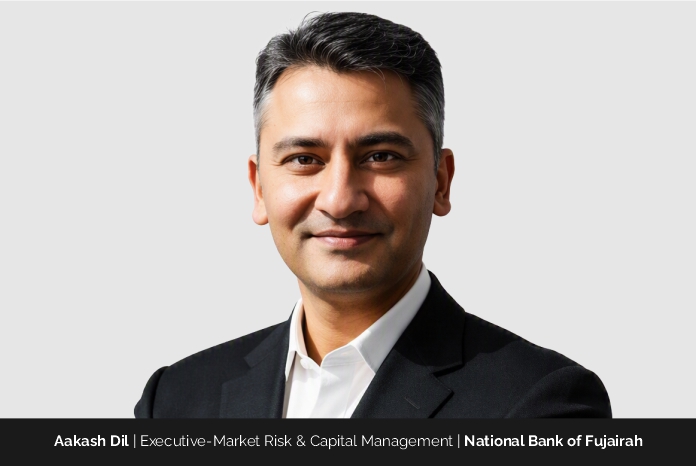
Dr. Aakash Ramchand Dil doesn’t see risk as something to fear. He sees it as something to understand. In 2008, while the financial world was in turmoil, he sat in a room where the prevailing wisdom was simple: Just say no. Protect the institution. Build walls. He saw it differently.
After years of studying mathematics, risk management, and the architecture of financial systems, he understood something his peers didn’t: Risk is not a cage, it’s a compass. It points toward opportunity. It reveals patterns. It tells you where the future is being built.
Today, as Executive/Head of Market Risk and Capital Management at the National Bank of Fujairah, Dr. Aakash doesn’t just manage risk, he orchestrates it. He doesn’t build barriers. He builds pathways.
“The moment they told me to say no to everything, I knew I had to say yes to something bigger,” he recalls.
That decision wasn’t just a career pivot. It was a philosophy. One that has shaped his approach to every challenge since and one that’s now influencing a new generation of finance leaders.
Architecting Resilient Growth
Dr. Aakash didn’t collect credentials. He collected tools. Each qualification, Actuarial Science, a PhD in Mathematics, a DBA in Risk Management, wasn’t about prestige. It was about capability. He wanted to understand how complex systems break, and more importantly, how they hold together under pressure.
His training at Columbia University in Financial Engineering and Risk Management through Coursera, gave him the quantitative firepower: derivatives valuation, option pricing, modeling under stress. His Postgraduate Diploma in Law at the University of Cumbria gave him something equally valuable: an understanding of the governance frameworks that shape financial decisions.
“Numbers don’t operate in isolation,” he explains. “They exist within systems of rules, regulations, and human behavior. You have to understand all of it.”
When IFRS9 arrived, a sweeping regulatory change that most banks treated as a compliance nightmare, he saw an opportunity. He wasn’t interested in avoiding the challenge. He was interested in solving it.
He single-handedly built the bank’s Loss Given Default model. From scratch. While others were confused with the complexity, he was driven by the puzzle. “I didn’t wait for a path to appear,” he says. “I built it. Stone by stone.”
Orchestrating Strategic Command
At the National Bank of Fujairah, Dr. Aakash doesn’t just oversee risk, he designs the systems that make resilience possible. Market Risk. BASEL Capital. Stress Testing. IFRS9 ECL. ICAAP. Models Governance. These aren’t separate functions to him. They’re interconnected systems that, working together, form the bank’s immune response to uncertainty.
“I don’t manage risk,” he says. “I orchestrate it.” When the Central Bank of the UAE mandates stress testing, he doesn’t stop at compliance. His team builds scenarios that reveal vulnerabilities before they become crises. They don’t just meet regulatory requirements, they use them as a framework to stress-test the bank’s entire strategy.
His influence extends across ALCO, the Risk Committee, the Investment Committee, and the Models Risk Committee. He doesn’t attend these meetings to observe, he attends them to shape outcomes.
“The goal isn’t to eliminate risk,” he explains. “The goal is to understand it so well that you can navigate through it.”
That’s the difference between a risk manager and a risk leader. One builds walls. The other builds pathways.
Preserving Energy and Purpose
He knows that resilience isn’t something you’re born with, it’s something you build. High-level responsibility demands more than technical expertise. It requires discipline. Presence. A clear mind. And a deliberate approach to preserving both energy and purpose.
At work, he’s fully present. With his family, he disconnects completely, no screens, no distractions, just the people who matter most. It’s not easy. But it’s essential.
Writing is his sanctuary. Seven books. Thirty-two articles and counting. Twenty-four research papers. Each one is a conversation with himself, a way to deconstruct chaos and find clarity in complexity.
Teaching serves as a second reset. Lecturing at universities across the UAE, Europe, Canada, and Hong Kong isn’t just about sharing knowledge, it’s about staying connected to why he started.
“Clarity doesn’t come before the journey,” he says. “It’s what you earn along the way.”
Beyond the Prestige
For this industry veteran, achievement is measured by long-term influence rather than short-term status. He captures this mindset: “Success isn’t a destination. It’s the wake you leave behind.”
Recognized among “The 10 Most Influential Leaders in Finance to Watch in 2026,” Dr. Aakash is redefining leadership across the global financial sector. By turning risk into a compass rather than a cage, he bridges quantitative theory with strategic growth.
Professionally, success means building systems that outlast him, models that provide genuine insight rather than regulatory compliance alone. Victory shows up when a model predicts a crisis before it happens, when his research earns citations in peer-reviewed journals, and when mentored team members step into leadership.
Personally, success means expanding influence far beyond a job title. He uses his voice across TEDx stages, books, and articles to help others reframe their relationship with risk and fear. Having once been an unsure student, he now offers the next generation a grounded perspective: “You don’t need a perfect plan. You just need to be a brave traveler.” In his eyes, the reward is watching that next generation realize they can handle uncertainty.
Conquering the Mental Barrier
The hardest challenges in risk management are rarely technical. They are psychological. Smart, brilliant people freeze, terrified of making the wrong decision, so they do not decide at all. Dr. Aakash points out that
“The biggest risk isn’t in the market. It’s in the mirror.”
He saw this institutional instinct to hide behind fear in 2008, and he sees it every day. When leading the IFRS9 implementation, he watched as everyone around him panicked, shouting: “Don’t get it wrong! We’ll be fined! We’ll be penalized!” He stepped in to reframe the narrative, asking: “What if this isn’t about defense? What if it’s about navigation?”
Instead of just complying, his team innovated. They built predictive models that mapped flexibility, recovery, and opportunity. His legal background proved unexpectedly valuable here, corporate governance provides the boundaries within which you can innovate, while his data science training provided the tools to see patterns that others missed.
By shifting the internal conversation from “what if I fail” to “what will I learn?” he proved that failure is not the opposite of progress, it’s often the fastest way to grow.
The True Value of Execution
He doesn’t measure success by awards. He measures it by proof. The silverware is nice, and there’s plenty of it. Excellence in Predictive Analysis for Banking at the 9th Middle East Banking and AI Analytics Summit 2025. Best Initiative in Risk Management of the Year at the 11th edition 2026. The Global Excellence in Risk Management & Quantitative Finance Leadership Award at the Elite Leadership Awards 2026. The International Author Excellence Award 2025 for his book on risk management. Recognition from the Global Association of Risk Professionals (GARP) Dubai for his keynote on IFRS9 in 2016.
But for Dr. Aakash, these accolades aren’t the point. They’re evidence. “The milestone that matters isn’t the award,” he says. “It’s the proof.”
The proof came early in his career when he single-handedly built the Loss Given Default model for IFRS9, a project most banks approached with dread. He approached it with obsession. The deadline was brutal. The entire bank’s compliance rested on the outcome. Day and night, he worked through the data, the variables, the hidden patterns. A complex puzzle demanding to be solved.
When the model went live, it proved something important: one person, with the right mindset and training, could bridge the gap between complex theory and real-world banking strategy.
That proof has been reaffirmed throughout his career. At the Elite Leadership Awards 2026, he didn’t just receive the Global Excellence in Risk Management & Quantitative Finance Leadership Award, he served as Exhibitor Partner and Keynote Speaker, sharing his approach to risk management with an international audience.
He’s been recognized by the Golden Awards Team for his contributions to academic storytelling and financial education. His work has been cited in peer-reviewed journals. He’s even made an official attempt at a Guinness World Record in Jenga and Chess, a testament to the same cognitive discipline he brings to risk management.
“The proof isn’t just in what I’ve built,” he says. “It’s in the fact that others are building on it.”
The Revolution of Risk
That proof, of what’s possible when you refuse to be paralyzed by fear, is what shapes his vision for the future of finance. Static finance is dead. Those clinging to old rulebooks will be left behind. Looking ahead to the next decade, three massive forces, artificial intelligence, shifting geopolitics, and evolving governance, are fundamentally rewriting the rules of corporate finance. Dr. Aakash notes that “The future of finance belongs to those who can dance with uncertainty.”
The financial industry is swiftly becoming a data industry. Through his data science training with IBM, he recognizes that leaders must know how to build, deploy, and interpret machine learning models. On the geopolitical chessboard, where policy changes, export restrictions, or regional conflicts hit the market, risk managers must look beyond model analysis to interpret narratives, understand power, and spot unseen patterns. Meanwhile, his legal education underscores that advancing technology requires evolving regulatory frameworks; corporate governance is the very foundation for sustainable innovation.
In this new domain, risk management takes center stage, moving from the department of “no” to the department of “how.” Modern risk leaders evolve into enablers, converting fear into fuel. They do not eliminate risk, they understand it so deeply that they transform raw uncertainty into competitive advantage. Dr. Aakash describes it as revolution, not just evolution.
Reframing the Horizon for Tomorrow’s Leaders
Future finance leaders must understand they are meant to be builders, not just guardians of the status quo. Shaping the future requires changing how rising talent views their role from day one. Dr. Aakash states, “I want them to see risk not as a cage, but as a compass.”
He wants young professionals to realize that risk management is fundamentally about enabling growth, innovation, and impact, far beyond static spreadsheets and compliance checklists.
Reflecting on his own start as an uncertain student, he found his purpose by staying curious and refusing to fear failure. Through his outreach and authorship, he encourages the next generation to step forward without waiting for perfect conditions.
Continuous growth is the ultimate engine for navigation. Every new skill equips a leader to chart unknown waters, and Dr. Aakash is helping the next generation step up to lead that dance.
Leading with Vision and Culture
Evolving from a technical expert into an executive leader requires moving past the urge to hold every answer. Dr. Aakash summarizes his core approach: “I don’t lead with authority. I lead with vision.”
His style stays hands-off by empowering the team, giving them overarching purpose while granting full autonomy over execution. In his words, “When the why is clear, the how is easy.” Instead of micromanaging, he coaches, challenges, and asks questions that drive sharper thinking. He creates an environment of psychological safety where people can experiment and fail, knowing that is where progress happens.
Early in his career, he was the expert, the one with all the answers. He thought leadership meant being the smartest person in the room. Now he knows better. Leadership means listening more than speaking and building a culture where everyone feels empowered to contribute. In the end, he focuses on building a lasting legacy because the best leaders do not create followers. Rather, they create more leaders.
The Formula for Actionable Growth
Waiting for perfect clarity before stepping forward is the surest way to stand still. For aspiring financial leaders, Dr. Aakash offers a direct bias toward action with his precise rule: “Choose. Move. Adjust. That’s the formula.”
To make a lasting mark, he breaks this mindset down into three essential principles.
First, overcome fear and stop waiting for perfect conditions, because clarity is a reward for taking action, not a prerequisite.
Second, never stop learning, the moment you think you know everything, you become obsolete.
Third, find your purpose. As he puts it, “When the why is clear, the how is easy.” That is a core survival strategy for working through hard times.
Your future does not require a perfect plan; it needs a brave traveler. He echoes the words of Theodore Roosevelt: “Far better it is to dare mighty things, than to rank with those poor spirits who neither enjoy much nor suffer much, because they live in the gray twilight that knows not victory nor defeat.”
The Art of Active Adaptation
In high-stakes corporate environments, adaptability is an active daily practice rather than a static character trait. Dr. Aakash acts on a firm principle: “Resilience isn’t a personality trait. It’s a practice.” Three core habits keep him grounded through uncertainty.
First, he reads and writes. Seven books. Thirty-two articles. Twenty-four research papers. Each one is a conversation with himself, a way to deconstruct chaos and find clarity. When the world grows noisy, writing provides his silence.
Second, he reframes fear. Instead of ignoring that quiet voice warning about potential failure, he leverages it by asking what the real risk is and identifying the necessary map, effectively turning fear into fuel and anxiety into action.
Third, he stays committed to continuous learning. Data science from IBM. Financial engineering from Columbia. Law from Cumbria. Every new skill is a fresh lens to view the world.
In a rapidly changing environment that never stops shifting, resilience rather than speed has become the competitive advantage, separating those who merely survive from those who truly flourish.
A Legacy to Remember
Dr. Aakash wants to be remembered for one thing: reframing what’s possible. Not just in finance. In life. He wants to show that risk isn’t something to hide from, it’s something to understand. That fear isn’t a stop sign, it’s a signal. That uncertainty isn’t a threat, it’s an invitation to grow.
Within finance, that means building bridges. Between theory and practice. Between compliance and strategy. Between what’s safe and what’s worth pursuing.
Beyond finance, it means something simpler: helping people form a healthier relationship with the unknown. “May your choices reflect your hopes, not your fears,” he says, quoting Nelson Mandela. It’s a line that has guided him through crises and decisions alike. He’s already building that legacy. One conversation. One talk. One book. One brave step at a time.
And he’s just getting started.