

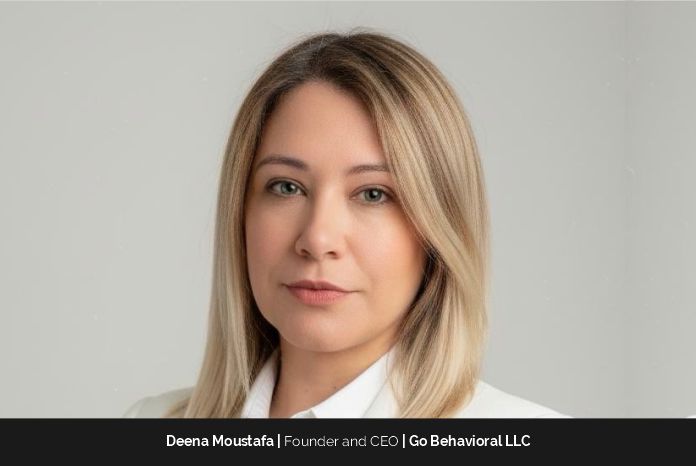
During her years in both the classroom and the clinic, Deena Moustafa noticed a persistent failure in behavioral health. Families were overwhelmed by fragmented systems. Simultaneously, clinicians were often overextended and lacked the mentorship they needed to succeed. The divide between academic research and the muck and mire of real-world implementation was evident. Parents were searching for guidance grounded in science but still human.
As a psychologist and professor, Deena saw these gaps from three different angles. Her academic training provided a foundation in data and scientific integrity. Her work as a teacher demonstrated to her how to translate complex behavioral principles into practical tools. As a clinician, she witnessed the emotional weight families carry when they first grapple with an autism diagnosis. She realized that to actually help, she had to build an organization centered on objective tracking and structured supervision. And built around these unmet needs, Go Behavioral LLC came into existence with Deena, its Founder and CEO.
She concentrated on data-supported outcomes, compliance safeguards, and parent education available in multiple languages. She wanted a system where there would be no room for guesswork. “It is a structured, scalable model built on research, accountability, and empathy,” Deena explains.
At its core, the company reflects a personal commitment to the power of ethical behavioral science. This sagacious businesswoman believes that when these principles are applied with compassion, they can stabilize an entire family unit. It is a professional effort to change the life course of every child the organization serves.
Two-In-One: A Scientist and An Entrepreneur
People often assume that scientific rigor and entrepreneurial agility pull in opposite directions. Deena considers them as a single, unified engine. In her view, the scientist and the entrepreneur work together to ensure that growth never comes at the expense of clinical integrity. She defines agility as disciplined adaptability.
The scientist in her is constantly looking for data and ethical replicability. Every program at Go Behavioral starts with validated assessments and measurable goals. This protects the backbone of the practice, keeping it evidence-based even as the organization expands.
The entrepreneur in her focuses on building the infrastructure to support those standards. Families cannot wait for perfect conditions; they need access to quality care now. Deena approaches business challenges with the same mindset she uses in the lab. When a staffing structure or a training model is not working, she analyzes the problem like a research question and improves it like a business leader.
This balance is kept steady by a clear sense of purpose. Scaling means expanding the reach of high-quality behavioral science with zero dilution. “That’s how you grow without losing your foundation!” Deena describes. For this thoughtfulness and tenacity, she has earned herself a place among “The 10 Most Iconic Businesswomen to Follow in 2026.” We celebrate her wholeheartedly.
The Weight of Leadership
Deena and her team understand that families are sharing their most vulnerable moments with them. Therefore, they do not take that responsibility lightly. Every decision made is filtered through a set of non-negotiables, like integrity, accountability, and compassion.
Integrity is the baseline for their work. This involves doing what is clinically right, even when that path is difficult or less profitable. If the data shows a strategy is failing, the team pivots immediately. Accountability assures that progress is always measurable rather than improvised. Deena wants to move away from the guessing games that often leave parents feeling lost.
Compassion provides the soul that science requires. Deena recognizes that behind every data point is an exhausted parent or a staff member carrying a heavy emotional load. She knows that at the end of the day, the true value of their work is found in the real-world stability of the families she serves.
When she faces a complex crisis, her criteria for moving forward are simple. She asks if a decision is ethical, sustainable, and protects the child, the family, and her team. If the answer is yes, they proceed. To her, everything else is secondary to the safety and progress of those in her care.
Engineering the Mission
At Go Behavioral, alignment is never a mission statement on a wall. It is built directly into supervision models and performance metrics from day one. Each and every team member understands that care must be as ethical as it is measurable. When expectations are defined and treatment goals are transparent, quality becomes standard, not a moving target.
Deena shares, “We don’t just hire clinicians — we develop them.” This practice guarantees the team stays grounded in science even as they grow professionally through structured mentorship and constant data review.
In a sector where new research emerges and family needs become more complex, Go Behavioral stays the course by holding clinical standards steady while allowing delivery methods to evolve. Deena knows that in this business, actions speak louder than words. By focusing on results over rhetoric, she ensures that every expansion serves the same core purpose.
Innovation, Done the Hard Way
For Deena, innovation in behavioral health is not about new tools or industry jargon. It is about improving outcomes without cutting ethical corners. She tackles it as a practical problem: how to make evidence-based care easier to access, more consistent to deliver, and reliable for families beyond the therapy hour.
At Go Behavioral, this work begins behind the scenes. The team pays close attention to systems most people never notice—data tracking, supervision structures, and clear onboarding processes. These details shape the quality of care as much as any clinical method. A clinician who is well-trained and properly supported is less likely to pass uncertainty on to a family already under strain.
That focus extends beyond the clinic walls. The organization supports parents through training offered in multiple languages. Services are coordinated throughout homes, clinics, and schools so everyone experiences it as a seamless whole. As the team grows, Deena invests in developing future supervisors who understand both the science and the responsibility that comes with it.
Innovation is not about replacing science. It aims at delivering it better, faster, and more sustainably without losing the human connection.
Seeing Families First
Trust cannot be built in a single meeting. It is earned through showing up dependably. “An autism diagnosis,” Deena explains, “can bring a wave of uncertainty and exhaustion.” Hence, before anyone talks about programs or data, they listen. The priority at Go Behavioral is to ensure families feel seen rather than processed.
Transparency is the real deal here. It keeps this trust alive. Clinicians explain the reason behind every choice. Plus, families have full access to goals and progress reports. If something is not working, the team admits it openly and adjusts the path alongside the parents.
The use of evidence-based assessments and structured plans provides visible proof that a child’s care is intentional. This commitment extends to the diverse communities they serve through parent training in multiple languages and culturally responsive communication.
On a community level, trust requires being a constant presence. The team collaborates with schools and supports local events because behavioral health should be woven into the community fabric rather than left in isolation. Real progress happens when words match actions.
Patience, Down to a Science
Working one-on-one with individuals with autism Deena learned, “progress needs patience, but it also requires precision.” In behavioral therapy, the tiniest details carry considerable weight. A slight change in tone or a split-second delay in a reward can shift an outcome entirely. This reality has influenced her leadership. She understands that growth cannot be rushed and foundational steps cannot be skipped.
Because individuals with autism often experience the world differently, Deena believes in adapting the approach rather than forcing a one-size-fits-all solution. She recognizes that meaningful change often happens in small increments that are just as vital as any major milestone.
Leading in an emotionally demanding field requires a specific kind of endurance. Deena treats her own well-being as a professional requirement. She protects her energy by building systems that do not rely on constant crisis management. By maintaining her own stability, she is able to provide the clarity her team needs to serve families effectively.
Systems That Support People
This C-suite executive knows that a paycheck is rarely enough to keep the best clinicians. In her words, “The strongest clinicians want three things: professional development, operational stability, and leadership they can trust. We focus on all three.” Retention at Go Behavioral starts with being honest about high standards. They are clear about the need for evidence-based care from the very first interview. This attracts people who want a career instead of just a shift.
The organization provides real mentorship and clear paths for growth. By focusing on case consultations and data reviews, the leadership ensures that staff members feel supported instead of watched. Deena has seen that people in this field do not usually burn out because the work is hard. They burn out because the systems around them are broken.
To fix this, the organization focuses on creating a stable environment where leadership is reliable. Culturally compatible hiring reduces turnover. “Retention ultimately comes down to this,” Deena remarks, “People stay where they feel valued, developed, and protected from unnecessary chaos.” She continues, “In behavioral health, talent is not just hired, it is cultivated.”
Changing the Conversation
Behavioral health should not exist on the margins of healthcare or education. Deena views these services as a vital part of family support that deserves full integration into society. For the team at Go Behavioral, the mission goes past simply providing therapy hours. They are working to raise the standards of the entire field and change how the public perceives behavioral intervention.
The team normalizes evidence-based care through clinical rigor. By focusing on trackable outcomes and clear communication, they show communities that this work is a results-oriented science. Accessibility is a major part of this effort. To keep care inclusive, the organization offers services in multiple languages and works directly in schools and homes. When support shows up at a family’s front door, the old stigma surrounding these services begins to fade.
The organization also looks at the long-term health of the profession. By mentoring new clinicians, the team strengthens the professional pipeline and improves the quality of care for everyone. Deena knows that real change happens through high standards.
Message for The Generation Next
For women entering healthcare or therapy, Deena suggests a very clear starting point. She believes that credibility is the most valuable asset a leader can own. It is built by mastering the clinical craft before trying to scale a business. In a field driven by data and ethics, deep expertise is the only way to earn real respect from a team and the community.
Leading a healthcare company requires a specific balance. Deena advises aspiring entrepreneurs to learn how to separate emotion from execution early in the process. This involves building a strong foundation in financial literacy and compliance to support the human side of the work.
Deena urges aspirants to set boundaries early. “Leadership does not mean overextending yourself to prove capability,” she reminds them. It means building systems strong enough that you are not the system. She adds, “Protect your time, your clarity, and your decision-making space.”
She also advocates for hiring people for their strengths rather than their ability to agree with her. Surrounding yourself with those who think differently is essential for long-term success. Deena encourages women not to wait for outside validation before stepping into a leadership role.
Building for the Long Term
For Deena, the most significant achievement is not a revenue milestone. It is the ability to sustain high-quality care at scale. She has built an organization that delivers measurable results without compromising on ethics. The real transition happened when she saw, “we weren’t just helping individual families; we were building a system that could support hundreds of children, develop dozens of clinicians, and operate across multiple communities with consistency.”
Seeing a child gain new skills is powerful, but ensuring those results happen within a stable organization is what matters most. By applying scientific principles to the business itself, she has created a model that lasts. Success is defined by an organization that continues to raise the standards of behavioral health long into the future.
Treating Intervention as Essential
If Deena could change one major policy, it would be, “Behavioral health should be treated as essential healthcare, not optional support.” Early intervention is a critical window for course correction. A tiny nudge today keeps a child on the right track for life while reducing long-term costs. She feels that current delays in authorizations are more than just red tape; they are direct obstacles to progress.
Part of this mission involves changing how the public sees therapy. Deena frames it as a way to build skills and increase a person’s independence. People respect the field more when they understand the depth of the science behind it.
The veteran intends to lead this change by making impacts visible. She publishes research, speaks at events, and educates local systems on what top-tier care looks like. By upholding high clinical standards and mentoring new providers, Deena is working toward a future in which this care is a foundational right for every family.