
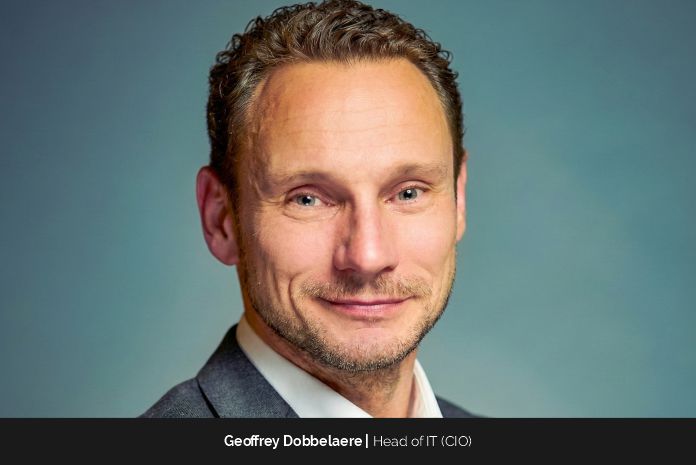
Production lines, logistics networks, and decision rooms now operate on the same fuel: information. In manufacturing and food production, technology shapes how organizations plan, produce, distribute, and respond to constant pressure around cost, sustainability, compliance, and speed. Data is everywhere, yet shared understanding remains elusive. The real challenge is not system availability, but turning information into clarity and coordinated action. Navigating this reality is Geoffrey Dobbelaere, a data innovation specialist known for his no-nonsense mindset and practical focus on using data to support better decisions across the business.
Geoffrey’s way of working begins with listening. He takes the time to understand what stakeholders are truly asking for, and just as importantly, why they are asking for it. Requirements are not accepted at face value. They are examined, challenged, and refined to ensure that the final solution serves the broader organization rather than reinforcing silos or short-term thinking. This approach creates trust, reduces friction, and leads to solutions that hold up over time.
With deep expertise in Data Intelligence, Analytics, Strategy and Information Technology, Geoffrey is known for building roadmaps that are grounded in reality and aimed squarely at value creation. Each initiative is designed with purpose, balancing ambition with feasibility and strategy with execution. The result is technology leadership that feels practical, focused, and human, centered on helping organizations move forward with clarity instead of complexity.
Path into Technology Leadership
Geoffrey did not arrive at technology leadership through fascination with tools, platforms, or trends. His journey began with something quieter and far more consequential: pattern recognition. Early in his career, he noticed a recurring flaw across organizations of every size and industry. Failures were rarely rooted in a lack of technology. They stemmed from fragmented context.
Systems were installed, processes documented, and consultants brought in, yet decision-making remained slow, inconsistent, and reactive. People operated from different versions of reality. The issue was not software capability but the absence of a shared architectural and informational backbone that allowed the organization to think as one.
Each role Geoffrey took pulled him deeper into the intersection where architecture, data, and operating models meet. His experience spanned consulting, enterprise IT, and large-scale transformation programs, where he encountered the same dysfunctions again and again. Logic duplicated across systems. Reporting trapped in silos. Governance structures that looked impressive on paper but failed under real operational pressure. A growing dependence on external vendors to provide thinking rather than support.
These experiences shaped a clear conviction. Technology leadership is not about managing systems. It is about designing environments where meaning survives scale. Without that, complexity grows faster than understanding.
As his responsibilities expanded, so did the scope of the challenges he addressed. Enterprise foundations had to be reconsidered end to end. ERP, production systems, data platforms, integration layers, governance models, and operating structures all needed to be aligned around shared meaning rather than technical ownership. This work went far beyond incremental digitalisation. It required questioning long-held assumptions about where truth resides and how decisions should be supported.
Energy Over Hours
Geoffrey does not describe his approach as time management. He speaks instead about energy. Large-scale digital transformation, in his view, is neither a sprint nor a calendar exercise. It is a sustained cognitive effort that unfolds over years, not quarters.
When mental clarity erodes, hours become irrelevant. This belief is reinforced by his commitment to endurance sports, particularly triathlon and Ironman training. These disciplines impose structure, humility, and honesty. Fatigue cannot be negotiated away. Either the system is respected, or it breaks down.
That same discipline carries into his professional life. Noise is eliminated deliberately. Signals are identified with precision. Priorities are set without sentimentality. Execution follows clarity, not motivation. This mindset creates sustainability in environments defined by ambiguity, resistance, and constant complexity.
Without such discipline, leaders burn out or retreat into short-term compromises. Those compromises may feel expedient in the moment, but they quietly damage the long-term architecture of the organization. Geoffrey’s approach is built to endure multi-year transformation cycles without losing coherence or intent.
Redefining Visionary Technology Leadership
In today’s rapidly shifting business landscape, Geoffrey believes visionary technology leadership begins with a refusal to copy the past. Legacy systems matter, but legacy mindsets matter far more. Many organizations fail not because they modernize too slowly, but because they modernize outdated assumptions. Too often, digital programs automate yesterday’s thinking instead of questioning it. Geoffrey sees the modern technology leader’s role as dismantling those invisible anchors. The task is not to replace systems, but to reframe how the organization understands itself.
A visionary approach builds context-driven architectures where technology functions as an intelligence layer for the enterprise. It is not a cost center, and it is not a service desk. It is the foundation that allows decisions to be made faster, with greater consistency and less friction. This requires a shift away from tool obsession and toward meaning. Semantic consistency. Clear data ownership. Reduced decision latency. Systems designed to adapt rather than harden over time.
Vision, in Geoffrey’s view, is not about predicting what comes next. It is about building systems that remain valid when the future arrives.
Confronting the Hardest Layer of Transformation
One of the most complex challenges Geoffrey has faced in leading transformation was not technical in nature. It was cognitive. Across the organization, every domain operated with conviction. ERP teams believed their system represented the truth. MES, WMS,PLM and other 3 letter application abbreviations, functions held the same belief within their own boundaries. Each system carried authority, history, and ownership. Integration efforts became prolonged negotiations between competing interpretations of reality rather than meaningful progress toward alignment.
The complexity did not lie in connecting systems. It lay in breaking the dependency on silo-based thinking. As long as truth was system-owned, integration remained fragile and political.
The turning point came when Geoffrey reframed the conversation entirely. Systems no longer defined truth. Data did. Everything was reorganized around governed data products, with clearly defined ownership, semantics, and accountability. Context became the shared denominator rather than an afterthought.
Once that shift occurred, the noise fell away. Integration stopped being a technical struggle and became a natural architectural outcome. The hardest work was not deploying software or platforms. It was changing how people thought about ownership, responsibility, and truth. That cognitive shift proved far more difficult than any implementation, and far more powerful in terms of scale.
Protecting the Long View While Enabling Growth
Geoffrey describes his role in simple terms: define the architecture, protect the long-term trajectory, and prevent short-term decisions from weakening the foundation. Technology leadership, in his view, is not about reacting to every request or trend. It is about stewardship. Each compromise made for speed or convenience has architectural consequences, and someone must be accountable for preserving coherence over time.
Alignment between IT strategy and business growth does not come from adding layers of translation between business and technology teams. It comes from removing them. Geoffrey has focused relentlessly on establishing one operating model, one semantic layer, contextual versions of the truth.
When those elements exist, strategy execution accelerates on its own. Decision-making friction disappears because conversations are grounded in shared understanding rather than interpretation. Growth does not emerge from more dashboards or reports. It emerges from less ambiguity.
A Defining Shift
Among the many milestones in Geoffrey’s career, one stands apart as a turning point. The transition from fragmented ERP landscapes and Excel-driven governance to a unified operating model built on data products fundamentally altered the organization.
This shift did more than streamline operations. It changed how people reasoned, decided, and collaborated. Once teams experienced what it meant to work from shared context, the old ways lost their appeal. There was no desire to return to fragmented interpretations or manual reconciliation.
For Geoffrey, that moment confirmed something he had long believed. When context becomes shared, alignment stops being enforced. It becomes natural.
Designing Teams for Real Agility
Innovation, in Geoffrey’s world, does not emerge from brainstorming sessions or motivational slogans. It is designed into the structure of work itself. Within his teams, artificial hierarchies are deliberately stripped away. Ownership is centered on data products rather than task lists. People are encouraged to understand not only what they are building, but how it affects upstream and downstream decisions across the enterprise.
This approach creates a different kind of energy. When individuals see the full impact of their work, creativity follows naturally. Agility, Geoffrey argues, is not emotional or motivational. It is structural. When context is shared and accountability is clear, speed is no longer forced. It appears on its own.
The Values that Anchor Leadership in Times of Disruption
Digital disruption introduces pressure to move fast, announce progress, and deliver visible change. Geoffrey resists that pressure by anchoring his decisions in a small set of non-negotiable values. Clarity comes first. Architectural integrity follows closely behind. Long-term thinking outweighs short-term optics. He is particularly wary of shortcuts that create technical debt while masquerading as progress.
In his view, true transformation may take longer to see, but it compounds rather than collapses over time.
Letting Go of ERP as the Center
There was a clear breakthrough moment that reshaped Geoffrey’s entire approach to technology strategy. It came when the organization abandoned the assumption that ERP defines the enterprise. Once data collaboration was placed at the center and systems were reframed as operational interfaces rather than sources of truth, dependencies began to collapse. Complexity dropped. Acceleration followed. That single reframing changed the trajectory of the transformation. Strategy stopped orbiting systems and began orbiting meaning.
Making Alignment the Default
Cross-functional collaboration, Geoffrey believes, should not require programs, workshops, or constant facilitation. It should emerge by design. Business, IT, and data teams operate on the same operating model, the same context, and the same semantic definitions. Middle layers that translate, reinterpret, or dilute meaning are removed.
When everyone speaks the same language, collaboration stops being an initiative. It becomes the default state of work.
Advice to the Next Generation
When asked what guidance he would offer aspiring CIOs, Geoffrey does not speak about certifications, platforms, or career tactics. His advice cuts deeper and challenges the very posture many technology leaders adopt. He urges future CIOs to stop acting as system custodians. Managing platforms, overseeing upgrades, and administering complexity may keep the lights on, but they rarely lead to meaningful change. Real leadership begins with making the complex simple again, not administration.
Geoffrey believes complexity should be removed, not managed. Approval flows should give way to context flows. Vendors must be challenged relentlessly, not deferred to.
At its core, he sees technology leadership as an act of coherence. Control creates bottlenecks. Coherence creates momentum.
Shaping What Comes Next
Geoffrey sees enterprise technology moving toward a fundamentally different future. Organizations are entering an era of agentic systems, where context feeds autonomous decision-making rather than being filtered through rigid hierarchies and committee structures.
The next generation of leaders will not operate legacy command chains. They will operate context networks. Authority will come from clarity rather than position, and governance will be embedded structurally rather than enforced manually. His work accelerates that shift by replacing point-to-point integrations with data collaboration models, report factories with semantic APIs, and manual governance with accountability built directly into the architecture. This is not incremental progress. It represents a change in how organizations think about themselves.
When Geoffrey reflects on the legacy he hopes to leave behind, he does not describe a system, a platform, or a transformation program. He describes an organization that no longer needs traditional technology leadership roles.
In his vision, the future belongs to a Chief Context Officer, a role that blends the responsibilities of CIO, CTO, and CDO into a single mandate. An enterprise where context-rich systems and autonomous agents make rigid hierarchies unnecessary. A foundation that continues to evolve, learn, and adapt without manual steering.
For Geoffrey, that is the only legacy that matters. Not control. Not scale. But an organization capable of thinking clearly, long after its architects have stepped aside.