
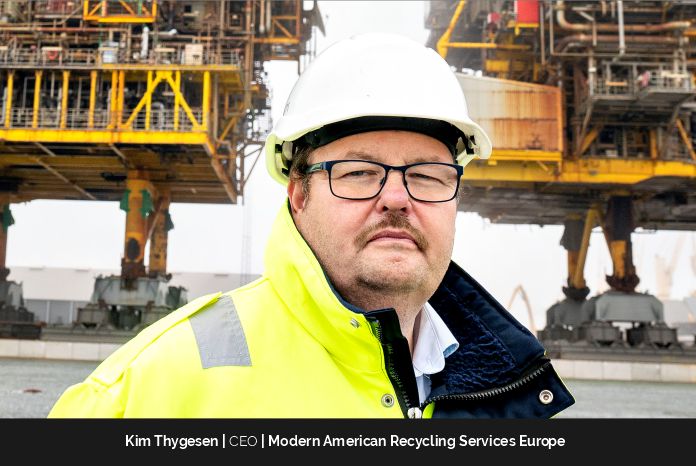
Kim Thygesen, CEO of Modern American Recycling Services Europe (M.A.R.S.), describes himself as a passionate, hard-working, face-to-face leader. Inspired by the changes within the recycling and maritime dismantling industry over the last decade, with its focus on safety, environmental awareness, and raw materials, he finds it very inspiring to be a part of this transformation, setting standards, and building up capacity around the globe.
Driving Global Expansion Through Sustainable Innovation
Kim takes pride in the fact that the founders and owners of M.A.R.S. entrusted him and his team with the task of establishing the first EU-approved green recycling facility. “This is a groundbreaking milestone, as it is the first yard in the world specifically designed to recycle heavily contaminated vessels and oil-producing platforms. Additionally, it marks the company’s first yard outside of the USA, expanding its footprint internationally,” he shares.
Another one of Kim’s significant achievements has been guiding the company from a primary focus on straightforward decommissioning and recycling towards a more specialized approach – recycling high-end, complex, and heavily contaminated assets. With significant guidance and support from the parent company, he successfully steered this transformation, positioning M.A.R.S. as a leader in recycling complex assets in a sustainable and environmentally responsible manner.
Building Empowered Teams Aligned with Purpose
For Kim, his greatest sense of fulfillment comes from seeing people grow and develop when given the opportunity. He likes to give young, newly educated team members a chance to develop and grow by entrusting them with responsibility early on. “I believe this approach not only builds their skills but also fosters a sense of ownership and engagement. Overall, my goal is to create an environment where team members feel supported, motivated, and empowered to contribute their best,” he explains.
Kim sees empowerment in leadership as giving employees the space and responsibility to take ownership of their work. “I give a lot of room for employees to assume responsibility, trusting them to make decisions and manage their tasks effectively. I often take the time to converse with them to ensure they feel confident and comfortable with the challenges they face, which helps motivate them to succeed,” he shares.
Kim credits his first big oil and gas project for teaching him, the hard way, how to build an organization and stay on top of project management, as he lacked the organization to support a project of that magnitude. He ensures that his team remains aligned with the company’s long-term mission, especially across international operations, by doing his best to give people a say in the process.
“Our management system is built to follow our strategy and mission; every procedure and work instruction follows that direction. I’m not sure that all employees can say it word-for-word, but they work according to it. We also strive to show people that we’ve taken action based on the feedback we received. I understand that this is appreciated. People feel acknowledged,” he reflects.
Driving Growth Through Environmental Excellence
Kim insists that environmental responsibility is the cornerstone of their business as it’s essential to assure all clients that they are operating with high safety standards and in an environmentally friendly manner. “This is how we can add value to our clients, so environmental responsibility has a direct impact on our growth. Because we have focused on compliance with the highest standards and are dedicated to continuous improvement, and self-critical, clients followed,” he observes.
Kim’s approach to innovation includes constantly looking for better ways to transform waste into resources and make sure the company stays ahead of regulations. “We constantly try to find new ways to handle the challenges in the projects. I try to push the organization to new directions, and my own profile is very much entrepreneur colored, so I challenge the team with new ideas to check, and it often turns up new ways to make things safer and cost-effective,” he explains. “Luckily, many clients are striving today to make an effort to contribute to the impact of climate change, and are urging us and competitors to continuously improve our standards on climate change and safety.”
Finding Balance Through Family and Routine
Kim’s personal life revolves around his wife and family of three children and seven grandchildren, which keeps him grounded. As the proud husband of Gitte, his wife of over 30 years, he sees her as the centre of his family and a rock in his life. “Gitte makes sure my priorities in life are well-balanced and that everyone in my family gets the attention they deserve. When I’m not working, I usually follow the schedule Gitte sets for me,” he says.
Kim’s morning routine is spent at the yard, talking to people, and having daily meetings with very skilled employees who update him on market analyses and the upcoming projects they need to move on. His weekends are mostly taken up with handball matches, football games, and family activities. In his time off, besides following his family to matches, he works on the houses, helps his children renovate their houses, and prepares barbecue evenings for friends and family.
Guiding the Next Generation of Sustainable Leaders
To emerging leaders in the decommissioning and ship recycling industry, who aspire to drive change in industrial sustainability or maritime services, Kim offers the following words of advice: Recruit a diverse team – not just because it’s fashionable, but because varied backgrounds and perspectives drive better solutions for complex, real-world problems. Start by identifying the specific skills and competencies the team requires, then hire them to fill those gaps.
Set clear ground rules for cooperation and communication from day one so everyone understands expectations, decision paths, and how to escalate issues. Foster a culture that values a variety of ideas and constructive challenge; encourage healthy debate while keeping discussions focused on outcomes.
Finally, lead by example: be curious, decisive, and accountable. Invest in continuous learning, measure progress against sustainability and safety metrics, and celebrate small wins. Change in this sector is incremental and systemic – a diverse, skilled, disciplined, and driven team will be your most effective engine.
Conclusion
As a passionate and visionary leader in the maritime and recycling sector, Kim Thygesen’s leadership has set a lasting standard for how maritime vessels and oil rigs are recycled – by prioritizing safety, environmental responsibility, and practical circular-economy solutions. His wish is for the practices they establish to become the benchmark for the industry, and to demonstrate that commercial success can go hand-in-hand with sustainable, ethical operations.
Equally important, Kim aims to develop and mentor skilled leaders who share this vision and can carry it forward. By building a diverse, competent team and embedding clear standards and behaviours, he expects future generations to continue improving processes, scaling sustainable practices, and raising the bar for the entire maritime and recycling sectors.