
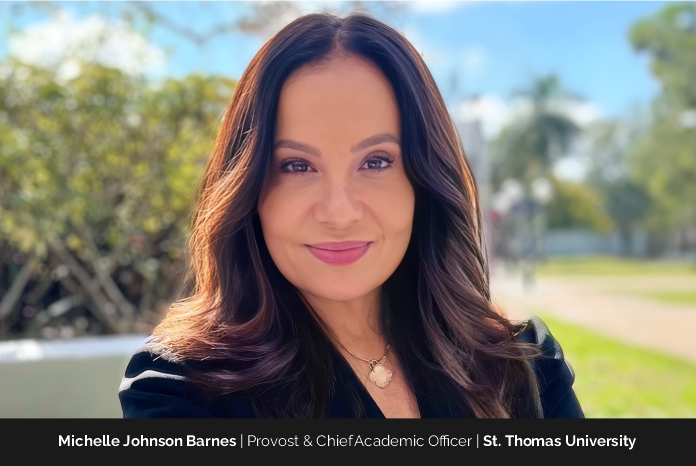
Michelle Johnson Barnes has spent more than 25 years in service to students, who remain the primary reason she enthusiastically shows up to work every day. As Provost and Chief Academic Officer at St. Thomas University (STU), her alma mater, she draws on years of experience in both business and higher education to lead with sharp strategic acumen and a commitment to student success.
At a time when universities face rapid technological change and evolving workforce demands, Michelle believes higher education must do more than transmit knowledge or prepare graduates for careers. It must develop critical thinkers who lead with empathy and act with moral clarity. By bringing business fundamentals into the academic mission, Michelle is helping to shape the university in a way that transforms lives for the better, positioning students to serve as ethical leaders in their professions and to make significant contributions within their communities.
An Unexpected Journey into Academia
Michelle’s path into academia was, in many ways, providential and entirely unplanned.
In her early twenties, she was well on her way to a fulfilling career in fashion and international business. Then marriage and motherhood happened. “I made the deliberate choice to step back, essentially pausing my professional career for five years,” she says.
The door to academia opened with an invitation to teach economics and mathematics as an adjunct professor. The classroom captivated her from the moment she walked in to give her first lecture. A full-time professorship followed, and she rose to become Dean of Academic Affairs and Chief Academic Officer of the campus.
Instead of shelving her business perspective, Michelle tapped into it to augment her academic leadership. “I discovered that my business background was not a liability in academia,” she says, “but a genuine asset. The intersection of those two worlds became the nexus of my leadership identity.”
Michelle’s leadership skills were tested at every turn. She recalls having to learn how to build culture and consensus while forming and shaping diverse teams. She had to articulate a clear vision and plot a path forward while making room for participation and collaboration. And she had to do it all while adhering to the business plan.
Bringing Business Experience to Higher Education
Building her career on a foundation of early business experience, Michelle developed an ability to view the academic landscape through a lens that is rare in higher education leadership. Her ability to hold the academic mission and the business model in the same line of sight simultaneously has served her well.
“I’ve always understood the financials, the ROI, the growth strategy, and the bottom line,” Michelle says. But she learned early on that sustainable institutional health requires more than fiscal discipline. It demands a relentless focus on student retention, genuine quality in the learning experience, industry-aligned career pathways, and holistic student preparation.
STU’s strategic vision is to be the leading Catholic university in the South. The university intends to develop global leaders through academic innovation, powerful student experiences, and strategic partnerships. “It is not just aligned with my background,” Michelle says. “It articulates exactly what I’ve spent my career building toward. I came home to help realize it.”
Keeping Academic Programs Relevant and Impactful
In academic programming, relevance is about building adaptive capacity, not chasing trends, Michelle notes. STU treats curriculum review as a continuous process rather than a once-per-decade exercise. It embeds industry advisory councils into program governance and conducts regular environmental scans of labor market signals. Most importantly, the university listens to its industry partners, students, and alumni.
“One of the most impactful changes we have made is accelerating the integration of experiential learning — community-engaged projects, simulation labs, and cross-disciplinary capstones that mirror the complexity of real-world problems,” Michelle says. The university has made experiential learning a graduation requirement for all undergraduate students, with full compliance across the institution.
And STU is intentional about technology integration. It has woven AI literacy, data fluency, and digital ethics into the fabric of programs across disciplines. “We understand and embrace the importance of the digital platform,” Michelle says, “but we are also committed to using it judiciously and credibly.”
Academic Excellence and Accessibility and Inclusion
When asked how she balances academic excellence with accessibility and inclusion, Michelle challenges the premise. “I firmly believe that the two are not mutually exclusive,” she says. “We must operate from the conviction that excellence is not possible without inclusion.”
She points out that an institution of higher education that fails to draw from the full breadth of human talent is, by definition, operating below its potential. Accessibility requires investment in academic support infrastructure, financial aid design, and faculty development around culturally responsive pedagogy. It also means removing the non-academic barriers that derail capable students.
When first-generation students, working adults, and students from underserved communities arrive at STU, they often bring extraordinary resilience and untapped potential. But, as Michelle says, they face structural headwinds that have nothing to do with their academic capability.
To help them overcome that, she follows a two-pronged approach: hold the academic bar high while expanding the scaffolding around it. This scaffolding takes the form of intrusive advising, co-requisite support models, peer mentoring, and flexible course delivery. Michelle says that these are the mechanisms by which a university honors the full potential of every student who chooses higher education.
Students at the Center of Decision-Making
Without students, a university cannot exist, let alone thrive. Michelle says the institution’s leaders remain student-centric in their decision-making, striving to provide a well-rounded, holistic education for every student regardless of need or stature.
She points out that, structurally, student voices should be embedded in governance architecture. Institutions also should conduct systematic data collection on the student experience, going beyond satisfaction surveys to longitudinal tracking of academic progression, engagement patterns, and post-graduation outcomes.
“But structure alone is not sufficient,” Michelle says. The cultural commitment requires that every administrator and faculty member treat student impact as the ultimate test of any policy decision.
“When we evaluate a new program, the first question is typically ‘Is this financially viable?’ followed by ‘Does this serve our students’ needs and advance their success to gainful employment?’” Michelle says. “Financial sustainability matters enormously, and it should be in service of the mission, not a replacement for it.”
Preparing Students for Success
Michelle and her team have adopted multiple strategies to prepare students for success in an increasingly global and digital world.
First, authentic cross-cultural exposure through genuine engagement is important. Michelle says that students need to develop the cultural intelligence to work effectively across boundaries, whether through global immersion programs, structured interactions with the university’s diverse student body, or international partnerships that bring global perspectives into the classroom. That is a learnable skill, she adds, one that institutions of higher learning have a responsibility to teach intentionally.
Second, focus should remain on iterative problem-solving experiences. The ability to tolerate ambiguity, prototype solutions, receive feedback, and adapt is foundational in a rapidly changing environment. Michelle says her teams have embedded design-thinking methodologies and project-based learning across programs to build this muscle. “This is a core requirement in curriculum development at all levels and across all programs at STU,” she adds. “It also has become a litmus test for me when making final approval decisions on new programs.”
Third, and the most underappreciated strategy, is ethical reasoning under complexity. Digital transformation has outpaced society’s collective moral frameworks. Students who can ask the right questions about the implications of a technology decision, a data practice, or a business model are scarce and valuable. At STU, the Catholic Intellectual Tradition offers a powerful platform for that kind of formation. Michelle believes the university’s continued success comes from leaning into that tradition rather than treating it as peripheral.
Faculty as the ‘Intellectual Engine’
Michelle calls faculty an institution’s “intellectual engine.” As such, she considers investment in their development foundational to everything the university is trying to accomplish. At STU, faculty development has been restructured around three pillars.
The first pillar is pedagogical innovation. Faculty are encouraged to integrate evidence-based teaching practices, emerging technologies, and active learning methodologies in ways that serve student learning rather than to adopt change for its own sake. Michelle points out that the Center for Teaching and Learning is a faculty-led resource, not a compliance function.
The second pillar is scholarly community. Michelle has seen faculty thrive when they are embedded in vibrant intellectual networks, within STU and across their disciplines. The university supports interdisciplinary research collaborations and seed funding for emerging research agendas. Structured opportunities for faculty from different schools to work together on shared problems are prioritized. These efforts are backed from the top down through competitive Presidential Scholarship Awards, which are pursued and awarded each year.
The third pillar is recognition and voice. Faculty who feels valued and heard, Michelle says, are faculty who innovate. That means meaningful transparency on institutional direction and public acknowledgment of faculty contributions beyond classroom instruction. Each year, the university celebrates faculty achievements through awards for excellence in teaching, research, community involvement, and service.
Higher Education’s Core Mission in a Changing World
For Michelle, the core mission of higher education has never been more vital or more complex. At its heart, a university should intentionally cultivate the whole person: intellectually, ethically, and socially. However, she notes that in a world reshaped by AI, constant disruption, and deepening imbalance, that mission demands more than transmitting knowledge.
“We must develop critical thinkers who can navigate uncertainty, lead with empathy, and act with moral clarity,” Michelle says.
What gives her confidence is that the most enduring questions, “Who am I? and How do I lead?” remain doggedly resistant to automation. According to her, the job of higher education is to create the space in which students wrestle with those questions seriously, supported by faculty who model intellectual courage and institutional structures that reward genuine inquiry.
This calls for a pedagogy that teaches students how to think, rather than force-feeding them narratives that tell them what to think. “It is in the ability to think critically that we can embrace more holistically the emerging technologies like AI, as that becomes merely a tool that guides our greater thinking,” Michelle says.
Source of Motivation
Michelle is moved by the moment a student discovers their mind works in a way they never knew, when an idea clicks, when they find their intellectual voice, when they realize the questions they have carried their whole lives are, in fact, serious scholarly questions worth pursuing. “That moment of recognition is transformative,” she says.
“I’m also motivated by the gravity of this moment in history,” she adds. The challenges facing society today, she points out, require exactly the kind of leaders that universities produce. What happens inside these institutions shapes what happens in the world. She finds this connection both sobering and electrifying.
On the hardest days, Michelle reminds herself that service is not a burden but a privilege. “My greatest successes have come when I remain humble and open to something other than what I know,” she says. “That is what ultimately motivates and inspires me.”
Role of Universities in the Future
Michelle believes that the university of the next decade will need to be more pliable, more personalized, and more accountable for outcomes, without sacrificing the depth of inquiry that distinguishes genuine education from training.
She also expects continued pressure on the traditional four-year residential model as the primary pathway. “The universities that thrive will be those that serve learners across their lifespan, offering stackable credentials, robust continuing education, and re-skilling programs alongside traditional degree pathways,” she says. The question is not whether this shift will happen, but whether institutions will lead it thoughtfully or scramble to catch up.
STU is preparing for that future. Michelle says the university is designing flexible program architectures, building its digital delivery infrastructure with intention, and deepening the community and employer partnerships that keep its curriculum grounded in real-world relevance.
The institution’s leaders also are having honest internal conversations about which aspects of the residential, in-person experience are irreplaceable, and how to protect them while expanding access.
They are strengthening the university’s identity as well. Michelle believes that institutions standing for something clear and compelling — whether a distinctive mission, a defined community, or a recognizable approach to formation — will be far better positioned than those trying to be everything to everyone.
The Legacy
When her time at St. Thomas University concludes, Michelle will care most that she made a lasting difference and left her beloved alma mater better than she found it. Much of that legacy already is cemented in the academic culture she has helped shape, a culture where every person feels their full potential is taken seriously and, hopefully, realized.
Before her tenure ends, Michelle wants to ensure that pathways to academic success are accessible to students from every background. She also wants faculty from underrepresented communities to see themselves reflected in leadership, with excellence understood to be something achieved together rather than at the expense of some.
“I also hope to leave STU with a stronger sense of its own identity and confidence in its mission,” Michelle says.
Catholic higher education, in her view, has something distinctive to offer the world. It upholds the dignity of every person and treats education as an act of service. It also holds the conviction that intellectual life and moral life are inseparable. “If my tenure deepens that conviction across the institution, I will consider that a meaningful legacy,” she says.