
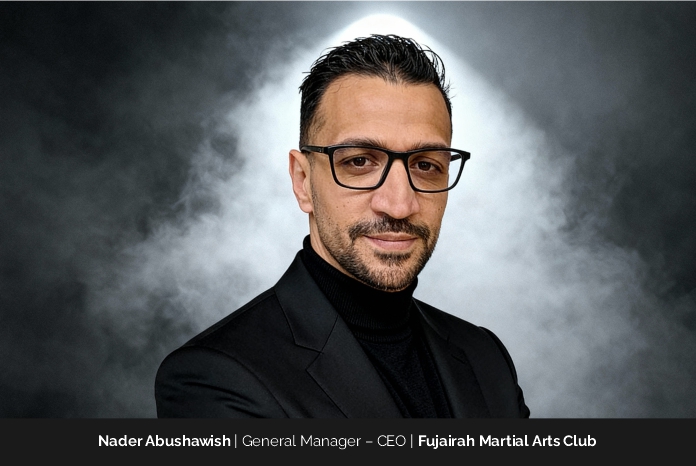
Fujairah Martial Arts Club (FMAC) is a leading sports institution in the Middle East, known for being socially responsible and committed to empowering future generations. At its helm is Nader Abushawish, a dynamic and visionary General Manager and CEO. He is steering the club toward becoming a world-class model that unites traditional values, advanced technology, and community to achieve better sporting results.
Nader is driven by the desire for every child who walks into FMAC to believe that greatness can begin in Fujairah. He sees the impact of his leadership in the smiles of children, the pride of families, and the positive culture they build together through sport.
The Path Leading to Fujairah Martial Arts Club
Nader’s interest in Taekwondo opened the door for greater career opportunities. It paved the way for his entry into the wider world of martial arts and the Fujairah Martial Arts Club (FMAC).
“I started as a Taekwondo coach,” he says. “I gave my full energy, time, and passion to build a strong and united team.” One of the earliest milestones in his career that he fondly recalls is his contribution to the Fujairah Open. His efforts have played a crucial role in its success story. Today, the Fujairah Open is one of the biggest Taekwondo events in the world, recognized by Guinness World Records and honored with a SPIA Award.
When Nader reached a certain point in his career, he realized that in the field of sports, his passion is not limited to training. He became drawn to the idea of building systems and environments that help others succeed.
“With the constant support I received from H.H. Sheikh Mohammed bin Hamad Al Sharqi,” Nader points out, “my career continued to grow steadily until I reached the position of CEO of FMAC. This role means a great deal to me.”
According to him, his vision was clear from the beginning: to create a world-class institution that combines traditional martial arts values with modern management and technology. “That vision still guides me today as I lead an incredible team toward excellence and global recognition,” Nader says.
Series of Transformative Initiatives
Nader cannot pinpoint one specific initiative that transformed FMAC. According to him, many projects have helped transform the club into a smarter, more connected, and future-ready environment. One of these is the FMAC Digital Transformation Project. He explains that it delivered an app with artificial intelligence (AI) capabilities to monitor player performance, simplify approvals, and serve as a conduit between coaches, management, and parents in their ecosystem.
Nader and his team also implemented a unified Smart Workflow and Task Management System. It brought operational alignment across departments and made sure that every employ understood their duties and timeline. “This system created unity, accountability, and communication to allow FMAC to function as one single productive group,” Nader points out.
Strategy Management System is another “tremendous leap forward” for FMAC. This system follows the club’s KPI’s and strategic goals on a real-time basis. It gives Nader and his team the ability to track progress, measure performance, and publicly demonstrate how they are a club that is run on data and outputs. “It is a real-life testament of a business model underpinned by excellence and innovation,” Nader says.
“FMAC has become something more than just a sports club,” he adds. “It has become a future-proof institution.”
A Major Defining Moment
For Nader, the most defining moment of his career was when he worked on and managed the World Taekwondo Cadet Championships in Fujairah, under the leadership and guidance of Dr. Ahmed Hamdan Al Zeyoudi, who has always been the driving force and leader behind all their major events.
It was a massive project that brought together thousands of participants, including young athletes, coaches, officials, and families from all around the world. Nader points out that the “scale was huge, the pressure was real, and the challenges were constant.” What made the difference was that FMAC’s employees worked with passion, precision, and pride. They proved that when they unite behind one vision, they can deliver events that leave a mark in history. “That championship showed that with teamwork, trust, and the right leadership, nothing is impossible,” Nader says.
“I’m proud that we didn’t just organize an event, but we also built a legacy that raised the standards for what Fujairah and FMAC can achieve,” he adds. “That experience taught me that true leadership means standing with your team, learning from your mentors, and turning pressure into progress.”
Achievements: Combination of Personal and Collective Success
The moments Nader looks back on with great pride are those that combine both personal and collective success. For him, on a personal level, one of the most emotional high points was when, in 2024, Faris Al Blooshi won the Asian gold medal in fencing. “It wasn’t just his victory,” Nader points out. “It was a moment that reflected years of effort, belief, and the spirit of FMAC.”
He felt that same surge of emotion when Alhiam Al Blooshi and Ahmed Khaled won the Mohammed Bin Rashid Award for Sports Excellence. Nader believes this recognition honors not only the hard work of these two athletes but also highlights the culture of continuous development that FMAC fosters in every athlete. At the club level, Nader is proud of several major milestones. These include two Guinness World Records, the Fatima Bint Mubarak Award, and the Best Arab Club Award. He values the recognition at the SPIA Awards as well, which he says “truly elevated” FMAC to a new international level. For him, each of these achievements represents the hard work, dedication, and unity of their entire team.
“Every time I look back at these moments, I feel proud — not just for the titles, but for the journey and the people who made them possible,” Nader says. “Together, we’ve built something that represents Fujairah and the UAE with honor on the world stage.”
Living Culture at FMAC
Nader and his team have built a clear Excellence and Quality Framework based on EFQM and Total Quality Management (TQM) principles. He points out that every department’s goals and KPIs are aligned with their strategic plan, which ensures that everyone moves in the same direction.
However, Nader recognizes that real strength lies in people and relationships. So, they work closely with every department, coach, and staff member to ensure smooth communication and make everyone feel valued and part of one team. Nader also maintains a strong connection with players and their families. “They are a vital part of our success,” he points out.
“This close relationship between management, athletes, and families ensures that our values, discipline, respect, and teamwork are a living culture within FMAC, not just written statements,” Nader says.
The Leadership Style: People-Centric Leader
Empowerment, accountability, and innovation are the pillars on which Nader has built his leadership philosophy. And he believes in leading by example. Instead of sitting in his C-suite executive chair and dictating what to do and not to do, he can be found on the ground with his team. He listens, guides, and challenges them to grow.
“I’m truly lucky to have the team I have today,” Nader points out. “They embody the love and pride of FMAC.” What makes him most proud is that some of them were once his students, and now, they have returned to serve in key positions and are giving back to the club with passion and heart.
Nader is successful because he is open to change and receptive to new ideas. His leadership approach has also evolved over the years. He has moved from being a performance-driven leader to a people-centered leader. “I’ve learned that the greatest investment any leader can make is in human potential,” Nader says. “Building people, not just systems, is what creates lasting success and a culture that carries the vision forward.”
Diary of a General Manager-CEO
Like most successful leaders, Nader’s days are never the same. He tends to rise early, and his mornings are usually dedicated to reflection, planning, and prioritization. Nader does not follow a fixed schedule. On some days, he talks with heads of departments, reviews key performance indicators (KPIs), and aligns their projects with the club’s strategic goals. He also spends time on the ground with the athletes, watches practices, and listens to coaches. “It’s a lovely reminder of why we do what we do,” he says.
And, according to him, the evenings are usually spent brainstorming new ideas. “Every day is a combination of leadership, learning, and inspiration,” he says. “And that is what keeps me going.”
As a leader, Nader approaches all challenges as if they were sparring matches. Whatever the situation, he remains calm, respects the opponent, and reacts fast. “These are the things that keep me grounded under pressure and help me think clearly,” he says.
Consistency, respect, and persistence are the three key lessons Nader learned as a taekwondo player on the mat. He continues to apply these lessons in his current position and believes that leadership is about balance more than control.
“Martial arts is the medium that keeps me grounded, centered, and always able to respond with clarity and assuredness,” he says.
Motivator: Together, Building Something Sustainable
Nader derives his motivation from seeing the growth and progress of players. He feels motivated to do better when a young player earns their first medal, when a coach develops a new training method, or when an employee grows into a leadership role. “These moments remind me that every effort we make contributes to a bigger vision,” he says.
He is also inspired by the trust and support of H.H. Sheikh Mohammed bin Hamad Al Sharqi. According to him, his vision for Fujairah motivates them to aim higher every day, and his belief in the club pushes them to set new standards of excellence and professionalism.
And the spirit of the FMAC family, the teamwork, the energy, and the shared pride gives Nader the strength to keep going. “My motivation comes from knowing that together, we’re building something that will last far beyond us,” he says.
Future of Martial Arts in the UAE
Nader foresees an “incredibly promising” future for martial arts in the UAE. He notes that the country has already become a regional hub for combat sports and expects the next phase to be driven by digital transformation, innovation, and education. “At FMAC, we’re fully aligned with this direction,” he says.
He and his team are tapping into AI systems, smart data analysis, and continuous talent development to create a new model for how sports clubs operate, one that combines technology, science, and tradition. Additionally, recent partnerships, such as the agreement with the Ministry of Education, are enabling Nader and his team to expand martial arts programs in schools and build a stronger foundation for the next generation.
“With the vision and support of H.H. Sheikh Mohammed bin Hamad Al Sharqi, the UAE is not just developing athletes,” Nader says, “it is developing leaders, innovators, and global ambassadors of martial arts.” He underscores that the future will belong to those who combine discipline with creativity. “That is exactly what we are building in Fujairah,” Nader says.
Advice to Young Leaders
Nader does not define leadership just in terms of titles or authority. He believes it is about making things better for others. So, his first piece of advice to young professionals is to start with purpose, not position. He encourages them to lead with passion, integrity, and consistency. “When you do that, success will follow naturally,” he says.
“Stay humble and keep learning” is another important piece of advice Nader offers to young leaders. He points out that the world is evolving fast, with rapid changes taking place in technology, sports, and society. “True leaders are those who adapt, listen, and grow with their teams,” he says. AHe tells young professionals to believe in people, invest in them, and celebrate their progress.
“And most importantly, remember that every small effort matters,” Nader says. “You don’t have to change the world overnight. Just focus on changing one life at a time, and you’ll already be leading by example.”
The Legacy!
Nader hopes to leave behind the legacy of a strong system, not just success stories. He wants to be known for developing a sustainable structure that continues to produce champions and leaders long after his time at the club. He wants to see FMAC emerge as a global model of how tradition, innovation, and community can unite under one vision.
“This is the legacy I hope to leave: an institution that inspires, empowers, and represents the values of the UAE on the world stage,” Nader says.