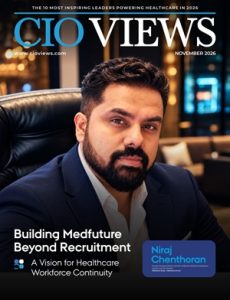

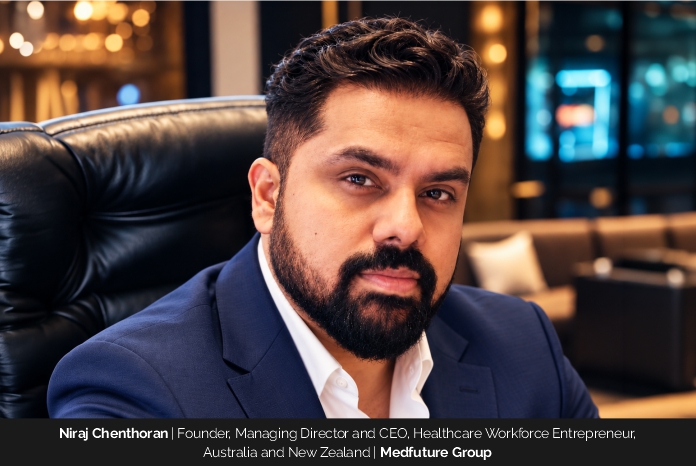
An unfilled corporate position may affect business performance, but an unfilled clinical position can directly affect a community’s access to essential healthcare. Niraj Chenthoran, Founder, Managing Director, and CEO of Medfuture Group, and a healthcare workforce entrepreneur across Australia and New Zealand, caught on to that reality while conducting market research for a Sydney-based healthcare technology startup during his accounting master’s degree. Everyone around him was trying to build typical job boards, yet his market research kept pointing toward a much bigger storm brewing across Australia. The population was aging rapidly, healthcare workers were spread unevenly across remote towns, and standard recruitment firms were just putting temporary bandages on open roles.
On 2 July 2014, Medfuture was incorporated in Sydney to rewrite that approach, bringing a numbers-backed, structured methodology to a vacancy-driven healthcare recruitment market. Reflecting on his purpose, Niraj explains, “My vision was never simply to build another healthcare recruitment company. It was to build a healthcare talent ecosystem that could contribute to the long-term sustainability of healthcare services.”
Driven by this strategy, Medfuture aimed to move doctors where they were needed most, manage complex regulations, support talent across their career journeys, and anticipate long-term workforce trends.
Niraj’s entrepreneurial beginning was strikingly modest. ‘My first business investment was AUD 30 for a prepaid SIM card,’ he recalls. ‘That gave me the means to start contacting medical clinics and earning their trust, one conversation at a time. I believe capital is important for growth, but the drive within you is what first propels a business forward.’ He focused on demonstrating that Medfuture could help clinics recruit their next GP, then reinvested sales revenue to build the business rather than treating early income as a personal reward. ‘The first investment was small; the commitment to making the business work was not,’ he says.
The numbers quickly reinforced his instincts. The Australian Bureau of Statistics projected that the over-65 population would increase from roughly 17 per cent in 2022 to between 25 per cent and 27 per cent by 2071. Meanwhile, the World Health Organisation warned of a global shortage of 11 million health workers by 2030. From day one, Medfuture was built to help healthcare systems prepare for these challenges.
From GP Recruitment to an Integrated Healthcare Workforce Organisation
When Medfuture commenced operations, Niraj focused on general practitioners to help local clinics keep their doors open. Getting doctors into community practices gave the firm a solid footing across Australia and New Zealand. However, listening closely to clinic owners revealed a broader challenge: a medical centre could secure a great doctor and still struggle without physiotherapists, podiatrists, occupational therapists, or speech pathologists. “Real growth opportunities often emerge when you understand your existing clients’ needs beyond the services you currently provide,” Niraj says. Recognising that clinical care requires a complete team, he established a dedicated Allied Health division, expanding the business beyond its core General Practitioner Recruitment service, which remains Medfuture’s major revenue engine. Sustainable growth required anticipating changing workforce needs. Recognising that domestic training alone could not keep pace with urgent demand, Niraj set up a dedicated international team three years ago to source, evaluate, and integrate skilled talent from overseas under strict regulatory guidelines and ethical standards.
Today, Medfuture operates through seven specialised recruitment units, each designed to address the distinct workforce requirements of healthcare employers and professionals:
- Family Medicine Specialist and General Practitioner Recruitment – Metro Operations
- Family Medicine Specialist and General Practitioner Recruitment – Rural Operations
- Family Medicine Specialist and General Practitioner Recruitment – International Recruitment Desk
- Family Medicine Specialist and General Practitioner Recruitment – Temporary Recruitment Desk
- Allied Health Professional Recruitment
- Mental Health Professionals Recruitment
- Oral Health Recruitment
Together, these dedicated units enable Medfuture to respond to diverse clinical workforce needs while maintaining the specialist knowledge and market focus required across each discipline. In Niraj’s words: “What began as a GP recruitment business in Sydney has evolved into a diversified healthcare recruitment organisation serving employers and professionals across Australia and New Zealand,” reflecting the organisation’s progression from a specialist GP recruiter to a multidisciplinary healthcare workforce solutions partner.
Alongside these seven specialised units, Medfuture continues to strengthen its General Practitioner recruitment presence in New Zealand. The organisation is also undertaking market research to inform potential expansion into international recruitment across additional healthcare professions, together with broader allied health recruitment solutions.
For Niraj, this measured approach to growth reflects a consistent principle: expansion should follow a clear understanding of employer demand, professional registration requirements and the long-term workforce needs of each market.
Medfuture has also received external recognition. APAC Insider named it ‘Most Trusted Healthcare Recruitment Agency 2023 – Australia’ in its 2023 Business Awards. In the Australian Achiever Awards’ 2024 results, Medfuture was listed as ‘Highly Recommended’ in the Office Services category for customer service. Both designations are cited as published by their respective award organisers.
That breadth is also a point of differentiation. ‘Many recruitment businesses specialise in a single professional category. I wanted Medfuture to serve healthcare organisations with interconnected workforce needs,’ Niraj explains. A multidisciplinary medical centre may require GPs, nurses, physiotherapists, occupational therapists, podiatrists and other clinicians. Medfuture’s cross-profession model aims to coordinate searches across those needs, potentially reducing the complexity of engaging multiple recruitment providers. Niraj emphasises that the value is coordinated specialist recruitment, not a claim that one agency can guarantee every appointment or always offer the lowest price.
According to Medfuture’s internal business records as of June 2026, the company worked with more than 3,500 GP clinics across Australia and more than 500 in New Zealand. At that date, Medfuture also reported service agreements with over 2,000 allied health employers and their service-delivery branches. These company-reported figures reflect the scale of Medfuture’s commercial relationships, rather than independently audited placement totals or a claim that every organisation has an active vacancy at any given time. For Niraj, they represent years of sustained relationship-building.
Addressing Structural Healthcare Workforce Challenges
Recruiting an appropriately qualified clinician involves far more than identifying a candidate with the required professional credentials. The toughest hurdle facing clinic owners across Australia and New Zealand is a mismatch between raw talent availability, geographical demand, and the way healthcare teams connect with everyday patients.
When a doctor or specialist moves into a new town, clinical knowledge is non-negotiable, but so is getting the local jargon, building trust, and breaking down complex medical advice for everyday families. Health New Zealand’s Health Workforce Plan 2024 identified significant medical workforce shortages under its workforce modelling, proving that simply filling vacant desks is no longer enough to keep healthcare running smoothly.
Meeting applicable registration, credential and professional requirements, including those administered by Ahpra in Australia, is essential. Workplace orientation and communication support are additional considerations. Niraj advocates a dual approach: “I recommend that Australia pursue two complementary workforce strategies.” That means sustained investment in domestic medical education, clinical training and graduate development pathways while simultaneously setting up practical, communication-focused onboarding programs for overseas talent. Helping clinicians get comfortable with local conversational habits, health literacy, and cultural nuances helps them settle in quickly and stay long term.
“I believe solving healthcare workforce shortages isn’t simply about increasing the number of available professionals,” Niraj stresses the wider picture. “It is about building a workforce that is clinically capable, effectively supported, confident in communication, and connected to the communities it serves.”
Different Communities, Different Workforce Realities
A medical centre in downtown Sydney faces different workforce recruitment challenges from those of a clinic out in Outback Queensland.
In major cities, Niraj shares, healthcare professionals may have greater choice between employers, with remuneration, flexibility and workplace culture influencing their decisions. Move out to regional centres and relocation decisions increasingly involve family, housing, education and lifestyle considerations. Farther out in remote townships, the stakes turn severe. Australian Institute of Health and Welfare data from 2024 revealed just 2.7 full-time-equivalent medical practitioners per 1,000 people in very remote zones versus 4.8 in major cities. Niraj highlights that out there, losing one doctor leaves an entire town exposed, making a blend of permanent placements, locum cover, and global talent pipelines an important combination of workforce responses.
What Clinicians Want Today
Competitive remuneration remains important. However, healthcare professionals increasingly look beyond the salary package before signing on, seeking transparency about workplace conditions, responsibilities, and future progression. Family doctors look closely at billing structures, clinical independence, patient demographics, and daily practice support, while allied health professionals look for solid mentoring and sustainable clinical workloads, appropriate professional support and opportunities for career development.
Medical specialists care about modern diagnostic gear and room to develop niche expertise, whereas international recruits want straight answers about visa timelines, local registration, and onboarding. Niraj stresses the importance of fit, “Successful placement comes down to matching a clinician’s professional goals with what the clinic offers, creating an environment where both sides thrive over time.”
From Vacancies to Workforce Continuity
Short-term staffing arrangements can address immediate service requirements, but long-term workforce stability requires a more structured approach. High turnover drains clinic budgets, exhausts remaining staff, and breaks up care for patients managing chronic conditions who rely on seeing familiar faces.
Niraj reframes the metric: “Filling a sudden vacancy eases the immediate panic, but steady workforce continuity keeps that shortage from becoming a recurring workforce challenge.” His ambition is for Medfuture to evaluate recruitment success through workforce stability and predictable staffing arrangements alongside placement outcomes. Combining permanent search with structured locum support gives clinics predictable coverage during peak seasons, keeping small staffing gaps from developing into more substantial operational challenges.
One Partner, Multiple Healthcare Workforce Needs
Amid a sudden staffing shortage, a regional hospital cannot afford to wait half a year for a permanent hire. Medfuture steps in by layering immediate locum coverage through initiatives like Premier Locum GP to keep patient care moving without interruption. While those interim locum arrangements support service continuity, the permanent team runs targeted searches at home, and the international arm brings in vetted overseas talent if suitable domestic candidates are not readily available.
As Founder, Managing Director, and CEO, Niraj outlines the model. He underscores, “I want Medfuture to operate as a trusted partner that health leaders rely on for long-term strategic growth, not just reactive vacancy management.” Managing everything from medical credentials to overseas relocation gives clinics a dependable path forward as workforce requirements evolve.
For such industry contributions, Niraj has earned a place among ‘The 10 Most Inspiring Leaders Powering Business Growth in 2026.’ This is something we are pleased to note.
Responsible International Recruitment and Healthcare Workforce Mobility
When healthcare systems run short of clinicians, international recruitment can help keep essential services running. Niraj points to the scale of its contribution, with international medical graduates representing a substantial proportion of New Zealand’s medical workforce, as documented by the Medical Council of New Zealand. Across the water, Australia’s Medical Board introduced its Expedited Specialist pathway in late 2024 to speed up registration for qualified overseas doctors.
Bringing in talent from abroad helps address critical workforce shortages. Yet Niraj notes it must follow the WHO Global Code of Practice to safeguard source countries while guiding incoming clinicians through local registration, credentials, and community life. He underlines, “International recruitment should never replace training local professionals. It should instead be one part of a balanced national setup that brings together domestic training, staff retention and responsible international talent mobility.”
It Takes More Than Tech
Technology can speed up recruitment. But seasoned leaders like Niraj know that trust still comes from human connection. At Medfuture, recruitment management systems, candidate platforms and credential-tracking processes can reduce administrative burdens and support compliance oversight, while artificial intelligence presents opportunities for future analytical improvements. Meanwhile, workforce data can help teams understand regional shortages, evaluate candidate availability and monitor recruitment performance.
Regardless, placing a clinician requires far more than matching qualifications to a job description. Human understanding remains indispensable to work through clinical experience, communication, team dynamics, location preferences, and long-term career aspirations. “Technology provides efficiency and data provides intelligence, but human relationships provide the trust required for sustainable recruitment partnerships,” Niraj states.
By offloading friction to digital systems, Medfuture enables its consultants to guide the full recruitment journey, from initial sourcing and rigorous screening to interviews, offers, and commencement, with a focus on genuine partnership.
A Step Ahead of the Vacancy
A resignation letter should never be the first trigger for a healthcare organisation to begin workforce planning. Niraj envisions a fundamental shift away from reactive vacancy management toward proactive, forward-looking strategy. Rather than waiting for clinical gaps to emerge, Medfuture aims to work with healthcare leaders to anticipate retirements, planned leave, facility expansion and recurring workforce needs.
By identifying future requirements earlier, Medfuture seeks to develop structured workforce arrangements, spanning permanent placements, dedicated locum frameworks, and international candidate pipelines, well before open roles impact patient care. This gives health systems operational visibility into candidate pools and can reduce the need to begin an entirely new recruitment search whenever coverage is required.
While Medfuture cannot single-handedly fix macro-level industry shortages, it alters how providers secure top-tier professionals. “The future of recruitment partnerships lies in understanding what employers will need tomorrow, rather than waiting for them to tell us what they needed yesterday,” Niraj mentions.
Building Beyond the Boss
Building a business across two countries takes ambition, but keeping it running smoothly requires steady principles that extend beyond one person’s decisions. Niraj guides Medfuture using five distinct pillars: a clear long-range vision, clear organisational accountability, absolute integrity in a highly regulated field, continuous process improvement, and strong people development. He believes clear operational systems let people take ownership without sacrificing quality. When teams feel supported by structured processes, consistent delivery follows naturally across every department.
Niraj is especially emphatic that Medfuture’s progress was never a solo achievement. ‘I began investing in senior people from the company’s second year because growth depends on people who can lead beyond the founder,’ he says. He acknowledges Gayathiri Thiruchenthoran, Director – Corporate Relationship & Compliance (joined 2016); Sree Ranju, Chief Manager – GP Locum & NZ Operation Unit (2017); Shajanth Satchithananthan, ICT Project Manager (2021); Amanda Fernando, Division Manager – GP International Recruitment (early 2022); Sayeda Musawi, Division Manager – GP Recruitment (2022); and Thareni Sri Kumar, Cluster Manager – Talent Sourcing & Recruitment (2022). These leaders, he says, helped translate entrepreneurial drive into specialised teams, operational systems and enduring client relationships.
The real test of leadership, Niraj believes, is whether an organisation can outgrow its founder without losing its mettle. “Leadership is not about how much control one person holds. It is about building an organisation capable of delivering excellence consistently, even as it grows beyond its founder,” he reflects.
Medfuture’s Long-Term Vision
Niraj envisions elevating Medfuture into a comprehensive workforce ecosystem across Australia and New Zealand, underpinned by responsible, ethically governed international mobility. Yet he measures true expansion far beyond commercial metrics, short-term financial performance or placement volumes. His ultimate aim is to forge a trusted institution in healthcare workforce continuity, one that acts as an enduring lifecycle partner for both clinical facilities and healthcare workers.
For a growing medical clinic, that means scaling from an initial GP placement into multi-disciplinary teams, locum coverage, and global talent pipelines. For clinicians, it means providing career scaffolding from early-career moves to specialised international roles. When remote communities maintain reliable access to doctors and local clinics stay operational, Medfuture fulfils the authentic purpose behind its founding.
A Message to the Next Generation
“Over the next decade,” Niraj indicates, “Traditional vacancy advertising alone will become increasingly insufficient. The market will demand predictive planning, global mobility networks, and deep technological integration paired with high-touch advisory services.”
The World Health Organisation projects a global shortfall of eleven million health workers by 2030. Addressing it calls for more than cross-border recruitment. Domestic training, ethical hiring, and proper support for overseas clinicians must go hand in hand. Cultural familiarity and community ties also matter when helping new recruits settle in.
For aspiring healthcare leaders, Niraj offers four practical lessons. First, he suggests that they understand the realities of clinical work. Learn the pressures, regulations, and human costs healthcare providers contend with before proposing solutions.
Second, the veteran wants them to protect their integrity. Short-term commercial gains rarely justify compromising compliance or the trust built over years.
Third, using technology with discernment is important. Predictive tools and data systems can ease administrative burdens. But clinical judgment and accountability must remain human responsibilities.
Finally, Niraj points out that addressing problems that persist across the sector, from regional staff retention to onboarding recruits, is essential. He leaves these aspirants with a parting thought: “Do not build a business merely to participate in an industry. Build an organisation that contributes to making that industry better.”