
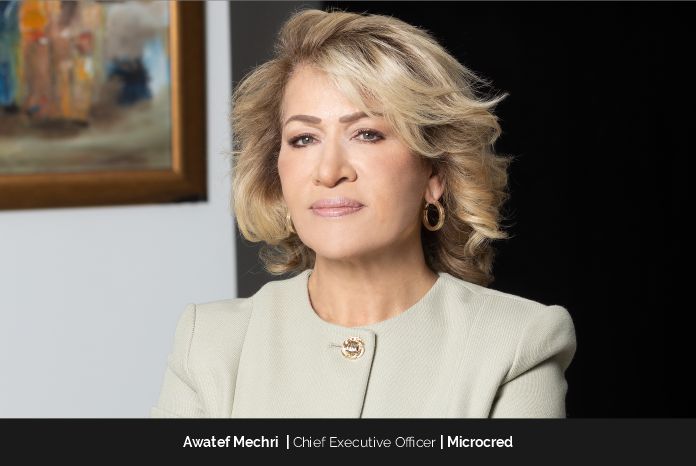
Awatef Mechri, CEO of Microcred Tunisia, is a leader who carries purpose in everything she does. If we had to describe her in one word, it would be grounded. As the saying goes, still waters run deep. She leads with calm strength and a profound sense of humanity.
Holding a degree in Economic and Management Sciences, Awatef has built a distinguished career spanning more than 30 years in the banking sector. She has worked with leading institutions. such as UBCI Bank (formerly part of the BNP Paribas Group) and Bank ABC, both onshore and offshore. Over the years, she has held key roles, including Head of Large Corporate Relationships and Senior Banker, overseeing major Tunisian private groups and public portfolios across local and international subsidiaries.
Her tenure as Head of Wholesale Banking and Country Manager further strengthened her expertise in managing financial institutions’ portfolios. Throughout her career, she has developed proven proficiency in loan syndications, corporate finance, money markets, mergers and acquisitions, and corporate governance, covering strategic sectors such as oil and gas, telecommunications, and commodities.
In January 2022, Awatef joined the HDK Group, where she oversaw the acquisition of Baobab Group’s interests in its Tunisian subsidiary, Baobab Tunisia. Later that year, she was appointed CEO of Microcred SA (formerly Baobab Tunisia). Under her leadership, Microcred became one of the leading players in Tunisia’s microfinance sector and fully controlled by Tunisian capital.
With the persistent support of its new governance, she has steered the organization toward embedding ESG principles at its core, advancing a transformation strategy built on inclusion, responsibility, and sustainability. “At Microcred, we don’t just offer financial services; we deliver dignity, opportunity, and hope,” she says. Her journey reflects what happens when deep financial expertise meets a steadfast commitment to social progress.
A Milestone of Identity and Purpose
When Microcred celebrated its 10th anniversary, it also reached a defining moment in its journey. In September 2022, the Tunisian group El Hadayek acquired the institution. As a result, Microcred became a fully Tunisian-owned company. For Awatef, this milestone was about belonging and reconnecting with the country’s social and economic fabric. She saw it as an opportunity to refocus the company’s strategy on the real needs of Tunisian micro-entrepreneurs.
With this new chapter, Microcred strengthened its focus on inclusive and responsible finance. The team began crafting a broader vision of inclusion. This vision addresses the challenges faced by underserved communities, particularly in rural and peri-urban regions.
The company also turned its attention to sectors that hold social and environmental importance, from green, blue, and orange economies to women-led and youth-driven enterprises. This renewed national identity made the organization more agile. It meant that decision-making became faster and its financial solutions were better tailored to local contexts.
Awatef sees this transformation as more than just growth. It is the very essence of relevance, resilience, and the lasting difference Microcred makes in the lives of those it serves.
Growing with Purpose
Awatef is a maverick leader, creating impact in ways no one else has. Balancing growth and social impact are at the heart of her approach at Microcred. She makes sure that every decision aligns with the company’s ‘ESG’ principles. What is that? It stands for Environmental, Social, and Governance. Microcred designs credit products that support green entrepreneurship, water-saving agriculture, and income-generating projects led by women and youth in rural areas. These efforts go beyond goodwill. They are investments in long-term social and economic resilience.
The institution also measures success beyond financial results. The team tracks jobs created, households protected through microinsurance, and the environmental benefits of renewable energy projects supported by its services. For Awatef and team, real growth does not mean privileging profit alone. Instead, consequential progress occurs by empowering clients, building local ecosystems, and contributing to the country’s broader development goals.
By infusing the values of Ethics, Engagement, Equity, and Agility into every layer of operations, they make sure that their commercial success and social mission reinforce each other rather than compete. Looking at her seminal imprint, Awatef’s accolade among the “Top 10 Business Leaders to Follow in 2025″ is no surprise to us. We exalt it wholeheartedly.
Most Challenging Decision as CEO
Climbing to the top is never easy. The road is full of bumps, unexpected turns, and moments that test you. Awatef’s journey is no different. One of her hardest challenges as CEO came after Microcred was acquired by El Hadayek in 2022. Becoming fully Tunisian-owned meant more than just a change on paper. The company had to rethink its vision, culture, and strategy.
At the same time, Microcred moved to a fully digital core banking system. Staff needed new training, workflows had to change, and the whole team had to adjust their mindset. On top of that, the company made a bold move to implement a historic interest rate reduction. This was the first of its kind in Tunisian microfinance. It gave clients, many of them women and rural entrepreneurs, room to grow their businesses under better conditions.
As expected, bringing a change is a formidable process. Challenges multiply amid inflation and escalating operational costs. But Awatef and the entire team under her remained unflinching. They focused on durable solutions rather than ephemeral shortcuts.
It was the only way to stay true to their purpose. The period was tense. However, the results spoke for themselves. Microcred became stronger, nimbler, and more ready to scale its impact. Sometimes, they say, you have to sail through rough seas to reach calmer waters. This saying is apt in the case of Awatef’s resolve and Microcred’s turnaround.
Finding Balance Amid Change
Successful work-life balance requires careful resource allocation, even on the best of days. Especially during a period of big change like the one Microcred is undergoing, it can become a serious operational headwind.
Yet Awatef pressed on. It demanded indefatigable resolve from her. The company moved to a fully digital system and reorganized to match its new strategy. Therefore, she constantly had to stay available and adaptable, all while supporting her teams, clients, and partners. “This proximity is essential,” she explains, “to maintain alignment, motivation, and momentum throughout the transformation.”
Nevertheless, Awatef knows the value of stepping back. She thoughtfully makes time to disconnect when she can. Even if only briefly, she recedes to recharge and reflect. This proficient executive believes that showing resilience while taking care of oneself sets the tone for the whole organization.
Gender Equality in Action!
When asked how she integrates gender equality into her leadership and embeds it across Microcred’s operations, Awatef responds decisively. Gender parity is more than a value. They uphold it as a strategic pillar of the organization’s leadership. She believes you can’t really talk about inclusion without making sure women have equal opportunities. This goes for the team inside the company and the communities they serve.
The company acts on this in practical ways. They hire inclusively, run leadership programs for women, and offer financial products designed to help women entrepreneurs, especially in rural areas. Not just that. They also keep track of the data to see what’s working and what needs improvement.
Awatef says, “When women thrive, communities grow stronger.” It’s like planting seeds. The growth might not be instant, but over time, it makes a real difference.
Promoting Innovation and Agility
Awatef firmly believes that innovation starts with granting teams the space to experiment and try new ideas. At Microcred, people are always encouraged to think beyond traditional microfinance, staying true to their core mission while exploring new terrain.
This culture of curiosity proved essential during a period of massive corporate shift. The entire team worked in close collaboration across each and every department, with every single employee playing a direct part in bringing about the change. This grassroots, collective approach kept the company flexible and responsive, all while making sure they never lost sight of their long-term mission. i.e., delivering inclusive, sustainable finance that really makes a difference.
Most Proud Achievement
One of the achievements Awatef is most proud of at Microcred is its complete transformation into a fully Tunisian-owned institution in 2022. She explains that this moment wasn’t just a structural change. Instead, it represented a profound strategic shift that truly solidified their purpose and their connection to the communities they served.
She notes that since that transformation, they have seen remarkable growth. Their active client base has increased by 1.5 times to over 26,500 clients. Correspondingly, their credit portfolio has more than doubled to 190 million TND. The remarkable thing is that they have achieved this incredible scale with the same network of 20 branches. No expansion of operational complexity. This, she says, basically proved they can deliver meaningful social impact while running an efficient, solid business.
The veteran states that the impact is quite visible, citing faster financing, better microinsurance, and a much stronger presence in rural areas. Such a landmark coup shows that being locally rooted and tech-driven is the perfect combination for delivering both business performance and social good.
Awatef concludes by citing a recent highlight. Microcred earned a double distinction from MicroRate, the leading international microfinance rating agency. She shares that they have earned an institutional rating of $\beta+$ (for governance and risk management) and a social rating of ★★★★ (4 stars) for their depth of impact. This international recognition, she adds, has simply reaffirmed their position as a trusted and leading player in inclusive finance.
Microcred ‘s Part in The Future of Sustainable Finance
How can finance truly change lives? To Awatef, sustainable finance is more than a goal. A true north essential for the Middle East and Africa. She indicates Microcred’s experience in Tunisia, showing that a local, flexible, and impact-focused approach can open doors for those often left behind, especially women, rural entrepreneurs, and informal workers.
Looking ahead, the plan is to scale this model beyond Tunisia. Yes, why stop at one country? Microcred aims to take what works, such as digital-first systems, close community ties, and a strong social focus. The next step is to adapt it to the needs of each new market.
Microcred is not just offering a banking model. The company is nurturing a mindset of inclusive growth, environmental responsibility, and solutions that really fit people’s lives. Awatef remarks, “By aligning our operations with ESG principles and leveraging partnerships, we aim to become a regional reference for responsible microfinance one that bridges the gap between financial services and sustainable development.”
Advising the Future Woman Leaders in Finance
Her advice to aspiring women leaders is precise and priceless. First of all, they need to trust their worth and have faith in their voice. Awatef explains that the financial industry actually requires their perspective, their empathy, and their resilience. Thus, she encourages these potential entrants not to wait for perfect conditions. Rather, they should step forward, speak up, and own their ambition. She advises them to surround themselves with people who both challenge and support them. Lead with purpose must be their guiding axiom, not just with performance metrics.
At the same time, the future female leaders should never underestimate the power of consistency, integrity, and listening. These are the tools for ascendancy, especially in a field where trust and impact go hand in hand.
Finally, Awatef reminds them that their presence opens doors for others. As she puts it, “Lead boldly so that others can move forward more freely.”
Redefining Transformation Through Purpose
The definition of driving transformation varies from one field to another. So does the way of leading it. Every leader brings their own rhythm and meaning to the process.
For Awatef, transformation in a purpose-led organization begins with clarity of vision. Each decision, she believes, must stay aligned with the company’s mission and its broader social and environmental goals. Resilience matters deeply to her. It is especially essential when the path ahead feels uncertain or new ways of working take shape.
Empathy, too, holds immense value. By understanding the hopes and challenges of her teams, clients, and partners, she builds trust and shared purpose. Adaptability and agility help the organization stay responsive to change while remaining grounded in its core values.
To Awatef, leadership is about helping people see change not as a disruption, but as a doorway to growth and sustainable progress.
A Legacy of Inclusion and Impact
They say we plant trees under whose shade we may never sit. That’s what leaving a legacy truly means, isn’t it? It’s about creating something that lasts beyond your own time. Awatef hopes her work at Microcred will reflect that kind of legacy rooted in inclusion, transformation, and national pride. She wants Microcred to stand as living proof of what a fully Tunisian institution can accomplish when purpose and performance walk together.
For her, success means helping underserved entrepreneurs, especially women and rural communities, to find dignity, opportunity, and a sense of belonging. She is among those who feel growth rings no good if it doesn’t lift people up along the way.
Outside Microcred, Awatef envisions pushing the financial sector in a more responsible and human-centric direction. To quote: “I want my path to inspire others to lead boldly, build authentically,” she says.
And if it sets even one mind alight, she feels that’s a legacy worth leaving. A continuum where finance becomes a true force for social justice and environmental progress across Tunisia and the wider region.