
Positioning of JTG and D-LAB
Headquartered in Tokyo, the JT Group operates globally across tobacco and processed food businesses with products reaching more than 130 markets. Within this vast ecosystem sits D-LAB, the Group’s corporate research and development organization.
D-LAB functions as an internal laboratory dedicated to zero-to-one ideation and one-to-ten incubation. While the broader group manages established global operations, D-LAB is positioned to look toward the long-term vision for society and the future. It operates with a distinct culture of exploring the why behind every innovation rather than focusing solely on technical implementation.
This mission is realized through an open-ecosystem approach. By prioritizing global collaboration over exclusive in-house development, D-LAB integrates external expertise with internal research. This allows the organization to move beyond simply acquiring ready-made solutions, focusing instead on co-creating new forms of value that complement the Group’s foundational strengths.
What is JT Group, JT Group Purpose, and “Delightful Moments”
The Group is guided by its long-standing management principle, the 4S Model, which seeks to create balanced value for consumers, shareholders, employees, and society. This foundation supports the overarching purpose of delivering Delightful Moments under the JT Group Purpose: Fulfilling Moments, Enriching Life. The Delightful Moments concept grows from the Group’s deep-rooted heritage in sensory experiences and moments of pause.
D-LAB carries this legacy forward by translating these values into the modern pursuit of well-being. By partnering with external innovators and scouting global technologies, the organization reimagines traditional business strengths to explore the deeper essence of mental enrichment. This collaborative lens ensures that the pursuit of “Delightful Moments” remains grounded in human-centric value and emotional resonance, rather than just technical output.
Research Activities and the 3C Hypothesis
D-LAB research activities include extensive collaborations with universities and creative partners to better understand the nature of mental enrichment and human experience. This work is grounded in a specific hypothesis, the 3C framework, which defines a Delightful Moment across three distinct dimensions.
The first C is Change, reflecting shifts between psychological or physiological states, such as moving from the ordinary to the extraordinary or from the rational to the intuitive.
The second is Choice, centered on intentional, self-led decisions rooted in one’s “Authentic Taste.” Here, individuals proactively choose experiences based on their own internal values, rather than external trends.
The third is Coherence. It speaks to meaningful connections among people, products, and shared emotions.
Together, this framework allows the team to imagine how future products might spark deeper, more fulfilling experiences, ones that truly resonate with the essence of human well-being.
Business Creation and Global Investment
The organization translates its insights into reality through a combination of internal business development and global investment. Business creation activities are split between self-led projects driven by internal teams and partner-led initiatives carried out through external startup studios.
Alongside these efforts sits the investment arm. Over time, it has built a strong global presence as an early-stage venture capital fund.
By backing more than 200 companies across the United States, Europe and Japan, D-LAB identifies emerging technologies and business seeds that align with the Delightful Moments concept. These investments open the door to new capabilities. At the same time, these efforts create a comprehensive portfolio of lifestyle and wellness innovations.
Social Implementation Case Studies
Five primary global initiatives demonstrate the practical application of these concepts in the real world.
The first is fufuly, a breathing guided robot cushion designed to improve the quality of rest through rhythmic movement.
The second initiative is Delightex, which researches natural substances to create mood snacks such as the hue.
The third is SCENTMATIC, a service that utilizes the KAORIUM system to visualize fragrance impressions and flavors through descriptive words.
The fourth case study is MENTAGRAPH, a mental battery service for the workplace that uses biometric data to visualize employee fatigue and promote sustainable work styles. It uses devices such as the Mentoring 2 smart ring and the Relaxonic Cover to monitor and improve restorative rest.
Yuki Otaki’s Story, The Navigator Who Won’t Pin the Map: A Study in “Unfixed” Leadership
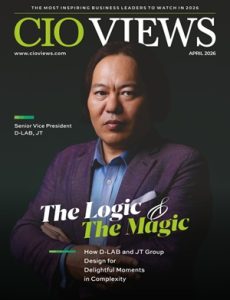
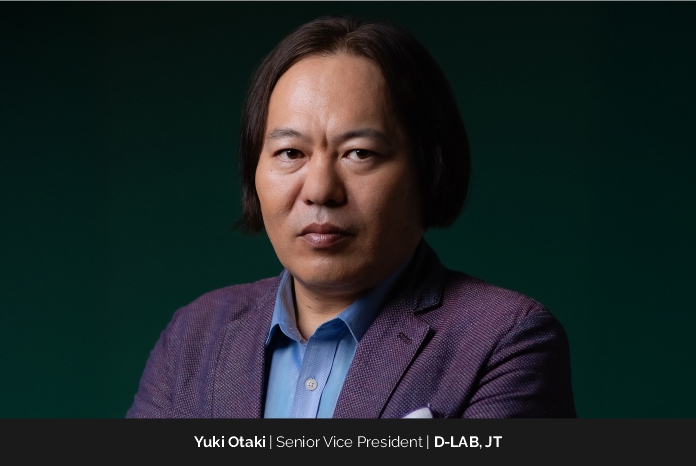
Yuki Otaki, SVP of D-LAB at Japan Tobacco (JT), has led corporate R&D and venturing since 2013, exploring new growth alongside core businesses. With an MBA from Hult and a BA from Keio University, his leadership style is defined by a focus on navigating complexity rather than rushing toward binary resolutions.
Despite his role, he remains grounded in the idea that leadership is an ongoing practice rather than a destination. “I am sincerely grateful for this recognition. At the same time, neither our organization nor I feel that we have ‘arrived.’ What we are doing is continuing the work of shaping the future. In that sense, we place great value on the awareness that we are still very much in the middle of that journey,” he reflects.
Origin of Perspective
The foundation of Yuki’s leadership philosophy was laid during his MBA studies in 2006. He felt a growing discomfort with the idea that the messy, organic reality of human societies and business systems could be neatly tucked into reductionist frames. To him, the standard theoretical tools seemed insufficient to capture how people and strategies actually evolve. By the time he graduated, he had synthesized this tension into a personal framework he calls ‘Logic & Magic.’ He decided that the goal was not to choose between opposing values or treat them as contradictions to be fixed; instead, he became focused on how to hold them together and harmonize them. This balance remains the central question of his career.
The Map is Not the Territory
This experienced executive believes that global experience isn’t about the stamps in a passport or the number of time zones crossed. It is something much more internal.
While based in Japan, Yuki works closely with people whose values and logic differ from what might be considered “typically Japanese.” This led to a solid realization. The real friction in strategy isn’t caused by national borders, but by the invisible assumptions we carry. He has learned to see his own way of thinking as just one perspective among many. “For me, global experience is not about crossing borders, but about learning to relativize my own assumptions in decision-making,” Yuki notes. By designing decisions that incorporate multiple premises, he builds a more stable foundation for long-term growth.
Designing a Space for the “Unfixed” Future
Yuki regards his role at JT Group as something akin to a navigator who refuses to pin a single point on the map. His daily work involves providing direction while ensuring the environment is flexible enough to allow decisions to evolve as they go. He calls this ‘ambidextrous decision-making.’ A constant balancing act between getting things done today and exploring what might happen tomorrow.
To him, vision isn’t a static image of the future. It is a state in which the quality of decision-making continues to improve as circumstances change. Therefore, instead of providing fixed answers in advance, he focuses on the context behind every choice. The intent is to ensure that different viewpoints can be shared without fear.
The Art of the Unfinished Decision
In the high-pressure environment of executive management, there is a constant, almost gravitational pull toward finding the “correct” answer. Yuki has navigated many such moments where time is short, and interests are deeply conflicted. He realized early on that simply handing down a conclusion often misses the point. The real challenge and the real growth come from learning how to keep moving when no perfect path exists.
He has shifted his focus away from being a traditional problem-solver toward becoming an architect of process. For Yuki, “leadership is not about providing the right answers, but about creating structures that allow decisions to move forward even when assumptions differ.” By articulating the invisible premises at play rather than just the final result, he ensures the organization doesn’t just reach a destination, but understands the journey it took to get there.
Holding Multiple Futures at Once
When managing fast-moving priorities across diverse international teams, Yuki practices a specific kind of mental discipline. He refuses to judge everything at the same speed. It is easy to feel that every problem requires an immediate resolution, but he consciously separates the “now” from the “not yet.” He intentionally holds onto certain open questions, allowing them to breathe rather than forcing a premature consensus.
In his view, a leader’s job is to sit comfortably with ambiguity. He feels, “clarity is not about narrowing options, but about continuing to work with multiple possibilities at the same time.” This approach enables his teams to stay agile. They aren’t locked into a single rigid path. They are instead prepared for several possible futures. It’s a way of maintaining focus without losing the peripheral vision necessary for long-term survival.
The Foundation of Presence
To Yuki, staying effective means maintaining a neutral mind rather than ritualizing productivity hacks. He is keenly aware of how easily judgment can become biased under pressure. That’s why he treats self-reflection as a core discipline.
He spends time organizing his thoughts and questioning his own motives. He also makes space for learning, whether through books, meeting new people, or spending time with his family. These moments help him shed his corporate skin and step away from constant evaluation.
Cultivating the Soil for Others
When it comes to leadership, Yuki avoids the traditional “top-down” approach to talent management. He doesn’t see people as assets to be molded, but as individuals who thrive under the right circumstances. “My guiding principle is not to develop people, but to create the conditions in which people can grow,” he explains.
Instead of demanding total transparency, which can often feel forced, he focuses on building a foundation of psychological safety. He aligns the team on a few essential things: the company’s purpose and their shared values. This minimal shared ground creates enough stability for people to voice their different opinions without it becoming a confrontation. For Yuki, the goal is to let unspoken intentions surface naturally so the team’s collective intelligence can take over.
Meaningful Milestone
If you ask Yuki about his proudest achievement, he won’t point to a specific deal or a successful product launch. For him, the real milestone is more subtle and much more lasting. It is the moment his way of thinking, by embracing complexity and inherent tensions, stopped being just “Yuki’s method” and became the way the organization itself speaks.
He finds deep meaning in seeing these decision-making frameworks take root as a shared language within JT Group. This collective foundation for sustained value creation, in his eyes, is the most significant achievement of his career.
Strategy as a Signal, not a Crystal Ball
Yuki doesn’t spend his time trying to predict the future with perfect accuracy. To him, the market isn’t a puzzle to be “solved” or a race to be won by being first. Instead, he sees every shift in consumer behavior and every new trend as a signal. A hint that helps him decide which strategic options to prepare in advance.
He manages the business by staying “ambidextrous.” On one hand, he addresses the market’s needs today; on the other, he quietly builds the tools for tomorrow. By moving between consumer insights, technology, and social structures, he ensures the company isn’t just reacting to change, but is already standing where the change is headed. It’s a way of co-creating the future rather than just waiting for it to arrive.
The Wisdom of Staying “Unfixed”
When asked for advice for the next generation of global leaders, Yuki is refreshingly honest. He doesn’t believe in universal formulas for success. His own practice is less about being right and more about being flexible.
He focuses on avoiding “fixed” decisions. The kind that leaves no room for new information. By clarifying assumptions early and resisting the urge to rush to a finish line, he ensures his choices remain effective across cultures and contexts. His message to young professionals is subtle yet powerful. He urges them not to worry about making a wrong decision as much as making one they can’t update.
Finding the Center of Gravity
This industry veteran sees a clear distinction between managing the day-to-day and leading a transformation, though he values both. Operational leadership is about stability, reliability, and making sure the machine runs well within its current rules. But, in his view, true leadership quality emerges when a person can step back and ask “why.”
It is about sensing where the “center of gravity” needs to be at any given moment, balancing the excellence of today’s operations with the long-term transformation of the entire organization.
A Living Legacy
If Yuki has his way, his legacy won’t be a specific project or a business result. His gaze is set on the long horizon. He envisions an organization that can continually revisit its own questions and update its judgments as the world changes. For Yuki, the ultimate success is seeing the quality of dialogue and thinking he has championed become so deeply embedded in the JT Group that it continues to evolve through the next generation. That ongoing cycle of renewal is the mark he truly hopes to leave.