
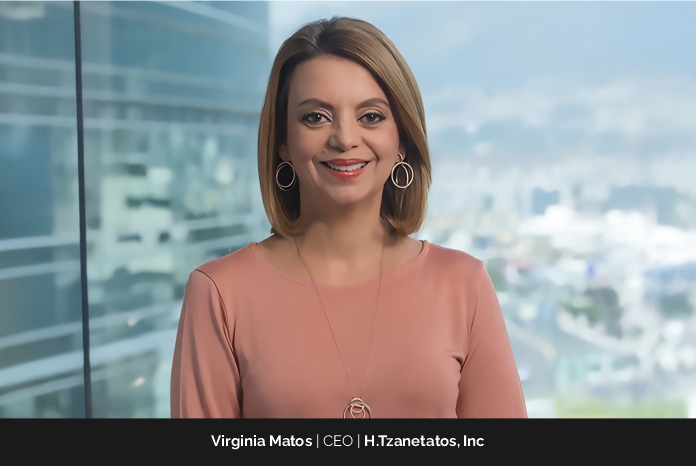
After a highly successful twenty-one years at Nestlé, Virginia Matos returned home to Panama to lead, H. Tzanetatos, Inc. As its CEO, she is transforming the company so that it remains competitive and can sustain itself for decades to come. Virginia can find the white spot even when everything is pitch-dark. Combined with her ethics and exemplary leadership, this positive attitude has made her an inspirational trailblazer in the business world.
Virginia is motivated by the idea that she can help improve the lives of the people working at the company. If, after many years, she can look back and see growth in every sense, professionally, personally, and educationally, that is the most “satisfying thing” for her. “It keeps me happy and motivated to continue working,” she says.
Returning Home to Panama
For five years, Virginia’s uncle, the founder of Grupo Tzanetatos, persistently called, trying to convince her to come back home and join the family business. “Virginia, I need you,” he often told her. “I need your support.” She was reluctant to leave Nestlé. But during discussions with her husband, she realized that together they had supported many other countries and many other people, and it was time to return home and do the same for Panama.
In December 2019, she finally told her uncle, “Yes, I’ll come.” In 2020, Virginia flew to Switzerland to resign from her position at Nestlé as CEO of Nestle in Ecuador, and later that year, she took over the reins of the family-owned group. For some time, she had lingering doubts about whether she had made the right choice by moving to Panama, leaving Nestlé.
But now, Virginia believes she made the right decision. She could be with her father during the last three years of his life. She was also able to spend two years with her uncle before he passed away. Her uncle’s wife, whom she considers a second mother, also needed her.
And there was no one else who could take on the responsibility. “My uncle tried with several people, appointed two or three CEOs, but that didn’t work,” she says. “Because when you’re in a family business, you’ve to take care of the family as well. You can’t be detached from them.”
According to Virginia, her main focus in returning was, first, to support her family and help the business succeed. Second, to improve the lives of every person working in the group. And third, to build a socially responsible company that makes a positive impact on the country.
Transforming the Group
Grupo Tzanetatos is composed of several companies from different sectors Tzanetatos Distribution company leading international, local brands and product form its own label (food, beverages, personal care products, cosmetics, etc); Lavery is factory that produces Dairy products, food, and personal care; Tzanetatos Real State; and Kinte an In bond warehouse. The group is currently undergoing a major transformation. During this phase, Virginia is doing much more than a regular CEO would. She ensures that every company in the group has a strong foundation for growth and the best talent in place. She also oversees the financial side of the business, with the support of the financial team.
Additionally, she makes sure people understand why changes are made, because the company needs to be sustainable for the future. “I’m also working with people to make sure they deliver results,” Virginia says.
Things were not easy when she took over as CEO. “There were a lot of challenges, in every sense and every way you can imagine,” she says.
Her uncle the founder of the company who grew his own company since 1960’s was use to making all the decisions, and that was the way of doing business back then. Part of the transformation, was to adapt managers to be empowered as well as the people. This was a major shift for them. As instead of receiving instructions and carrying them out, they were now encouraged to take ownership and think independently. This required a significant mindset change. So, a training program was started throughout the company, which helped build the foundation.
When Virginia joined H. Tzanetatos, she noted that salespeople were still using a handwritten process to take orders in supermarkets and mom-and-pop stores. During the COVID-19 pandemic, she decided to modernize their processes. They began transitioning to handheld devices and sophisticated tools. Once the sales team saw that they no longer had to go to the office to deliver orders and could place them directly from their phones, it made a huge difference, according to Virginia.
“Things started improving, including some KPIs,” she adds. “We focused on specific KPIs that people needed to achieve at every level, and that helped the company grow.”
Virginia says that her uncle was recognized as a philanthropist and a person who helped many people in the country. With this in mind, the company worked on a strong Social Responsibility program together with Sumarse, a local group, to reshape their social responsibility program and focus on where they could make the greatest impact. According to Virginia, they focused on three areas: education, entrepreneurship, and the environment. She and her team went through a thorough process to determine where the company was already making an impact and where it could do better.
In education, they started by reviewing how many employees still needed to finish high school. Virginia and the HR team worked with several entities IPER (Instituto Panameño de Educación por Radio), and now, they have almost 30 employees enrolled in a program to complete their schooling. For undergraduate studies, the company offers another option.
In the area of entrepreneurship, they supported delivery chauffeurs who wanted to help their sons or other family members start businesses. Virginia says they have now helped nearly 40 of them create their own enterprises.
When she was in Ecuador, she served on the board of the Alliance of Entrepreneurship and Innovation. The model was launch in Panama she became its chairman. The alliance currently supports a large number of entrepreneurs. According to Virginia, more than 300 people are employed through it, and sales exceed $3 million.
Additionally, there are many initiatives underway in both entrepreneurship and environmental sustainability. “We are focusing heavily on recycling and on planting trees,” Virginia says. They have already planted between 2,000 and 3,000 trees throughout the city. They are also tracking KPIs for electricity consumption, water, and other resources. “Panama is positive on environmental indicators,” Virginia says, “and we are contributing significantly to that.”
All these efforts, along with shifting the mindset of the people, have supported the company’s growth.
Achievement and Experience in Guatemala
For Virginia, her family is her greatest personal achievement. She and her husband are parents of three children, who are now 29 and married. According to her, it was a real challenge to keep the family together while advancing in her career. Fortunately, her husband has always supported her. She remembers the time when Nestlé wanted her to move to Guatemala. No one in her family was keen on moving. “It was a great achievement to see the family finally support the move to Guatemala,” Virginia says.
Guatemala proved to be a life-changing experience for her. She was the first woman in the history of Nestlé to lead a country operation in Latin America. In Guatemala, where women in leadership positions are rare, her appointment to the position of CEO was groundbreaking. “It was a lot of responsibility,” Virginia says. Also, people found it difficult to accept that a woman would be leading them.
Initially, customers didn’t take her seriously. When she went to meet her first customer, he was dismissive and questioned how Nestlé could send a woman leader to Guatemala. She felt frustrated, but then she realized, “It’s not their problem. I’m the one who is different, and I’ve to work with that.”
She sought help from an HR colleague to first help employees accept that they now had a woman leader, and then to work on acceptance from customers. They began tackling every aspect of the problem.
Virginia also started going out into the field with her teams. She became involved with the finance, customer relationship, and logistics teams, as well as strengthening leadership with the ladies of the team. Gradually, people started to think, “Okay, it’s not so bad to have a woman leader.”
“The initial days in Guatemala were super challenging,” Virginia says, “but at the end, it turned out to be super satisfying.” “Their gratitude meant so much to me, not only for the way I had led, but because they accepted someone so different: a woman leader,” she adds. During the last days of her time in Guatemala, many team members took the time to express their gratitude, share stories and achievements. Several of them grew to higher positions within the company, and those who were more reluctant about working with women changed to a more positive perspective.
Pillars of Success and Main Goal
Virginia believes hard work, perseverance, and ethics are the key to success. People, she says, often assume that it is easy to achieve success and rise in the corporate world. That may be true for some people, but it was not the case for Virginia.
What worked for her was that her focus was always on excelling in the position she held at the time. For example, when she started in the food division at Nestlé, her focus was on delivering the best performance for that business. The enabled her to consolidate the strongest operation for Nestlé in Latin America, and in some categories, they became best in class worldwide, an impressive achievement for a region like Central America.
“When you perform and stay focused on where you are today, your superiors will notice, and you will continue to grow,” Virginia says. “One also has to maintain a high level of ethics.”
And she says that leaders must think about how to develop their teams, support the country where they operate, and improve lives. “For me, that has always been my main goal,” says Virginia.
Plans for the Future
Virginia plans to live in Pedasí in the future, where she and her husband have already built a house. There, she intends to support small entrepreneurs.
She would like to see H. Tzanetatos become fully self-sufficient with the managers she has now. Her nieces, who are in their twenties, are also working in the business, and she hopes this third generation will be empowered to become the leaders needed to continue the business for another 60 years. That, she says, is one of her main goals.
Personally, she wants to see her children happy with their families, grow in their professional lives and keep doing what they are doing.
Firm Belief in God
“I believe in God,” Virginia says. “I believe He has moved me around to do something and challenged me to improve myself.”
She shares that whenever she was on the verge of giving up, something always happened that pushed her to continue. “But then something amazing happened,” she says. When she told the HR head that she wanted to leave, the HR head responded, “Okay, Virginia, I’ll support you completely in your decision. Let’s just see how we manage the fact that you would be the first female to lead, and the first to quit.”
That made Virginia realize that if she left, she would jeopardize the future of other women at Nestlé. “God sent me a big signal that I needed to continue,” she says. “And it became one of the most amazing experiences of my life.”
Advice to Aspiring Women Leaders
Virginia advises aspiring women leaders to focus on improving the lives of the people they work with, train the teams for success and have clear and focus KPis to follow. She encourages them to focus on the key elements that will help their company grow.
“If you can improve the life of your people, along with building a healthy, growing company, nobody can stop you,” Virginia says.