
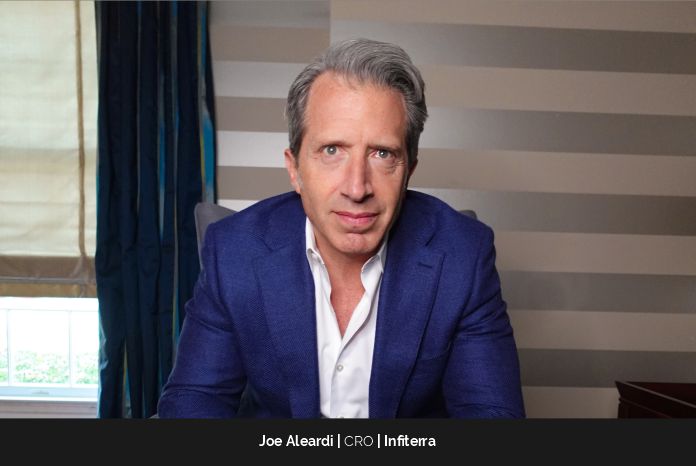
On our executive profile, this time we have Joe Aleardi, CRO, Infiterra.
Throughout his career, Joe has been guided by a few core values like integrity, curiosity, and accountability. “Early on, I learned that success in technology and business isn’t just about innovation,” he says, “it’s about trust, both within your teams and with your customers.”
Joe continues, “My formative years in enterprise software taught me that you can’t drive sustainable growth without listening deeply, leading with empathy, and creating an atmosphere where people feel empowered to perform at their best.”
Working across both start-ups and global SaaS enterprises gave him an informed view of what drives progress. Smaller teams sharpened his agility and customer focus, while larger ones showed him how structure and scale support durable growth. These experiences shaped a leadership approach grounded in shared objectives, the right enablement systems, and collective ownership of results.
Why Infiterra?
We ask Joe why he was drawn to Infiterra. He shares a very cogent answer. It was the unique combination of innovation, transformation, and heritage. The company recently rebranded from interworks.cloud to Infiterra. It wasn’t just like swapping out a nameplate. It is an indication of the clear vision of the next chapter of subscription commerce.
“Infiterra’s mission is to simplify and modernize subscription service delivery, empowering IT distributors, MSPs, and Telcos to automate operations, integrate seamlessly, and grow efficiently,” Joe remarks. This purpose perfectly aligns with his career focus on building organizations where technology, workflows, and talent work in sync to generate verifiable results.
Defining Success in Subscription Commerce
Success in subscription commerce rests on a simple test of whether you create value that endures. The field is moving away from isolated sales toward long-term relationships shaped by experience, flexibility, and credibility.
At Infiterra, progress is evaluated by the strength of customer growth and the influence the company has on its operations. The questions Joe returns to are practical: Are we helping them grow faster? Are we enabling smarter monetization strategies and stronger retention? When the data unequivocally says ‘Yes,’ the revenue surge is an inevitable byproduct.
He also emphasizes flexibility as a defining factor. Subscription models shift quickly as tools change and expectations rise, requiring early detection and precise response.
Strategies for Global Platform Scaling
A critical initial measure, Joe notes, involved the fortification of the operational structure. This involved refining the sales methodology, augmenting pipeline visibility, and securing the requisite analytical and enablement infrastructure. Such resources are essential for informed decision-making across all organizational tiers. At the same time, the focus narrowed to those markets where customer value is optimized.
Investment in customer success is a non-negotiable primary propellant. In the subscription paradigm, retention and expansion carry the same weight as new customer acquisition. By intensifying client engagement and consistently delivering quantifiable value, Infiterra establishes the precondition for durable progress.
Finally, Joe explains that global expansion mandates cultural homogeneity. He states, “We are currently cultivating a high-performance, inclusive environment sustained by innovation and shared accountability.”
Balancing Short-Term Revenue with Strategic Growth
Reconciling short-term performance metrics with enduring strategic growth represents a core responsibility for any revenue executive. Joe acknowledges that. He says the key to this balance is a clear purpose. Understanding that every quarterly goal should support the bigger strategic vision. “At Infiterra, we focus on more than simply hitting numerical targets,” he states. The goal is calibrated growth. Joe continues, “We are engineering a durable enterprise capable of delivering sustainable value for the forthcoming years.”
To actualize this mandate, Joe notes, the market penetration strategy is structurally supported by three essential pillars: predictability, repeatability, and scale. He stresses that these depend on sound process, reliable data, and a disciplined culture. Process creates consistency in execution for both clients and stakeholders. Data provides empirical grounding, shows what works, and where adjustments are needed. Culture keeps every initiative congruent with Infiterra’s long-term objective of advancing subscription commerce globally.
Joe adds that effective leadership requires attention to both horizons. The company must deliver stable revenue today while investing in systems, people, and customer partnerships that strengthen its position over time. This combination, he notes, maintains organizational agility in a dynamic market without losing focus on durable growth. It establishes Infiterra as a global industry leader with indelible influence.
Customer Success as a Revenue Strategy Pillar
At Infiterra, customer success is at the core of our revenue strategy. Joe characterizes it as an organizational mindset rather than a mere department. In a subscription-based economy, growth can only happen when clients experience tangible utility from the platform, not upon contract finalization. Infiterra’s core mandate is enabling IT distributors, MSPs, and telcos to revolutionize their subscription frameworks through automation, facilitating enhanced operational efficiency, accelerated scaling, and increased market confidence.
Joe emphasizes that customer success is intricately integrated within the market penetration model. Teams collaborate closely with Sales, Marketing, and Product divisions to make sure every client interaction propels measurable business outcomes.
“When our clients succeed, we succeed,” Joe states. This methodology cultivates durable relationships founded on trust, verified impact, and mutual prosperity, effectively converting realized value into sustained loyalty and global expansion.
Fostering a High-Performance Revenue Culture
As the saying goes, “clear lines make steady hands.” Joe frames his approach around three elements: clarity, trust, and accountability.
He explains that clarity is the foundation. People work at a higher level when they understand the purpose behind their objectives and see how their role advances Infiterra’s vision for subscription commerce. He ensures that every contributor in sales, marketing, partnerships, and customer success can trace their work to that broader aim.
Trust and accountability ensure that ambitious targets sit alongside transparent metrics and access to the resources needed to meet them. When expectations are clear and support is present, individuals take ownership of results.
Experiences That Work in Practice
This C-suite executive brings a unique blend of experience and performance to the table. And this edge has not gone unnoticed: He was recently recognized as one of the “Top 10 Most Impactful Leaders Making a Difference, 2025.”
Each stage of his career has been instrumental in calibrating Joe’s present leadership methodology. Initially, roles at IBM and Sterling Commerce provided the requisite blueprint for scaling intricate, global enterprises.
This work required him to establish structural coherence, process rigor, and operational excellence across different markets and teams. In practice, it showed him the criticality of alignment at scale. It also underscored why uniformity matters when an organization is pursuing large-scale growth.
Subsequently, at EDITED, Joe recounts the challenge of restructuring and guiding a high-growth SaaS entity through an intensive two-year transformation. This is where he truly pushed the envelope, achieving a threefold increase in Annual Recurring Revenue (ARR) alongside improvements in retention and client valuation. This exploration validated the success of data-informed decisions and illustrated the significant impact of customer-centered innovation.
Later, at SWRVE, Joe’s focus shifted to upgrading the market-penetration engine. He brought sales, marketing, and customer success into a singular, coordinated growth engine. He learned something important. Organizational change is essentially about human capability. It depends on equipping teams with clarity, strategic purpose, and the appropriate instruments for success.
Consequently, these professional chapters have prepared this erudite leader to guide Infiterra through its current stage with both discipline and organizational dexterity. He now works with the steadiness of an enterprise operator and the pace expected in a young, expanding venture.
Joe adds that this blend of precision and responsiveness will be essential as the company continues its global expansion. He sees it as the basis for steady growth and consistent value delivery for clients worldwide.
The Proudest Accomplishments
Joe shares that one milestone that shines particularly bright is the unveiling of the new Infiterra brand. More than a mere label change, it was the ringing of the bell for a fresh chapter. Leading the market strategy during that shift was, for him, a moment of profound gratification. Watching the new identity immediately resonate with customers and the market added to that sense of accomplishment. He also mentions another meaningful accomplishment. The physical expansion of Infiterra around the globe, including opening the London office and continuing to build the U.S. team. To Joe, these aren’t just pins on a map. Instead, they are physical proof that the company is scaling thoughtfully, always ensuring it remains close, geographically and relationally, to its customers.
Joe then pauses, his tone shifting to what truly matters. He expresses genuine pride in the culture taking root inside the walls of the organization. Joe leans forward, a warm sense of satisfaction in his voice as he offers a glimpse into a workplace. An environment that genuinely values innovation, partnership, and a unified sense of purpose. Seeing teams across the globe lock arms around one clear vision and deliver consistent results has, without a doubt, been the most poignant outcome of his tenure as CRO. It’s the human element of the success story.
The Roadblocks
Joe would be the first to tell you that success isn’t just handed out. It’s earned, often through tough stretches. He recalls one moment that stands out vividly for its sheer difficulty. This was during a major overhaul of the go-to-market strategy early in his career. The company was fundamentally changing its business model. As expected, the entire revenue organization had to be rebuilt almost from the inside out. He mentions that the pressure during that intense period was significant. Indeed, a true test of leadership.
He shares that this entire phase provided an invaluable, practical lesson: the power of clarity and steady communication. Change naturally brings uncertainty, and uncertainty is the fastest way to slow a team down unless it’s tackled head-on and openly. Joe chose to focus his efforts on keeping everyone laser-focused on one single direction. Crucially, he made sure to be fully transparent about both the immediate obstacles and the exciting possibilities that came with the shift. He also took care to empower people to own their piece of the transformation.
This whole experience, Joe concludes, deeply shaped the way he leads today. In his view, any big organizational change hinges on resilience, adjustability, and trust. When those key elements lead the process, he believes, even the most challenging moments ultimately become the fuel for long-term progress.
Curiosity and Agility to Stay Ahead
Staying ahead in this field, according to Joe, is truly dependent on having a steady, almost stubborn curiosity. Why? The industry moves fast. Technology shifts constantly. Customer behavior changes month to month. Even market conditions evolve without warning. He notes that methods that guarantee success today might not hold up tomorrow, so he treats ongoing learning as a basic, non-negotiable requirement.
So, how does he manage to stay so current? He explains that he deliberately sets aside time each week to stay close to the pulse of the market. He tracks new technologies and watches shifts in customer needs with a keen eye. He also spends time studying emerging business models.
But it’s not just internal work. Joe heavily relies on external resources: research, conversations with trusted peers, and direct discussions with customers and partners. Major analyst and industry events, he adds, are vital; they help him test his own assumptions and gather fresh, essential insight.
That same mindset, he assures, guides his teams. They are actively encouraged to take part in structured learning. They are also set up to work across functions, allowing them to exchange ideas quickly. Do they have the freedom to try new things? Absolutely. They have the space to test, refine, and openly share what they learn. Their decisions aren’t based on guesswork. But rather, they rely firmly on data, which enables them to adjust their course with precision and confidence.
“Adaptability isn’t just a useful skill anymore,” Joe highlights. “It’s a powerful competitive advantage.” But how do you bake that into a company’s core Identity? He explains, “By fostering a culture that genuinely values innovation, curiosity, and accountability, we make sure Infiterra doesn’t just react to shifts in the market.” Instead, he notes, “We actively anticipate change, lead it, and most importantly, we help our customers thrive right within it.”
Guiding the Future Leaders
For aspiring revenue leaders, his very first piece of advice is, “Stay relentlessly curious.”
He points out that the world of SaaS and cloud technology moves fast. Because of this rapid change, no one ever really has the complete picture. Continuous learning, therefore, is what keeps leaders grounded. It helps them rely on facts rather than assumptions. And it’s crucial for adjusting quickly when markets or customer needs suddenly shift.
Next, he talks about the essential importance of alignment and trust. Revenue work is never just about hitting targets. Success truly hinges on how well a leader can rally teams. Can they bring everyone together around one shared purpose and a clear idea of what ‘winning’ looks like? In his experience, strong internal coordination is often the deciding factor in whether a strategy actually succeeds.
He closes with a point he considers non-negotiable. He strongly advises leaders to always act with empathy and integrity. Credibility grows when people witness consistent, honest behavior. This principle is key internally, but customers respond to it powerfully as well.
When character, curiosity, and collaboration come together, he says, leaders can make a lasting, meaningful contribution rather than deliver a short-term result.
-
Website: https://infiterra.com/
- Social Media Handles:
- LinkedIn: https://www.linkedin.com/company/infiterra
- Facebook: https://www.facebook.com/infiterracom/
- Instagram: https://www.instagram.com/infiterracom
- X (Twitter): https://x.com/infiterracom
- YouTube: https://www.youtube.com/@Infiterra
- Reddit: https://www.reddit.com/user/infiterra/