

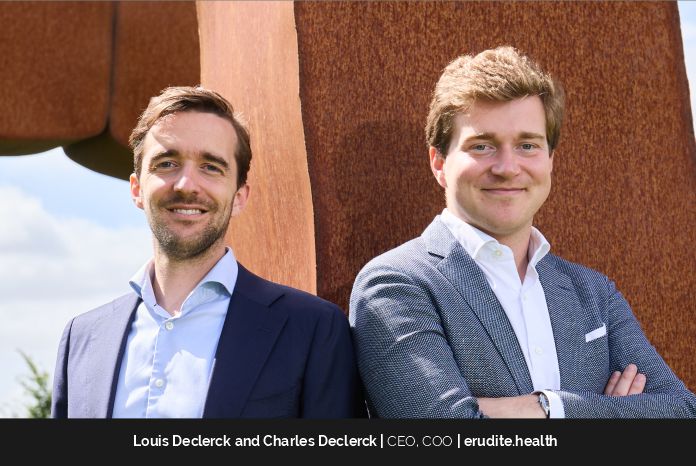
Louis and Charles Declerck are building erudite.health into Europe’s answer to the broken pharmaceutical model—and they’re doing it with evidence-based supplements, proprietary AI, and a radical bet on Unified medicine.
“The entire healthcare economy is messed up.”
Louis Declerck doesn’t mince words. The 36-year-old physician-turned-CEO sits in his office in Ghent, Belgium, surrounded by the architectural remnants of old-world European pharma—but his vision is anything but traditional. In three years, he and his younger brother Charles have assembled a €36 million revenue business, acquired two legacy supplement brands, and built an AI engine designed to do what Big Pharma won’t: treat the root cause, not just the symptoms.
“Money flows are not transparent. Disease needs are not transparent. And the industry is failing patients,” Louis continues, his frustration palpable. “We started erudite.health to change that.”
It’s a bold claim. But the Declerck brothers aren’t typical entrepreneurs. Louis holds both an MD and a civil engineering degree. Charles, 30, is a bioscience engineer who sharpened his expertise in the UK and US start-up/biotech ecosystems before joining a biotech venture capital fund. Both spent significant time inside the belly of the beast—venture capital—watching billions flow into drugs that treat symptoms while root causes go ignored.
“We saw the value gap,” Charles explains. “The resources needed to push an asset to market versus the actual value created for patients. It’s broken. We’re not investors. We’re builders.”
So, in 2022, when Louis called his brother and asked, “Are you ready to jump?” Charles didn’t hesitate. They jumped.
The €36 Million Foundation
What began as two brothers and a thesis has become a 123-person organization generating €36 million annually. The rapid scale came through strategic acquisitions: Nutriphyt in 2023, a Belgian supplement stalwart with deep pharmacy relationships, and Trenker in 2024, a BENELUX powerhouse with significant export reach.
But erudite.health isn’t a roll-up play. It’s a Trojan horse.
“Everyone thinks we’re a supplement company,” Louis says with a slight smile. “We’re not. We’re building the infrastructure for Unified medicine at scale.”
The company operates on three pillars that most observers miss:
ERUDITE SPECTRUM: A proprietary generative AI platform trained on immune-related disease pathways, designed to guide physicians toward personalized treatment protocols. Not to replace doctors—Louis is adamant about this—but to arm them with evidence they don’t have time to compile themselves.
erudite.health: The visible layer. Evidence-based supplements, probiotics, and medical nutrition products sold through 4,000+ pharmacies across the BENELUX. This is the revenue engine, the trust-builder, the pharmacy relationship.
ERUDITE THERAPEUTICS: The long game. Small molecule drug development focused on immune modulation. “Think of it as the platform’s natural evolution,” Charles notes. “Once we understand the system, we can intervene at every level.”
It’s a vertically integrated play that would make Jeff Bezos nod appreciatively. Control the production facility (they own their own in Belgium), control the distribution (pharmacist relationships), control the data (AI platform tracking outcomes), control the science (in-house R&D and proprietary testing labs).
“We’re not trying to be another supplement brand,” Louis emphasizes. “We’re building the alternative to how medicine works.”
The Unified Medicine Bet
Here’s where it gets interesting. The brothers aren’t just talking about personalized medicine—everyone talks about that. They’re talking about Unified medicine: treating the body as an integrated, dynamic system rather than isolated problems.
“Conventional medicine treats a migraine with a painkiller,” Louis explains, leaning forward. “We ask: Why does this person get migraines? Is it gut inflammation? Hormone imbalance? Nutrient deficiency? The body is trying to tell us something. We just need to listen.”
This is where the AI comes in. erudite.health’s platform—currently under development—ingests patient data and suggests root-cause pathways backed by peer-reviewed research. It’s not diagnosis (that would require regulatory approval). It’s clinical decision support on steroids.
“We’re essentially building the world’s best resident physician,” Charles adds. “One that’s read every paper, remembers every patient outcome, and has infinite patience.”
The market opportunity is staggering. The global dietary supplements market alone is projected to reach €440 billion by 2030. But the brothers aren’t interested in just taking market share. They want to change the game entirely.
Why This Works (And Why It Hasn’t Been Done)
The pharmaceutical industry has a structural problem: there’s no money in prevention. A patient who stays healthy doesn’t buy drugs. The incentive structure is fundamentally misaligned with patient outcomes.
“Big Pharma can’t do what we’re doing,” Louis states flatly. “Their entire business model depends on chronic disease management. We’re optimizing for the opposite: getting people healthy and keeping them that way.”
erudite.health’s advantage is threefold:
First, trust. By working through pharmacists and GPs rather than direct-to-consumer, they’ve embedded themselves in the existing healthcare infrastructure. Doctors recommend erudite.health products because they’re evidence-based and traceable. “Every product is Belgian made and fully traceable with the best ingredients” Charles notes.
Second, data. While DTC brands are optimizing for Instagram engagement, erudite.health is collecting real clinical outcomes through their physician partnerships. This data will feed the AI, which improves recommendations, which drives better outcomes, which generates more data. It’s a flywheel.
Third, quality and transparency. Because we own our production facility, every step is under our control — traceable, auditable, and scientifically defensible. While Big Pharma needs months to adjust formulations or respond to regulatory shifts, we can reformulate, validate stability, and update compliance in weeks. “When a physician needs a specific gut–brain axis formulation, we can transparently adapt and align with regulatory requirements — with far more flexibility than anyone else,” Louis says.
The Family Dynamic That Powers It All
There’s an intangible element here that can’t be replicated: the brothers actually trust each other. Completely.
“Charles is the only person I trust blindly,” Louis admits. “I wouldn’t do this with anyone else.”
It’s not sentimentality—it’s strategic advantage. In a space where most co-founder breakups doom the company, the Declerck brothers have a bond forged over three decades. They disagree, frequently and loudly, but they don’t let it fester.
“If we fundamentally disagree on something, we name it immediately,” Charles explains. “We debate it. We don’t let it become the elephant in the room. That’s how you kill a company—unspoken resentments and assumptions.”
Their complementarity is almost too perfect to be real. Louis brings the clinical vision and physician credibility. Charles brings operational excellence and systems thinking. Louis is the external face, pitching investors and partners. Charles is the internal engine, ensuring the machine runs efficiently.
“I’ve seen plenty of co-founder teams in start-up ecosystems and in VC,” Charles reflects. “Most don’t survive the first real crisis. Louis and I? We’ve been through crises since I was in diapers. This is just another one.”
The Audacious Plan: Becoming Europe’s Healthcare Platform
The BENELUX is just the beginning. The brothers have their sights set on European expansion, with a rollout strategy that would make any growth-stage founder envious.
“We’re interested in distributors for parts of the world we cannot develop ourselves for now” Louis states firmly. “We eventually want to own the market. That means direct presence, direct relationships with pharmacies and physicians, direct control of the quality and experience.”
“By 2030, we want to be the default platform for Unified medicine in Europe,” Charles says without a hint of irony. “Every GP, every specialist, every pharmacist should be thinking: ‘For medical conditions of all sorts, I go to erudite.health.'”
The revenue model is elegant. Products generate immediate cash flow. AI platform subscriptions create recurring revenue from healthcare providers. Therapeutics, when they hit market, provide the home run potential that VCs love.
“We’re building something that can stand alongside J&J, Pfizer, AstraZeneca,” Louis declares. “But we’re doing it with a completely different philosophy. We’re proving you can build a massive healthcare company that actually optimizes for patient outcomes.”
The Stakes: A Generational Bet on Healthcare
Here’s what makes this story different from every other healthcare disruption narrative: the Declerck brothers aren’t planning an exit.
“I want to pass this to my kids,” Louis says simply. “This isn’t a five-year flip. This is a generational mission. We’re changing how medicine works. That takes decades.”
Charles echoes the sentiment: “If a legacy is built around a person’s ego, it fades. If it’s built around principles—evidence, empathy, systems thinking—it endures. That’s what we’re building.”
It’s an almost anachronistic vision in an era of quick exits and SPAC deals. But it might be exactly what healthcare needs: founders who are playing the infinite game.
The pharmaceutical industry is a €1.48 trillion global market. It’s also one of the least innovative, most entrenched, most resistant to change. If two brothers from Belgium can crack even a fraction of that—if they can prove that Unified medicine works at scale, that AI can augment physicians without replacing them, that prevention can be profitable—they won’t just build a valuable company.
They’ll rewrite the rules.
“People think we’re crazy,” Louis admits with a grin. “A physician and an engineer taking on Big Pharma? With supplements and AI?”
He leans back in his chair, confident.
“Good. Let them think that. We’ll be too far ahead by the time they realize what we’re building.”