
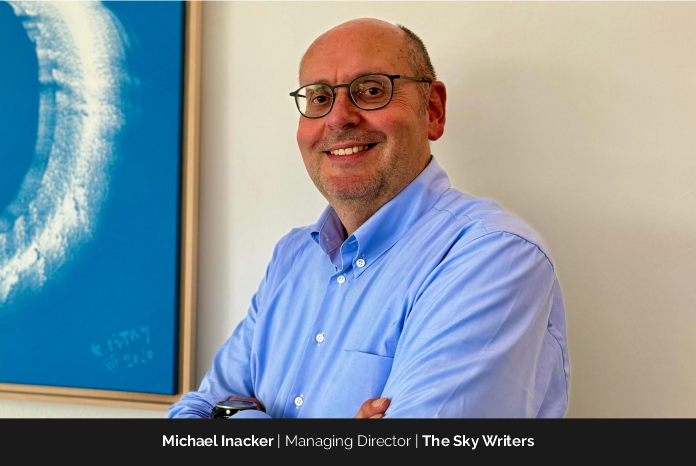
Introducing Dr. Michael J. Inacker, the venerable Founder and Co-CEO of The Skywriters/Die HimmelsSchreiber GmbH. The firm is a communications and public affairs powerhouse based in Berlin, with offices in Frankfurt and Brussels. His work builds on a career shaped in politics, journalism, and corporate leadership, supported by a perspicacious understanding of how political, economical, and media-institutions think and act.
Michael Inacker reported from global conflict zones, guided central editorial offices, led corporate communication and public affairs functions for some of Germany’s largest companies, and later ran a prominent advisory group. These experiences influenced his approach to strategy and public dialogue. Today, his work ranks him among the advisors who have long proven themselves worth their salt in Germany’s communication domain.
Philosophy on Storytelling and Communication
For Michael Inacker powerful communication begins with clarity, intent, and respect for the audience. He believes every message must carry purpose and hold enough depth to stand on its own. He considers storytelling as a discipline that blends observation, structure, and empathy. It can turn facts into meaning and build emotive resonance with the audience.
He holds that successful public relations are fundamentally dependent on two intertwined skills: “the ability to tell a compelling story, and the emotional intelligence to feel the world around you.” He argues that digital algorithms and tools are important, but they “serve, they do not lead.” They can never replace instinct, empathy, or a genuine conversation between a communicator and the outside world.
Accuracy sits at the heart of his method. Michael Inacker considers good communication as inseparable from “the principle of telling the truth.” He operates under the fastidious principle that any message must be fact-based, arguing that lies are quickly exposed by investigative journalism, and advises clients that credibility cannot be sustained on untruths or just by order.
Michael Inacker rejects communication crafted merely as ‘content marketing,’ which he believes erodes credibility. He warns that such “Potemkin villages of communication,” messages packaged like ads instead of journalism, “collapse under scrutiny.” The antidote, he argues, is rigorous storytelling grounded in incontrovertible truth.
The veteran treats every brief as an opportunity to understand context, anticipate reactions, and guide complex themes into a form that people can connect with. He encourages communicators to study their environment, read situations with care, and build narratives that contribute to responsible public dialogue. Michael Inacker feels that this alignment of truth, tone, and timing is an essential part of leadership.
The Early Influences
This seasoned executive built his intellectual base through academic training in political science, law, and history at the University of Bonn. Such an assiduous blend sharpened his interest in institutions and the forces that shape public life. His understanding deepened when he joined the Planning Staff of the German Federal Ministry of Defence. The role exposed him to strategic decision-making at a national level and strengthened his analytical discipline.
These early years shaped the way he approaches communication. They taught Michael Inacker how policies form, how information moves, and how different actors interpret the same message. This foundation guided the path that followed across journalism, industry leadership, and advisory work.
Transition to Journalism
His move into journalism did not happen by chance. It took place at a time when global events demanded sharp analysis and steady reporting. His early assignments took him to war zones in Cambodia, Somalia, Bosnia, and Croatia. These environments taught him how to observe, question, and communicate under pressure. The work refined his sense of responsibility toward accuracy and public understanding.
Michael Inacker went on to serve in senior editorial roles at respected German newspapers, like, WELT am SONNTAG, and later the Sunday edition of the Frankfurter Allgemeine Zeitung. This position was followed by experiences as vice-editor-in-chief of the leading German business daily and weekly “Handelsblatt” and “WirtschaftsWoche.” Each role strengthened his grasp of political and economical reporting, public sentiment, and the mechanics of narrative.
The newsroom became a training ground for leadership. From this experience, Michael Inacker developed the conviction that a good communicator must “turn scattered data and facts into a coherent story to think and act journalistically.” It implies crafting a narrative that could “survive an editorial conference” and adhere to journalistic standards of clarity, conflict, and credibility. Stories that are rigorous and “grounded in truth,” rather than marketing “content bites” designed merely to please clients. This period also expanded his insight into how stories influence public behavior and how institutions respond to media scrutiny.
Industry Leadership and Corporate Experience
Michael Inacker entered the corporate world with the same discipline he had applied to journalism. His first major step came at DaimlerChrysler – at present called Mercedes-Benz, where he served in the chairman’s planning staff. The role exposed him to complex organizational priorities and the internal dynamics that shape decisions in large global companies. It also broadened his view of how communication supports strategy, reputation, and leadership.
He later returned to the company as Vice President responsible for External Affairs and Public Policy in Stuttgart. This position placed him at the nexus of industry, government, and public discourse. It called for a deep understanding of regulatory environments. It also required a steady hand in crafting messages that would have traction nationally and internationally.
Michael Inacker insists that the communicator’s “social, emotional, and political intelligence” (or “gut feeling”) is vital to connecting a company’s message to its broader political environment. He criticizes the fact that many communication strategies fail because senior management misreads potential resistance. He also endorses the communicator who can read the room and “bring the outside world into the boardroom.” His definition of true mastery stands apart. It represents helping a corporate story leave the business pages and enter the political section, recognizing that this is when new, influential players join the conversation.
Michael Inacker also challenges the “illusion or stereotype among multinational oriented CEOs in Germany arguing that the domestic public and German profile, or German rooting, no longer matter for a business-leader.” While acknowledging the importance of international media, he maintains that in a crisis, it is ultimately the German public and media and sometimes politics who decide a German CEO’s fate.
His next chapter was at METRO AG, one of the world’s largest wholesale and retail companies where he held the title of Senior Vice President and Head of Corporate Communications and Public Affairs. His portfolio represented the full breadth of Corporate Communications, including both internal and external communications, political engagement, and responsibilities for the company’s work on Corporate Social Responsibility. The expansive scope of the role enhanced his experience in providing direction to teams, as well as managing complex networks of stakeholders while balancing the demands and interests of the business and wider environment.
This experience served to transform him from a journalist to a senior corporate strategist. They are experiences that added to his understanding of leadership, governance, and public influence, which prepared him for the advisory work that would follow.
Return to Advisory Leadership
Michael Inacker returned to the advisory world as CEO of WMP EuroCom AG in Berlin. The role placed him for a period of seven years at the helm of a well-known strategic communication and public affairs group. His work required calm judgment, precise messaging, and an ability to read shifts in public perception.
After a conflict between the major shareholders, he decided to leave the firm in 2020. The transition became a turning point in his biography that opened the path for a new chapter built on his own vision of modern communication and integrates the full lessons of his various positions.
Founding The Skywriters
Together with his friend and business-partner Michael Behrens he dove straight in, launching The Skywriters/Die HimmelsSchreiber GmbH in Berlin soon after leaving WMP. The firm focuses on communication and public affairs with a presence in Frankfurt for financial communication and Brussels for European regulatory matters. The company reflects his belief in disciplined storytelling, strategic clarity, and close client partnership.
Michael Inacker’s transition to founding The Skywriters followed his return to the advisory world. And he describes it as the “famous leap into cold water,” a shift from reporting on power to acting inside the strorm close to his clients. This work, he says, is a “demanding, almost athletic contest.” His launch of The Skywriters was undeniably gung-ho. Unlike large corporations with separate sales departments, in an agency, “you are the sales channel. You go to the front line.” This immersion in seeing the impact of his own arguments right away is what distinguishes his firm’s agility and its focus on building trust within minutes, much like in speed dating.
His leadership blends experience from government, newsrooms, and corporate boardrooms. The firm applies this breadth to help clients navigate public debates, regulatory shifts, and high-stakes communication challenges. The Skywriters stands as the culmination of his decades of expertise and his commitment to shaping dialogue with integrity and purpose.
Boards, Foundations and Public Engagement
In addition to his professional pursuits, Michael Inacker is on several boards and foundations. He is the Chairman of the Supervisory Board of Otto Quast Bau AG, a family-owned construction company located in his hometown Siegen. He is also the chair of the board of the Internationale Martin Luther Stiftung in Erfurt, which is focused on the relationship between business and question of ethical principles and leadership, and public life.
His public engagement extends further. He was a member of the Council for Innovation of the state of Baden-Württemberg. He has served on the Executive Committee of the German Council on Foreign Relations and spent nearly a decade on the Board of Trustees of the American Institute for Contemporary German Studies in Washington. Beyond his professional and board work, Michael Inacker also uses his voice to encourage people that “one can live and act with Parkinson’s, desease ” demonstrating his personal calm resilience cultivated over decades of experience.
He is also an author of books on the Gulf War of 1991, the relationship between church and democracy in Germany, and several publications on economic and foreign affairs. His work reflects a long-standing interest in the connection between policy, society, and responsible communication.
A Leadership Style Built Over Decades
The communication strategist moves with discipline, curiosity, and measured instinct, always reading between the lines. His experience across politics, journalism, and corporate life has taught him that leadership grows from preparation and presence. He listens closely, carefully evaluates situations, and encourages teams to think beyond the obvious. He expects clarity in thought and honesty in communication. People who work with Michael Inacker describe a leader who values accuracy, respects complexity, and stays grounded in facts. His disposition reflects a lifetime of maneuvering real-world pressure and guiding others through it.
The Throughline of His Career
A clear pattern runs through his professional journey. Michael Inacker has consistently gravitated toward positions requiring judgment, strategic thinking, and steady action. His first opportunity with political analysis influenced his early interest in decision-making. Years of journalism honed his eye for truth and for extrapolating structure from complex information. His work in corporate positions further enabled him to understand economic priorities and institutional expectations. His advisory work brought these skills together.
The throughline is simple: he has always focused on interpreting reality and helping others understand it. This includes the belief that “digital tools help, but they don’t replace instinct,” and that the ability to “think and act journalistically” is paramount to success in communication.
He highlights the power of a company to “write its own positive story, and make others tell it, too” by citing the example of Deutsche Post building its own electric delivery vans after German carmakers deemed the project “not profitable.” This example illustrates his conviction that a truly meaningful story must embody the rules he defines: Clarity, Relatability, Surprise, and Simplicity.
Outlook on the Future of Communication
Michael Inacker believes the next era of communication belongs to professionals who will work by blending instinct with precision and digital judgement. Modern tools will make the act of communication easier. However, human judgment will remain the decisive differentiator in this next chapter. He sees value in narratives that engage people, carry responsibility, and reflect real social sentiment. He encourages communicators to stay curious, build broad networks, and learn to sense the mood beyond digital signals. His outlook is rooted in a conviction that clear language, honest storytelling, and careful listening will shape credibility in the years ahead.
A Standard Set by Experience
Few professionals move through politics, journalism, corporate leadership, and advisory work with equal ease. Michael Inacker has done so by staying committed to substance over spectacle. He continues to help institutions find language that earns trust and carries weight. His career sets a clear standard for what responsible communication should look like in a world that still values truth.