
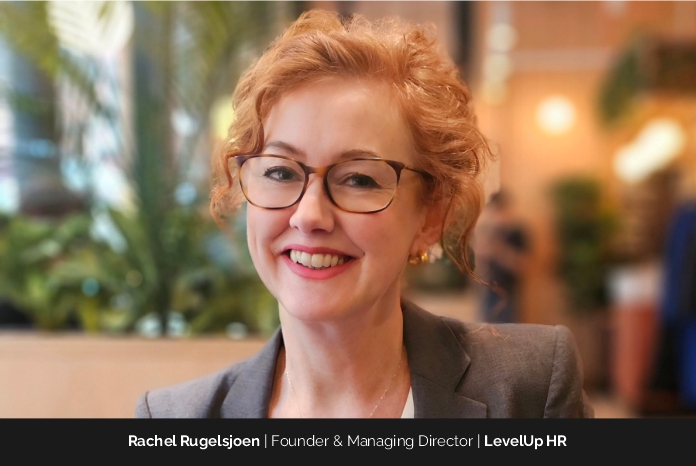
Rachel Wilson Rugelsjøen is the Founder and Managing Director of LevelUp HR, a strategic HR consultancy based in Norway. With more than 20 years of international experience across investment banking, technology, energy, and complex global organisations, she works with leaders who understand that results are ultimately delivered through people, but that people do not thrive without clarity.
At the heart of Rachel’s work is a simple but often overlooked belief: organisations rarely fail because they lack ambition, talent, or strategy. They fail because leadership decisions become blurred, accountability weakens, and the human impact of change is underestimated. When that happens, even the strongest business models begin to fracture. “I don’t believe organisations have ‘people problems’,” Rachel says. “They have leadership, design, and decision-making problems, and those show up through people.”
Oftentimes, she explains, what looks like a people issue is friction that has been built into the organisation itself, through unclear roles, overlapping responsibilities, and no clear handover points. LevelUp HR exists to address exactly that.
The human factor: what breaks organisations
Rachel’s interest in HR wasn’t sparked by a single defining moment, but by a growing curiosity about how organisations unravel. While studying business and economics, alongside psychology and neuropsychology, she found herself drawn to high-profile corporate collapses, organisations that appeared successful on paper but ultimately failed. Enron. Barings Bank. British Energy. Different industries, different contexts, but familiar patterns.
“When you look beyond the headlines, it’s rarely just about systems or controls,” she explains. “It’s about how people behaved under pressure, how decisions were made or avoided, and what leaders chose not to confront.”
That curiosity led her naturally into HR, not as an administrative function, but as a strategic one. Early in her career, she trained in the HR business partner model within global organisations and investment banks in London, working in fast-paced, high-stakes environments where judgement mattered as much as technical expertise.
“In those environments, HR can’t sit on the sidelines,” she says. “You’re expected to understand the business deeply, challenge leaders respectfully, and help them make decisions that carry real consequences.” That foundation shaped how Rachel still works today.
From global corporates to building something deliberate
After more than two decades in senior HR and Chief of Staff roles, including positions at Merrill Lynch, Barclays Capital, the Norwegian Oil Fund, and Cognizant, Rachel began to feel a pull toward working differently. It wasn’t about stepping away from complexity. It was about engaging with it more directly.
The COVID-19 pandemic sharpened that instinct. At the time, Rachel was Head of HR for Norway at Cognizant, navigating what she describes as a profound people crisis. “Suddenly leadership became deeply personal,” she says. “We weren’t just talking about performance and delivery. We were talking about fear, health, isolation, and responsibility.”
For Rachel, the pandemic exposed both the fragility and the potential of leadership. HR teams became counsellors, crisis managers, translators of uncertainty. And many leaders, for the first time, truly saw the value of experienced people professionals. “That period reinforced something I already believed,” she says. “HR is not there to soften decisions. It’s there to help leaders make better ones.”
When a subsequent role in a retail start-up ended in bankruptcy in less than a year, it became an unexpected turning point. “It was painful, but invaluable,” Rachel reflects. “I saw first-hand what happens when ambition outpaces structure, when clarity comes too late, and when people are left carrying uncertainty without direction.” Rather than returning to a corporate role, she chose to build LevelUp HR.
LevelUp HR: senior judgement, not volume HR
LevelUp HR is not a traditional consultancy, and that is by design. “I’m not interested in selling HR as a commodity,” Rachel says. “My clients don’t need more frameworks, policies, or junior consultants cycling through their organisation. They need experienced judgement.” They need someone who can join the dots, work holistically, and think strategically, understanding that decisions made now shape outcomes months or years later.
LevelUp HR works with a small number of clients at any one time, often in periods of change, growth, or pressure. Rachel embeds herself closely with leadership teams, acting as a strategic advisor rather than an external supplier. Her work spans organisational design, leadership development, workforce strategy, change and transformation, and complex people decisions, often where there is no obvious “right” answer. “What I offer is clarity,” she explains. “Clarity about roles, expectations, decision rights, and leadership behaviour. Culture follows from that, not the other way around.”
Some clients refer to Rachel as a “culture architect,” but she’s quick to clarify what that really means. “Culture isn’t posters or values statements,” she says. “It’s the accumulation of decisions, behaviours, and trade-offs over time. If you want to change culture, you have to change what leaders do consistently.”
And HR does this by designing people processes that pull in the same direction, from incentive structures and reward systems, to career development, talent acquisition, and how performance is recognised and reinforced.
Clarity, compassion, and commercial courage
Rachel is clear that compassion and performance are not opposing forces. “In leadership, compassion without action isn’t helpful,” she says. “And accountability without humanity doesn’t last.”
Her approach is grounded in what she calls courageous compassion, the ability to hold people to high standards while recognising the human reality of work. That means naming friction, addressing underperformance early, and designing organisations that reduce unnecessary strain. “Often, people are exhausted not because the work is hard,” she explains, “but because the organisation is unclear. Overlapping responsibilities, unclear priorities, constant change without explanation, that drains energy fast.” This is where Rachel’s commercial edge becomes evident. She speaks fluently about risk, cost, and execution, not just engagement. “I care deeply about people,” she says. “But I also care about results. Those two things must be equally weighted. They are inseparable.”
Leadership today and the reality for women
Having spent much of her career in male-dominated industries, Rachel is thoughtful and realistic about leadership as a woman. “There’s often an unspoken expectation that women will absorb emotional labour,” she notes. “That we’ll smooth things over, carry complexity quietly, and keep things moving.” Her response has been to lead with calm authority, clarity, and credibility. “I don’t lead by being the loudest voice in the room,” she says. “I lead by asking the questions others avoid, and by staying steady and curious when decisions are uncomfortable.”
For Rachel, modern leadership is less about charisma and more about judgement. Less about certainty, more about sense-making. “People don’t need leaders to have all the answers,” she says. “They need leaders who keep learning, think clearly under pressure, and act with integrity.”
Growth on purpose
Almost four years after founding LevelUp HR, Rachel is proud of what she has built, and equally proud of what she has chosen not to build. She runs a lean operation, supported by trusted specialists where needed, and has grown steadily without external investment. Over 75% of her clients return, some working with her for several years. “I’m not chasing scale for its own sake,” she says. “I’m interested in depth, impact, and work that genuinely matters.”
Looking ahead, Rachel plans to continue working with leaders who are open to challenge and want to do the hard work of building organisations that perform without burning people out in the process.
A message to aspiring leaders
For those building careers in HR or leadership, Rachel offers grounded advice. “Develop your business acumen,” she says. “Understand how the organisation actually makes money, where risk sits, and how decisions ripple through the system.”
And understand that leadership is not about carrying everything alone. Strong leaders build capability around them, invite challenge, and design organisations where responsibility is shared rather than silently absorbed. She also encourages leaders not to hide behind tools or trends. “Technology and AI can help,” she acknowledges, “but leadership is still relational. Trust, judgement, and credibility can’t be automated.”
Ultimately, Rachel believes leadership today demands two things that are simple, but not easy: curiosity and clarity. Curiosity to keep asking better questions. Clarity on what business results need to be delivered, and how to deliver them through people who thrive.