
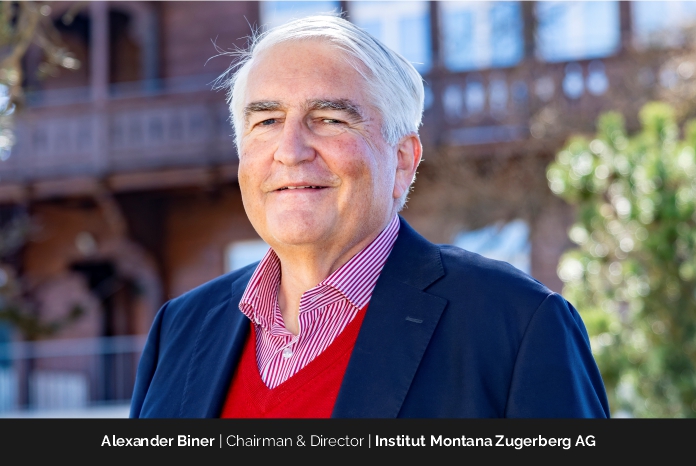
Alexander Biner is Chairman and former Director of Institut Montana Zugerberg AG. After studying business at Institut Montana Zugerberg and St.Gallen (HSG) and completing a master’s in International Relations at Johns Hopkins University, he began a career in banking in Switzerland. He later joined a boutique consultancy company in 1989 and transitioned out of a fulfilling role there in 2015. In 2011, he became Chairman at Institut Montana and took on the role of Director as well in May 2018, bringing his passion for education and long-standing connection to the school to help young adults reach their full potential.
Leading Education Through Experience
Alexander grew up in Zermatt with a Swiss father and an American mother. Surrounded by an international environment, he gained a love for the mountains. In 1970, he found himself at Institut Montana, where he studied the Swiss Matura, specialising in business and law. From there, he went on to study business at St.Gallen (HSG) before doing his master’s in international relations at Johns Hopkins University.
After Alexander returned to Switzerland, he began a career in banking. He later joined a boutique consultancy company in 1989 and transitioned out of a fulfilling role there in 2015. Since 2011, he has been Chairman at Institut Montana and took on the role of Director as well in May 2018 (until summer 2023).
Reflecting on his path, he says, “My educational journey travelled from a small primary school in the mountains of Switzerland, through eight years as a boarder at Montana, to universities in Switzerland and the United States. Finally, I ended up leading my old school on its Board and as its Director.”
Alexander recalls that he learnt many things along the way. “They convinced me that a holistic approach to schooling is the most valuable way we can help our students get the best out of their time with us. Schools are about a lot more than standardized testing and grade points; students are individuals, and it is up to us, the educators, to take account of that in everything we do. It is the responsibility of leadership in education to make sure that happens in your school,” he observes.
With his passion for education and as an alumn of the same school where his younger brother and son also had the opportunity to learn, Alexander knows that Institut Montana offers students a truly unique, educational environment, and he aims to leverage that to help young adults reach their full potential.
Values That Shape the Future
At the heart of the school’s philosophy lies a simple conviction: every child carries within them a unique talent waiting to be discovered. The school’s mission is to unlock that potential by nurturing curiosity, confidence, and a lifelong love of learning. This belief shapes the role of educators as well – teachers are not merely instructors, but guides whose most important task is to ignite a passion for learning that will stay with students long after they leave the classroom.
In turn, the role of a school extends beyond academic preparation; it is to equip young people with the mindset and resilience needed to face the challenges of the future. Within a compassionate environment where students feel understood and supported, learning becomes more than achievement – it becomes the foundation of confidence and personal growth.
Alexander reflects that leading the school through its 100th anniversary is a big responsibility, even more than ensuring a celebration worthy of reaching 100 years. For him, there is also the responsibility for what comes next. He sees it as a responsibility to the school itself and explains that they are using this milestone to take stock, adding with a smile that he needs to “organize a good party too.”
“We need to understand what it is about Montana that is special and use that understanding to build for the future, asking what needs to be done to keep providing a meaningful Montana education for generations of students to come and continue to help young people in our care to shine,” he observes.
Alexander describes it as a responsibility to the school’s mission and believes the school’s core values, the 4 Is, must continue through students to have an impact on a world that needs them. At Institut Montana, he speaks of an international mindset that sees people as citizens of the world and believes that the big problems of maintaining a planet that sustains life, using information technology responsibly, and preserving a humanist outlook in the face of hatred can only be resolved with a mindset that sees solutions beyond borders.
Alexander stresses the need for confident individuals who can think for themselves and cut through the misinformation overwhelming society, emphasising that integration is essential to making Internationalism and Individualism work in harmony. “Innovation is key; conventional solutions are quickly outdated. Students will need to be agile, clear thinking, and determined,” he says.
Moments That Defined Montana’s Path
Alexander reflects on the defining moments that shaped the school’s legacy at Institut Montana. He notes how the passion of the founder created a school firmly rooted in enduring values and enabled recovery from a financial crisis in 1995, when Montana was rescued by a concerted effort from its cohesive and loyal community, continuing to look to the future with a strong reiteration of its original values.
He also recalls how, during COVID, they watched and took pre-emptive action so that, when schools had to close in March 2020, they were ready and the team was skilled up so that not a day of student learning was lost. Systems were dynamic and flexible and could adapt as restrictions came and went, and boarders who could not travel were cared for in the school as their home.
Alexander acknowledges that guiding any old institution brings challenges, from maintaining and updating historic buildings to keeping them fit for purpose to finding the finance to do so, as well as other, more subtle challenges. He believes that the balance between tradition and innovation is a core characteristic at Institut Montana, where diversity brings an approach that is always self-critical and constantly reassessing the situation, while discouraging attitudes that lead to organizational atrophy.
“Specifically in education, we have found that working with the CIS on accreditations is a vehicle that keeps us continually on our toes. At the same time, we honour those traditions that bring smiles to faces, like the annual visit of Samichlaus or a bit of magic and mayhem at Halloween,” he shares.
Bringing Montana Together
Alexander reflects on a meaningful achievement during his tenure at Institut Montana, saying it has been the way a school comprised of two sections with differing programmes has learned how to work together, adding that this helped them see how they all share the same educational goals.
“There was a history of developing separation and ensuing tensions. We have introduced ways of getting people together to identify what is essentially Montana and how we all share the same educational goals. We are using the term The Montana Learning Experience to help us understand what is special about Montana,” he explains.
He explains that the school was set up by its founder on a specific, clearly stated set of values that have seen it through the past, help with current questions, and guide its future direction. For him, it is not about his values, yet he believes absolutely in the values carved into Montana’s history by its founder because they align with his own.
He notes that Institut Montana prides itself on being a family-like community, and the school’s small size helps it achieve the warm relationships that are part of how Montana does education.
Innovation That Keeps Montana Growing
Alexander reflects on the role of innovation in staying relevant at Institut Montana. He notes that people often speak about the changing world and how different things will be when current students leave school, and that education needs to embrace innovation to stay with the flow. “Moving beyond the mantra, the important role of innovation is to keep us looking hard at what we do and never assuming that we should keep doing it in the same way,” he adds.
Alexander explains that any organization can develop a tendency to iron creases into the fabric of how it does things and keep on doing them creating a permanent crease. An innovative approach is to ask questions that prevent that from happening.
“Our school motto, ‘My Place to Grow’, fits into this way of looking at the question. We provide the optimal conditions for our students to grow into healthy, responsible adults. At the same time, we, as an organisation, are continually learning and growing too,” he explains.
Advice Rooted in Real Purpose
Alexander warns aspiring educational leaders to beware of empty visions and meaningless missions. “Beware of the empty vision and meaningless mission that comes with corporate speak,” he cautions, adding, “Education is different. You need to ask – why is my school here? The answer will be quintessentially about your school.” He describes the school’s purpose as educating the internationalists of tomorrow, whatever their future paths might be, with an aim to help each student grow into an open-minded, kind, critical thinker and global citizen.
“Many students find a place at our school where they can, through individual attention and supportive teachers, succeed in ways they never thought possible,” he elaborates. “Yes, we have a lot of very privileged young people on our beautiful campus. Our school is here to help everyone of those become an open-minded, kind, critical thinker and global citizen with an enthusiasm for life and learning. Quite a goal! You really have to know your school and how it can make a difference. That is how you can make a difference in education.”
Alexander emphasizes that truly knowing the school and understanding how it can make a difference is the key to making a meaningful impact in education. “You really have to know your school and how it can make a difference. That is how you can make a difference in education,” he concludes.
Shaping the Future of Global Education
Alexander Biner clarifies that when discussing global education, he focuses on how he believes it should evolve rather than trying to predict it. He frames the discussion around international education, describing it as a specific educational philosophy and practice with its own set of programmes.
He explains that education around the world should, and in many places is, becoming more like international education. This approach was developed so that schooling could remain free from nationally or politically based interpretations of what should be taught and how.
It aims to create curricula that view knowledge as supra-national, not defined by any particular nation’s perspective. Cultural history and many languages are taught without suggesting that one culture is superior to another. Independent, critical thinking is encouraged, along with tolerance and open-mindedness.
“Montana is not just preparing for this evolution. It is part of it already. We have national and international programmes, which is who we are. At the same time, we have wonderful teachers who work to bring those qualities of international education to their teaching right across the school. Montana is shaping students to be open-minded, critical thinkers and global citizens, fully prepared to engage with the world,” he affirms.
Conclusion
For Alexander Biner, the lasting impact of Institut Montana lies not in any individual, but in the strength of the school’s values. He notes that teachers and future leaders are drawn to the school because they support its mission and want to be part of it, while future students will discover a happy, thriving community that lives its vision. For him, the true measure of legacy is not his own, but the values that the school continues to contribute to the world.