
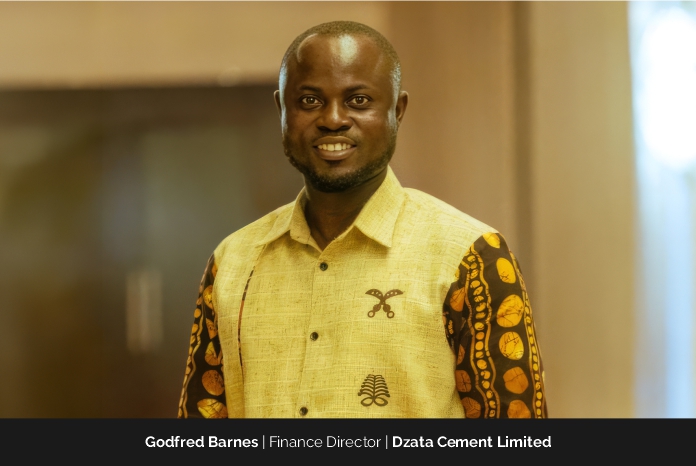
Godfred Barnes, Finance Director at Dzata Cement Limited, is a seasoned finance professional with over a decade of experience in accounting, finance, taxation, e-commerce, systems, and data analytics. Renowned for his strong financial modelling skills, he brings deep practical expertise and a results-driven approach to financial management.
Godfred is a member of the Institute of Chartered Accountants, Ghana (ICAG), the Chartered Institute of Management Accountants, UK (CIMA), the Institute of Certified Forensic Investigative Professionals (ICFIP), and the Chartered Institute of Taxation, Ghana (CITG).
He holds a Master of Arts in Tax Law, Policy and Practice from the University of Ghana School of Law, and a Bachelor’s degree in Business Administration from SMC University, Switzerland. He also obtained a First-Class Higher National Diploma in Accounting from Cape Coast Technical University.
A Love For Numbers And Opportunity
Growing up from Senya Beraku in the Central Region of Ghana, Godfred was told that, after doctors, the second most paid job is a Chartered Accountant, “because a chartered accountant can work at five different companies at the same time.” He also recalls a senior friend, Richard Bonney, who told him, “We do not learn mathematics, we work mathematics.” That thinking, coupled with his love for numbers, influenced his early life.
Godfred began his career at Ghacem Limited, where he spent over eight years rising from an intern to Acting Chief Accountant. During this time, he played key roles in major initiatives, including the implementation of e-commerce systems across Africa and the East Mediterranean cluster of the HeidelbergCement Group, and managed a large customer and supplier portfolio as Head of Accounts Payable and Receivable.
Leadership Lessons From A Unique Workforce
Godfred’s role at Dzata Cement reaffirmed the popular saying that leaders are meant to serve, not to be served. The early setup of Dzata was unique because the carpenters, masons, steel benders, and other labourers who were used to build the factory later formed the core base of the employees.
These were people from diverse backgrounds outside the field of manufacturing who carried the pride of building the factory from scratch and deserved constant recognition as pioneers of the company. “To be able to lead these working teaming individuals, you need to be more than a leader; you must act, lead, and work like them,” he explains.
This experience helped Godfred understand people from a wide range of perspectives and challenged him to find ways to be like them while still guiding them to accept his principles and style of work. “I’ve learnt in these few years at Dzata more than my entire years in the classroom,” he explains. “Even though it’s a high machinery manufacturing sector, I came to understand that I’m not only managing plants or machines, I’m also managing people and processes, all deserving of equal and critical attention.”
A Defining Leap Of Faith
One of the most defining challenges of Godfred’s career was resigning from a globally known third-largest cement manufacturing company, HeidelbergCement, where he served as Acting Chief Accountant at the age of 34, to join a new locally owned cement manufacturing company that was starting afresh at the same Chief Accountant position.
The move came at a particularly sensitive time in 2021, when the company was owned by an indigenous entrepreneur, and a philanthropist whose brother, a former President of Ghana, had lost the 2020 elections. Many well-meaning people around him advised Godfred not to take such a risk. “All the contacts I had built were from the company I was resigning from, since I started there as a student and rose to the rank of Chief Accountant,” he explains.
Leaving also meant walking away from relationships built over nearly nine years with friends, senior colleagues, and what he considered family. His career path at HeidelbergCement was clear and well defined, while the future at Dzata was uncertain. After extensive consultations and reading timely articles from CIMA newsletters on when to change jobs, he decided to move forward. “My reasons were simple, I would rather try and fail than not try and regret that I did not try,” he reflects. While Dzata will afford me the opportunity to learn new things, I also saw it as a call to national duty for its being the first indegnious cement manufacuturing company in Ghana.
Mentoring The Next Generation Of Leaders
One of Godfred’s proudest accomplishments has been leading a team of young, energetic professionals, many of whom were fresh from school or had no prior experience in cement or manufacturing. While he initially hoped for team members with industry experience to complement him, he understood the owner’s vision of nurturing a new generation to approach the industry differently from the foreign-dominated landscape at the time.
“My biggest achievement is training these dedicated young men,” he notes. “I created sections within the department, positioned each for each section, and trained them by working hand in hand until they could operate independently.” Reflecting on the success of his mentorship, Godfred notes his satisfaction in seeing one of these young men succeed him as Chief Accountant when he moved to the role of Finance Director. “I train by practical demonstration with full hands-on,” he says. “These are the ones running the department while I focus more on compliance and strategic guidance.”
Africa’s Cement Future and Financial Discipline
Godfred observes that the future of construction, and cement for that matter, is Africa, with Ghana serving as the gateway to the continent. The industry has evolved significantly from a single producer, Ghacem, holding a 33-year monopoly to a diversified landscape now featuring about 14 cement manufacturing companies, with more likely to enter the market. “Our main goal is to keep producing the best product while keeping production costs at their minimum and giving back the savings to the Ghanaian people,” he notes.
Godfred emphasises that Dzata Cement carries a unique national identity as the only wholly indigenous cement manufacturing company built by the people themselves. This places a responsibility on the company to prioritise value and accessibility for the local market. “Dzata is the only wholly indigenous cement manufacturing company that was built by the people themselves and therefore must be for the people,” he emphasizes. Dzata Cement is a growing challenger brand in Ghana’s cement industry with an estimated low-to-mid single digit market share, trending upward every year. The Company is currently number 1 when it comes to cement for mining, block moulding , road construction and high rising projects due ot its unique products.
Technology, according to Godfred, plays a critical role in strengthening financial accuracy and transparency within the sector. Reducing the human element in financial processes helps minimise errors while enabling automation and stronger security systems that support effective oversight. “Technology takes away the human element while ensuring proper automation and stringent security measures,” he explains. “These systems ultimately strengthen financial governance across the business. This helps with revenue assurance and cost control measures.”
Balancing Discipline With Long-Term Vision
Godfred notes that financial discipline ultimately exists to protect livelihoods and ensure continuity, and that balancing financial discipline with innovation at Dzata Cement is rooted in the vision of the company’s sole owner, Mr. Ibrahim Mahama. When tensions arise between strict financial discipline and long-term investment, the company prioritises sustainability and the broader impact of the business.
“At Dzata, the motto is Building for Generations. How do we build for generations without long-term competitiveness and innovation in mind?” he asks, adding, “Financial discipline is nothing if it is not done to save jobs and sustain the livelihood of the thousands of people he has employed and their families.”
Dzata Cement’s contribution to Ghana’s economic development goes beyond manufacturing cement. In an industry largely dominated by foreign companies, the presence of a wholly Ghanaian-owned manufacturer has created a renewed sense of national pride. “Dzata Cement has given the Ghanaian people a sense of nationalism,” Godfred explains.
Beyond this symbolic value, the company plays a tangible role in strengthening the country’s economy through employment and fiscal contributions. “Job creation and sustainability of family livelihood, coupled with contribution to direct and indirect taxes, help build the state,” he observes.
Faith, Humility, and Purposeful Leadership
Godfred approaches work-life integration through a simple guiding order of priorities. Outside of work, he’s a devoted husband to his wife, Irene, and a proud father of three daughters, Awompa , Nasey and Awoatobi. For him, faith and family come before professional responsibilities, but each must be given its rightful time and attention.
“God first, family second, the rest is work,” he explains. “I’m guided by the Bible principle that says there’s an appointed time for everything. When it’s time for work, God and family do not come, and the opposite is also true.”
Reflecting on the impact he hopes to leave on future generations of finance professionals, Godfred believes leadership must be grounded in humility and openness to learning from others, and that meaningful knowledge often comes from everyday interactions, not only from formal education. “Everyone deserves a chance. There’s no human being who’s a waste. We have more to learn from people around us than we’ve learnt from the classrooms,” he reflects.
He also notes that learning new things often requires letting go of outdated thinking and approaching leadership with humility. This is essential for both personal growth and effective leadership. “To learn the new and unlearn the old, you need humility to learn from others and to get others to follow you,” he explains.
For aspiring finance leaders who want to make a meaningful difference in large-scale industries, Godfred stresses the importance of integrity, openness, and people-focused leadership. “Keep your focus, be honest and sincere and transparent,” he advises. “Don’t appear to know it all, otherwise no one will give you their input. Be open to suggestions and invest in people and processes just as you invest in machines and tools.”
The unique Spotlight
Rising from a student intern to Director of Finance within a span of 12 years in the cement manufacturing sector—and having made bold and defining career decisions along the way—Godfred has established himself as one of the finest finance professionals in one of the country’s most competitive industries.
At under 40 years of age, this achievement underscores his exceptional capabilities. He is widely recognized for his strong cost control discipline, outstanding negotiation skills, and admirable interpersonal approach. His ability to deliver timely and strategic tax advisory services has consistently driven significant tax savings, reduced operational costs, and strengthened bottom-line performance.
He has also led the deployment and integration of artificial intelligence–driven solutions across the organization, enhancing revenue assurance, improving workforce efficiency, reducing turnaround times, and reinforcing inventory control systems—all of which have contributed meaningfully to sustained profitability.
Conclusion
Through his journey in Ghana’s evolving cement industry, Godfred Barnes has demonstrated that effective leadership in finance extends beyond numbers to people, purpose, and long-term vision. As Finance Director at Dzata Cement, he has combined financial discipline with innovation, helping guide a proudly indigenous company in a competitive and rapidly expanding sector. Grounded in humility, service-oriented leadership, and a commitment to national development, Godfred continues to shape a legacy that prioritises sustainable growth, opportunity for others, and value for the communities the business serves.