
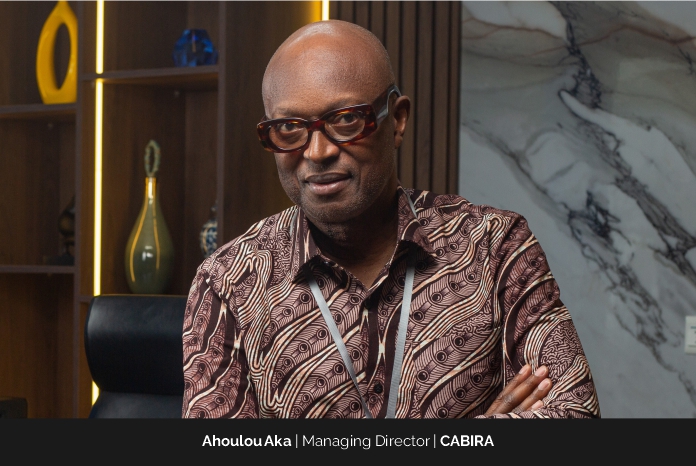
In the ever-changing world of African infrastructure and engineering, few tales embody the spirit of perseverance, intellect, and transformation like that of Ahoulou Aka, Managing Director of CABIRA. His story is not one of company formation, per se, but of a vision to boldly challenge the status quo that has for so long constrained the understanding of African intellect.
Since the inception of his vision, Ahoulou has always recognized that the challenges he would face would not only be those of intellect but of psychology. In a world where his credentials would have been imported and his integrity externally validated, he has instead built a brand of leadership that has consistently redefined what it means to lead, not through the importation of external validation, but through the consistent demonstration of excellence that has come to open doors that were once forever closed.
The story of Ahoulou is one of perseverance, of every challenge being a lesson and every achievement a testament to the power of quiet conviction.
The Origins of a Vision: From Observation to Action
Every transformative journey begins with a moment of clarity, and for Ahoulou Aka, that moment emerged early in his career as an electromechanical engineer. His professional path was shaped by experiences that not only influenced his technical thinking but also ignited a larger vision, one that would eventually lead to the creation of CABIRA.
During his advanced training in high-voltage engineering between 1986 and 1987 in Western countries, Ahoulou observed a model that left a lasting impression. Young engineers were encouraged to create their own enterprises within their areas of specialization. They were entrusted with solving precise engineering challenges, supported by structured contracts and fairly remunerated service orders. This model of technical entrepreneurship demonstrated how knowledge could be translated into ownership and innovation.
However, it was upon returning home that his vision truly crystallized. Ahoulou noticed a striking imbalance, Western consulting firms were charging electricity companies across Africa excessively high fees for solving problems that local engineers were equally capable of addressing.
“We possessed the same knowledge and technical foundations,” he explains. “My initial motivation was therefore clear: reduce those engineering costs in Francophone Africa while maintaining the same level of technical rigor and quality.”
This realization marked the beginning of CABIRA, not just as a company, but as a response to a systemic inefficiency and a broader issue of undervaluation.
Challenging Perceptions: Leadership Rooted in Belief
The early years of CABIRA were defined not by rapid growth, but by resistance and exclusion. Shortly after founding the company on September 4, 1994, Ahoulou Aka encountered a reality that would shape his leadership philosophy for years to come.
“The greatest barrier was not technical, it was psychological,” he asserts.
This realization was personally important to him. He tells of an anecdote from his youth, in which an elder he respected challenged his aspirations to become an electrical engineer, saying, “Why do you want to be an engineer when the Whites have already invented everything?” This was an expression of a deep-seated understanding, one that underestimated the intellectual ability of the African.
CABIRA was created in direct response to this understanding.
The initial six years were difficult. The firm had no recognized experience and could not get access to donor-funded projects. It was not even considered in the shortlisting process for smaller projects. The decision-makers did not consider it worthwhile to entrust complex intellectual work to a local firm, considering it a risk. Ahoulou could have given in to these constraints, but he instead used them to his advantage. CABIRA specialized in organizing innovative training programs and worked on smaller national missions, overseeing small network extensions, and electrifying villages.
“We invested our first revenues in specialized software, professional standards, and scientific publications,” he explains. “Professionalism had to be demonstrated through measurable rigor, not declared.”
At the same time, he worked to transform the mindset within his team. Ahoulou encouraged both men and women in the organization to overcome inferiority complexes, to commit to continuous learning, and to trust in their capabilities.
“Excellence requires intellectual discipline and self-belief,” he says. This dual focus, on technical capability and psychological empowerment, became the cornerstone of CABIRA’s identity.
The Cost of Commitment: Sacrifice and Persistence
Building an organization capable of challenging global perceptions required more than vision, it demanded sacrifice. For Ahoulou Aka, the journey of leading CABIRA came at a significant personal cost.
“For more than twenty years, I had virtually no personal life,” he admits.
His workdays were long and relentless, often beginning early in the morning and extending late into the night. Even after returning home, work continued. Weekends and holidays were rare, as his commitment to the company remained absolute.
It was during this time that he traveled extensively throughout West Africa, promoting the vision of CABIRA and searching for opportunities to build credibility. Yet, he was often encouraged to form an alliance with a Western company, an offer which came with limitations. This meant that the African companies would only be involved in secondary roles, such as data collection, and not in any technical capacity. This was not an option Ahoulou was willing to accept, as it undermined his idea of independence.
Yet, there was a breakthrough in 2000 and 2001, when a Western company offered CABIRA a major subcontract role. This allowed them to gain some important experience and build their credentials. Although this was not a major breakthrough, it showed that with perseverance and determination, Ahoulou could eventually find the recognition he wanted.
A Turning Point: Proving Capability Through Results
The year 2004 marked a defining moment in CABIRA’s journey. After years of persistence and preparation, the company secured major projects in Togo and Benin, an achievement that would reshape its trajectory.
An influential Egyptian professional recognized the value of CABIRA’s commitment to promoting African expertise and advocated on its behalf. This support led to the introduction of more inclusive selection criteria, creating genuine equal opportunity.
“We won two major contracts through rigorous procurement procedures,” Ahoulou recalls. “These successes surprised some established international firms.”
The projects were executed with precision and adherence to the highest professional standards. High-voltage infrastructure supervised by CABIRA was successfully commissioned and remains fully operational today.
“Our objective, reducing engineering costs without compromising quality, was achieved,” he explains. These successes not only validated CABIRA’s capabilities but also challenged prevailing assumptions about local firms’ ability to handle complex assignments.
Resilience in the Face of Structural Challenges
Despite these achievements, the challenges did not disappear. One of the most persistent obstacles Ahoulou Aka continues to face is the enduring belief that local firms are incapable of managing complex engineering projects.
“Even with proven results, this stigma continues,” he says.
In recent years, additional barriers have emerged, such as implicit requirements for international certifications like ISO standards. While these requirements can be justified in principle, they often disproportionately affect local firms. Rather than resisting these changes, Ahoulou responded strategically. CABIRA obtained ISO 9001 certification and continues to pursue additional certifications to strengthen its credibility.
“My conviction remains simple: sustained excellence is the most powerful answer to structural exclusion,” he asserts. This approach reflects his broader leadership philosophy, addressing challenges not through complaint, but through action and continuous improvement.
Inspiring the Next Generation
For Ahoulou Aka, leadership is not defined by titles or recognition, but by impact. He believes that the true measure of his work lies in the example it sets for future generations.
“If there is an impact, I hope it lies in demonstration rather than discourse,” he explains.
Through CABIRA, he has shown that a local African firm can successfully execute complex missions traditionally reserved for international consultancies. By insisting on intellectual participation and refusing to remain confined to subordinate roles, he aims to inspire a new generation of leaders.
His message is clear: competence, integrity, and discipline are the foundations of sustainable success.
A Philosophy of Knowledge and Growth
At the heart of Ahoulou’s leadership philosophy is a deep respect for knowledge. He draws inspiration from the ideas of philosopher Bertrand Russell, emphasizing the importance of moving beyond basic understanding toward structured and refined knowledge.
“True understanding gives structure to raw knowledge,” he explains.
He encourages aspiring leaders to invest in intellectual development, adopt high-performance tools, and align with global standards of excellence. For him, competing internationally is not about imitation, but about achieving parity in rigor and capability.
“Leadership requires courage, both technical and moral,” he adds. This perspective underscores the importance of continuous learning and the willingness to challenge one’s own limitations.
Innovation with Purpose
Innovation at CABIRA is not driven by trends, but by necessity and context. Ahoulou emphasizes that true innovation lies in the ability to design solutions tailored to local realities.
“We invest in advanced technologies and certifications, but innovation is not imitation,” he explains.
The company fosters a culture built on intellectual legitimacy, inclusion, responsibility, and high standards. This approach ensures that innovation remains both practical and impactful.
Looking Ahead: The Future of African Engineering
As Africa continues to evolve, Ahoulou Aka sees immense potential in the energy sector. He believes that initiatives such as rural electrification, national transmission expansion, and renewable energy integration will play a transformative role in the coming decade.
“These developments will require high-level study and supervision missions,” he notes. “CABIRA intends to be fully involved in supporting this transformation.”
His vision for the future is one where African firms are not just participants, but leaders in shaping the continent’s infrastructure.
Conclusion: A Legacy of Intellectual Dignity
Ahoulou Aka’s journey is more than a story of professional success, it is a testament to the power of belief, discipline, and resilience. Through decades of effort, he has not only built a respected organization but also challenged deeply rooted perceptions about African capability.
“I hope to leave an intellectual, ethical, and human legacy,” he reflects.
For Ahoulou, this legacy is defined by the proof that competence knows no boundaries, and that excellence, when pursued with integrity, can overcome even the most persistent barriers. His story serves as a reminder that true leadership is not about conforming to expectations, but about redefining them, and in doing so, creating pathways for others to follow.