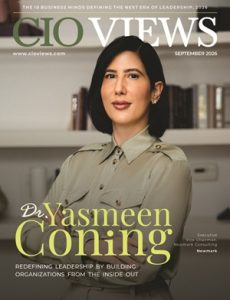

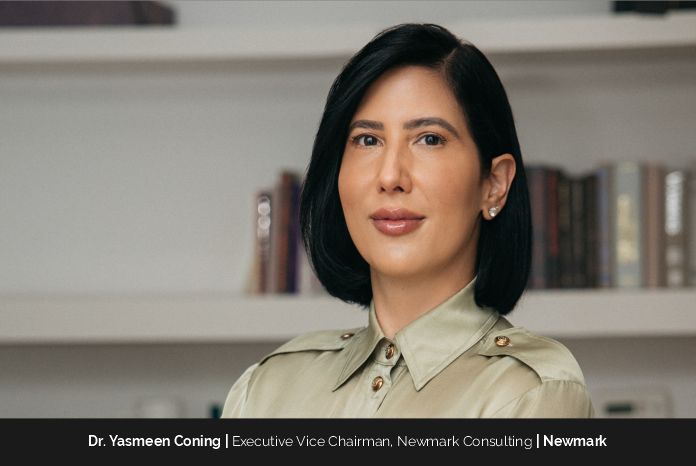
Dr. Yasmeen Coning, Executive Vice Chairman of Newmark Consulting Group (NCG), holds a Doctorate in Business and is an entrepreneur whose work focuses on the human drivers of business performance. She is the inventor of Collective Organizational Identification (COI™) and founder and Chairman of the Board of EMBER™, the first scientifically validated workforce performance system to demonstrate the causal relationship between workforce identity and measurable business outcomes, including innovation, customer experience, enterprise performance, and revenue. Her work is helping organizations transform culture from an abstract concept into one of the most measurable and actionable drivers of competitive advantage.
Putting People at the Center of Business Strategy
Across three decades in management consulting and entrepreneurship, Dr. Coning has focused on solving some of the world’s most complex business challenges. Throughout that journey, one question continued to surface: Why do so many organizations with sound strategies fail to execute them successfully? Her research led her to a clear conclusion: most large-scale transformations fail not because of flawed strategy, but because of cultural and behavioral barriers. While organizations invest heavily in financial engineering, technology, and operational planning; it is the human system, the engine of performance, which is too often treated as secondary.
Dr. Coning explains that organizational behavior is not a “soft” discipline but one of the most critical drivers of enterprise value. “AI is created and scaled by people. When alignment, identity, and belief are weak, even the best strategies struggle,” she says. In her view, the CEO, CMO and CHRO sit at the intersection of market behavior and human behavior, with employees representing one of a brand’s most important audiences. Her research on COI demonstrates that shared identity drives measurable business outcomes, showing that enterprise growth is ultimately determined by the strength of an organization’s people system.
“Organizations don’t execute strategy. People do,” Dr. Coning says. “Yet people are still too often treated as an afterthought rather than the strategic driver of business performance. Organizational behavior isn’t only an HR responsibility. It belongs at the center of the executive agenda. The greatest competitive advantage any organization has isn’t technology or capital; it’s the belief system of the people who show up every day. That belief shapes the employee experience, which ultimately shapes the customer experience. And creating that belief starts at the top.”
Moving Beyond Engagement to Identification as the Future of Culture & Workforce Performance
Dr. Coning developed COI to address a fundamental gap in how organizations measure workforce performance. Throughout her consulting career, one question continued to challenge her: if people are the engine of organizational performance, why do most organizations rely on tools that measure employee sentiment rather than the organizational conditions that drive business outcomes?
Working alongside C-suite leaders on mergers and acquisitions, spin-offs, large-scale transformations, organizational redesigns, and growth initiatives, she identified a consistent pattern: many of the most significant business challenges ultimately traced back to people. Transactions that appeared strategically sound often underperformed not because of the financial or operational rationale, but because organizations underestimated the human and cultural dynamics required to execute them successfully. This raised a fundamental question: if these are people-centric challenges with material business consequences, why aren’t organizations measuring the behavioral conditions that determine whether those strategies succeed or fail?
That question became the foundation for the development of COI, shifting measurement beyond employee sentiment to the organizational conditions that predict workforce performance and, ultimately, business growth. Traditional engagement surveys capture how employees feel at a given moment in time. While valuable, sentiment is inherently variable and can change from one day, or even one interaction, to the next. Dr. Coning’s research found that employee engagement was never designed to explain, nor causally linked to, enterprise outcomes.
To better understand and predict those outcomes, COI was developed to take a fundamentally different approach. Rather than measuring temporary feelings, it measures the degree to which employees identify with the organization and see its success as inseparable from their own. Because identification is rooted in an individual’s self-concept, it is significantly more stable than sentiment and provides a far more reliable lens for understanding the human conditions that drive organizational performance.
“Engagement tells you how people feel,” Dr. Coning explains. “Identification tells you whether they’ll help build the future of the organization. When employees see their own success as intertwined with the organization’s success, they collaborate differently, innovate more readily, solve problems together, and become stronger advocates for the brand both internally and externally.”
“Culture is not a vague organizational aspiration. It’s a measurable system that, when properly understood and managed, becomes one of the most powerful drivers of business,” Dr. Coning says. That conviction led Dr. Coning to commercialize COI through EMBER, the company and workforce performance system she founded to bring the research into practical use at scale. By enabling organizations to diagnose, measure, and strengthen the organizational conditions that drive identification, EMBER transforms culture from an abstract concept into a measurable driver of enterprise value.
Unlike engagement, which asks whether employees are satisfied or motivated, COI asks whether people truly identify with the organization and its future. “That distinction matters,” she says. “When identification is strong, employees don’t simply perform tasks. They actively contribute to growth, strengthen the brand, and invest their energy in creating value.”
Connecting Workforce Identity to Business Performance
Dr. Coning’s research was the first to establish a causal relationship between workforce identity and market growth. For decades, organizations have evaluated financial, operational, and market factors independently from the workforce responsible for delivering them. Her work connected those two worlds, revealing how workforce identity influences business performance from the inside out.
At the center of that breakthrough is EMBER. Today, the platform is supported by a growing first-party workforce database spanning more than 25 industries, including organizations across every Fortune 500 company, providing one of the most comprehensive datasets for understanding workforce and business performance at scale. By measuring and activating the drivers of COI at scale, EMBER enables leaders to understand how the human system inside the organization directly influences innovation, customer experience, enterprise performance, and ultimately revenue.
“This changes the conversation entirely,” Dr. Coning explains. “Historically, companies have managed financial performance and workforce performance as separate disciplines. Our research shows that they are connected. When leaders strengthen workforce identity, they are not simply improving culture. They are creating the conditions that allow strategy to succeed.”
For Dr. Coning, this represents a shift in enterprise leadership. Rather than managing culture as a soft organizational initiative, leaders can now understand, measure, and optimize it as a strategic business asset. Organizations that recognize business performance as a function of both strategy and the strength of their people system will be best positioned to thrive in an increasingly AI enabled world.
The Human Side of Transformation
Dr. Coning advises Fortune 500 leaders across finance, healthcare, technology, hospitality, and consumer goods. Across every industry, she has found that the most consistent driver of successful transformation is remarkably simple: leaders who recognize that change ultimately begins with people.
Dr. Coning’s perspective is that transformation has become one of the most overused words in business. True transformation represents a radical shift in how an organization operates, competes, or creates value. It is not a permanent condition, nor should companies remain in a constant state of transformation.
“Organizations don’t transform. People do,” Dr. Coning says. “Transformation is the culmination of many smaller shifts that eventually reshape the organization. When leaders ignore the human dimension, even the best designed transformation strategies struggle. Every transformation is ultimately a human transformation.”
If transformation is fundamentally human, then its success depends on the quality of leadership guiding it. Dr. Coning believes people follow leaders they trust. Culture changes when leaders consistently model the behaviors they want to see. One of the most influential leadership lessons she learned came from her father, whose philosophy in business has always been, “I’m going to be on your team before I ever ask you to be on mine.” That philosophy continues to shape her own approach to leadership. Before expecting commitment, leaders must first invest in their people’s success. She believes the most effective leaders lead with relatability, humility, and genuine curiosity.
Leaders who connect authentically create environments where people contribute their best thinking. They acknowledge uncertainty, invite others to solve problems together, and remain students of their own organizations, always looking beyond today’s challenges to anticipate what’s ahead. “When these qualities come together, leadership becomes a catalyst for alignment and performance,” Dr. Coning says.
Leadership Capabilities for the AI Era
As artificial intelligence becomes more deeply integrated into every aspect of business, Dr. Coning believes the greatest leadership challenge is not adopting AI but ensuring it amplifies rather than replaces human judgment. While AI is evolving decision making, workflows, and productivity, it cannot replicate the uniquely human capabilities that drive organizational performance, including creativity, critical thinking, collaboration, and shared purpose.
“The more digital work becomes, the more intentional organizations must be about designing environments where human interaction can thrive,” Dr. Coning explains. “Technology can process information, but people create meaning. AI can identify patterns, but insight requires context, judgment, and experience.”
For Dr. Coning, predictive intelligence is not about generating more data. It is about helping leaders make better decisions. “It’s not about the data. It’s about the insight,” she says. “Volume alone does not create clarity. Leaders need confidence that the information they’re using is reliable, scientifically rigorous, and capable of predicting meaningful business outcomes.”
Her perspective is that the organizations that will lead in the AI era will combine technological capability with behavioral understanding. The physical workplace, digital tools, culture, and leadership must reinforce one another, creating environments where people can think, collaborate, innovate, and solve problems together.
“The most effective leaders will not simply react to change. They will build organizations that adapt as a natural part of how they operate,” Dr. Coning says. “Technology will continue to transform how work gets done, but people will always determine how organizations create value. The future belongs to leaders who understand both.”
A Practitioner-Scholar’s Approach to Work and Curiosity
For Dr. Coning, academic research, consulting leadership, and innovation are not separate pursuits, but deeply interconnected. Her decision to pursue a doctorate was driven by a simple but profound ambition: to move from saying, “I think,” to being able to say, “I know.” In business, opinions are abundant, but evidence is far rarer because discovering knowledge that can be validated, replicated, and trusted requires extraordinary rigor. That pursuit of scientific truth continues to shape how she approaches every client challenge.
One of her professors once told her that once she began seeing the world through the lens of research, business would never look the same. “That turned out to be very true,” she reflects. “It changes how you interpret problems, question assumptions, and evaluate whether an idea is truly supported by evidence.”
As a practitioner-scholar, Dr. Coning works at the intersection of research and real-world application. Her research informs her work for clients, while the complex challenges organizations face continue to inspire new research questions. Together, they create a continuous cycle of inquiry, application, and innovation.
“‘I know’ statements are rare because they’re earned through rigorous scientific inquiry, not opinion,” says Dr. Coning. “Creating new knowledge is incredibly challenging, but also incredibly rewarding. There are still many important questions in business that remain unanswered and being able to explore those questions while helping leaders apply those insights in practice is both a privilege and a responsibility that I take very seriously.”
A Vision for Leadership Beyond Traditional Models
For Dr. Coning, being recognized as one of the “10 Business Minds Defining the Next Era of Leadership” is both an honor and a responsibility. It is less about personal achievement and more about advancing a broader understanding of the human dimension of business. She believes leadership must evolve beyond traditional models rooted in hierarchy and control to a model that recognizes people not as resources to be managed, but as the strategy itself. The most effective leaders create environments where people feel connected to a shared purpose, empowered to contribute meaningfully, and recognized not simply for what they do, but for who they are.
Dr. Coning views that the next era of leadership will require a deeper understanding of how human behavior, organizational identity, and collective purpose influence performance. In her view, culture, identity, and human performance are not secondary considerations but strategic assets that shape innovation, customer experience, resilience, and long-term growth. She also challenges the notion that people have one identity at work and another outside of it. Instead, she believes individuals bring the same values, beliefs, aspirations, and experiences with them every day, and that great leaders recognize that potential, nurture it.
Dr. Coning advises emerging leaders to begin with a simple realization: no matter how sophisticated technology becomes, organizations ultimately run on people. The greatest competitive advantage an organization can build is not technological capability or financial scale, but its ability to align people around a shared purpose, make it safe to challenge ideas, and build cultures where individuals see their success as connected to the success of the organization and the customers it serves.
She also emphasizes intellectual rigor and curiosity, noting that the most effective leaders remain students of their industries. They question assumptions, seek insight rather than noise, and surround themselves with people who challenge their thinking. Leadership requires both the courage to pursue bold ideas amid uncertainty and the humility to recognize that leadership is not about having every answer, but about creating the conditions where the best ideas can emerge.
“My vision for leadership is one where organizations treat people not simply as resources, but as the driving force behind innovation, resilience, and sustainable growth,” Dr. Coning says. “People often associate my work with HR because it focuses on organizational behavior, and HR plays an incredibly important role in bringing these ideas to life. But the implications extend far beyond HR. Organizational behavior is fundamentally a business discipline, one that shapes decisions made by CEOs, COOs, CFOs, CMOs, CHROs, and every leader responsible for enterprise performance. My doctorate is in business, and I have always approached organizations through the lens of business strategy. The evidence is clear. People are the engine of every business. If you want to improve innovation, customer experience, growth, or revenue, you have to start with the people who make those outcomes possible. The leaders who will shape the future will not simply be the ones who adopt the newest technology. They will be the ones who understand human behavior, remain relentlessly curious, challenge conventional thinking, and build organizations where people are aligned around a common purpose.”
The Future of Business Is Service
For Dr. Coning, the understanding that people are at the center of business strategy is reinforced by one of the most important developments in modern management theory: the shift to a service-dominant economy. She credits the pioneering work of Dr. Stephen Vargo and Dr. Robert Lusch, whose theory of service-dominant logic fundamentally changed how she thinks about business. Their research argues that organizations do not simply sell products. They create value by helping customers achieve outcomes through service.
One of the theory’s most influential ideas is the distinction between operand resources, such as products, assets, and capital, and operant resources, people whose knowledge, skills, and capabilities create value. For Dr. Coning, that insight reinforces a central theme of her own research: if people are the primary creators of value, then business performance depends on how effectively organizations align, develop, and activate them.
She sees that AI is accelerating this shift rather than replacing it. AI is transforming how services are designed, delivered, and experienced, but it does not change where value is ultimately created.
“The work of Dr. Vargo and Dr. Lusch has been foundational to how I think about business,” Dr. Coning says. “AI will continue to transform how value is delivered, but it does not change where value is created. Value is, and always will be, created through people. Organizations will not compete simply on what they produce. They will compete on how effectively they develop, align, and activate the people who create value.”
Bringing Research to Life Through a New Model of Consulting
Everything Dr. Coning has spent her career researching, building, and validating now comes together in her role as Executive Vice Chairman of Newmark Consulting. There, she is leading a new model of business strategy consulting with Chairman Susan Machtiger, former Ogilvy Consulting North America President. Built around “People, Purpose, Place, and Brand,” the model brings together business strategy, predictive intelligence, behavioral science, enterprise and AI transformation, workforce strategy, and brand into a single advisory approach. At its core is the scientific principle, informed by Dr. Coning’s research, that organizations perform at their best when every element of the enterprise works together as one integrated system, with people at the center.
Unlike traditional consulting models that often address business strategy, culture, and brand as separate disciplines, Dr. Coning believes they are all part of the same system. “Organizations don’t experience challenges in silos, and neither should the solutions,” she explains. “Our work begins with the business challenge the executive team is trying to solve. From there, we integrate strategy, people, workplace, brand, predictive intelligence, and AI into a single approach that helps organizations make better decisions and achieve measurable business outcomes.”
For Dr. Coning, Newmark represents a unique opportunity to redefine the role of real estate within business strategy. People and place are often two of the largest investments on an organization’s balance sheet, yet they have historically, and at times, been managed independently rather than as interconnected drivers of enterprise performance. Increasingly, organizations are recognizing them as strategic growth accelerants. In her view, the strongest workplace strategies begin with a deep understanding of the workforce. “We’re redefining what workplace means in real estate. Workforce is the new workplace, because every decision about place should start with understanding people. We’re moving the starting line from the building to the human beings inside it.” By understanding how people think, connect, collaborate, and perform, organizations can intentionally design workplaces and experiences that reinforce those behaviors. Whether someone enters a space as an employee or as a customer, brand is ultimately the lived experience of that environment.
Supporting this new, integrated consulting model is EMBER, Dr. Coning’s scientifically validated workforce performance system, which provides the predictive intelligence needed to bring greater scientific rigor to workforce strategy and, most importantly, business strategy and decision-making. EMBER strengthens NCG’s approach to business strategy by connecting an organization’s human drivers to transformation, leadership, workplace, brand, and AI, while, for the first time, enabling organizations to measure and influence their direct impact on revenue.
“We built our consulting model around the principle that people, purpose, place, and brand must work together as one integrated system,” Dr. Coning says. “When organizations align those elements, they make better decisions, adapt faster, execute more effectively, and create greater long-term value. This is the future of management consulting, and it is the model we are building at Newmark Consulting Group.”
Looking Ahead
Across research, consulting, and innovation, Dr. Coning is helping reshape how leaders think about business performance. By bringing scientific rigor to the human side of enterprise, she has challenged long-held assumptions about culture, leadership, workforce, workplace, and business strategy, demonstrating that these are not separate disciplines, but interconnected drivers of organizational success.
As organizations navigate an increasingly AI-enabled future, Dr. Coning’s provides a compelling vision for the next era of leadership, one where technology and data amplify human potential rather than replace it.
Ultimately, Dr. Coning’s work reminds leaders of a simple but profound truth: people are not separate from business strategy. They are the strategy. And the organizations that recognize that first won’t just adapt to the future, they’ll define it.