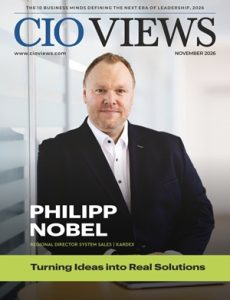

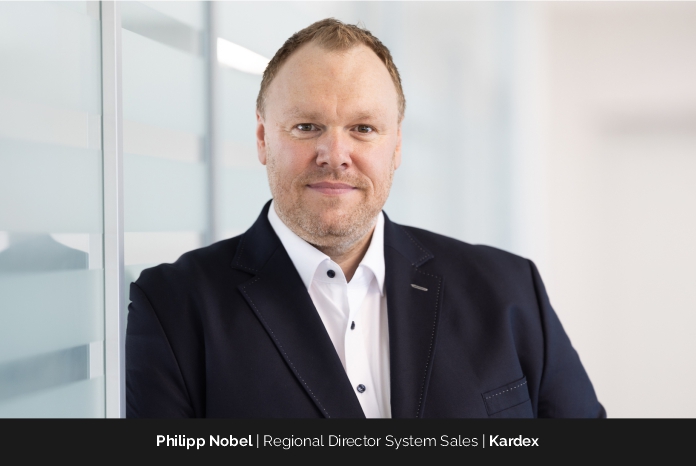
Philipp Nobel never let a title dictate his career direction. He is currently Regional Director System Sales at Kardex, a leading global partner for intralogistics solutions. But he did not begin his career in technology or management. He started in operational logistics. As he progressed and took on more responsibility, he became interested in why some processes work and others do not and, above all, in how they can be improved. This led him into process optimisation and project management, then into software and automation, and later into developing complete intralogistics systems.
At Kardex, which he joined in 2015, Philipp’s journey developed step by step, from software consulting to system sales, solution design, and broader responsibility for system solutions, and ultimately to his current international role. A holistic understanding of logistics and the ability to connect operational experience with technology, data, automation, and commercial thinking continue to define his professional path.
What fascinates him most about intralogistics, Philipp says, is how an idea can become a real solution, with an impact that can be clearly seen and measured.
Joining Kardex as Software Consultant
Philipp had wanted to work in consulting for a long time. By joining Kardex as a Software Consultant, he took the first step in that direction. He still remembers that during the interview, the HR manager commented that he had a very dynamic CV, with several companies, positions, and areas of responsibility. For some, this might seem like a disadvantage, but not to Philipp. It became one of his greatest strengths. According to him, he had seen logistics from many different perspectives and knew first-hand how processes work in reality, and where they do not.
Philipp started at a time when logistics was still heavily paper-driven. He recalls experiencing manual information flows, paper-based process control, and decision-making with far less data available. Because of that, he had a clear view of the potential of digitalisation, software, and automation.
As a Software Consultant, he could draw on his operational experience while sitting on the other side of the table: listening, analysing processes, challenging established approaches, and developing better solutions together with the customer. Today, Philipp works on much larger and more complex system solutions and has international responsibility. The core, however, remains the same: understanding how something works today, questioning why it works that way, and developing a better solution together.
Challenges of Transitioning to Leadership
Philipp encountered a major challenge after he stepped into the leadership role with responsibility across several countries. Coming from an operational background, he was used to getting involved in projects himself, analysing problems, and developing solutions together with customers. In a decentralised leadership role, that is no longer possible for every topic. “You have to learn to hand over responsibility and trust your employees, even when they choose a different path from the one you would have chosen,” he says.
As a leader, Philipp had to provide common strategic direction without compromising the local autonomy. This proved challenging, as the company’s markets in Central and Eastern Europe differ significantly. What works in Switzerland or Germany is not automatically the right approach for Poland, the Czech Republic, Austria, or another market.
Philipp also had to learn to distinguish more clearly between situations in which he should provide operational support and those in which his role is to set the framework and let the team decide. He gained a valuable lesson from that: leadership does not mean always having the best answer. It means creating an environment in which others can find the right answers and take responsibility for them.
Multiple Reasons to be Proud
At Kardex, Philipp has been able to drive and implement projects that had never been realised in that form before. One example is connecting one of the company’s longest-established and most proven products with modern robotics. The solution combines established Kardex storage technology with robotics and the associated software and material-flow components needed to make the overall process work.
Philipp made two attempts to bring that idea to market. When he first tried it about a decade ago, the conditions were not conducive for it. He discovered that a good technical idea alone is not enough. For an idea to succeed, the market, technology, customer, and partners all have to come together at the right time. On his second attempt, exactly that happened.
He and his team found the right customer, the right application, the right internal project participants, and a technology partner, with whom they could connect their proven product with robotics and turn the idea into a real customer solution.
Philipp is also proud of his personal development. His path, from operational logistics through software and automation to his current leadership responsibility, has not been linear, and continuous education has been an important part of it. His qualification in Supply Chain Management, with a specialisation in Digital Integration, symbolises his belief that professional experience and learning are never complete.
Along with what he has achieved, Philipp is proud of the development of his employees and of seeing ideas within the team become real projects and new business opportunities.
Responsibilities as Regional Director
As Regional Director System Sales, Philipp oversees the strategic development of the systems business in Central and Eastern Europe. However, he does not steer the business only from a strategic distance. He remains operationally active in the market and engaged with customers.
Particularly with new products and automation solutions, he considers it important to understand them in practice and sell them himself. That is how he identifies the real customer benefits, the potential complexities in planning and implementation, and what the new solution will ultimately mean for service and after-sales. The experience gained from real customer projects flows directly back into the strategic development of the business. Philipp also connects specialists working in different countries, so that they do not recreate the same knowledge in multiple markets. Instead, they share and apply it across borders.
He says that the company’s geographical and organisational scope is broad. It covers the strategic development of System Sales across Austria, Switzerland, Germany, the Czech Republic, Slovakia, Hungary, Poland, Romania, Slovenia, and Turkey. This means connecting decentralised local sales organisations, System Sales specialists, solution designers, project resources, and technology competencies across national borders.
And System Sales is not just about selling individual machines. Philipp explains that it is about developing integrated intralogistics solutions that may combine vertical storage technology, shuttle systems, automated storage solutions, conveyor technology, robotics, autonomous transport, software, WMS, WCS, ERP and SAP integration, as well as third-party technologies and technology partners.
“That’s why I remain personally involved in selected customer projects and new technologies,” he adds. “Strategy should first prove itself against real customer needs before it is scaled across an organisation.”
He considers this process crucial: developing the strategy, testing it in the market, learning from it, and then scaling it together with the teams. This is how he and his team create sustainable growth and continuously develop Kardex from a product supplier into a partner for integrated and increasingly complex automation solutions.
Work-Life Balance
Philipp does not believe in a work-life balance in which work and private life are in perfect proportion every day. In an international leadership role such as his, there are periods of extensive travel, customer projects, and decisions that require more time and energy. So, he tries to consciously create balance.
There are times when he prioritises work over everything else. But there are also moments when he focuses his attention on something else. “I find one of those moments when scuba diving on holiday,” he says. Underwater, there are no phone calls, no emails, and no meetings, and he has to focus completely on what is happening around him. “That’s where I feel comfortable and where I can truly shift my mind onto something entirely different,” Philipp says.
He also tries to use his time consciously and set priorities. Trust in his team plays an important role here. There is also his wife, who regularly reminds him, usually with a smile, that there is a world outside work too.
“For me, balance therefore doesn’t mean working with less ambition,” Philipp says. “It means preserving the energy, curiosity and concentration required over the long term to take responsibility and make good decisions.”
Innovation That Works
Philipp believes that real innovation often comes from a targeted extension or improvement of an existing solution, based on observations from the market, customer projects, and the day-to-day interaction between software and hardware. One of his guiding principles is: “Machines move material, software makes decisions.”
He and his team do not start by asking, “Which product can we sell?” Instead, they ask, “Which process does the customer want to automate?” This results in solutions that connect storage technology with software, conveyors, robotics, and autonomous transport systems.
According to Philipp, collaboration also leads to innovation. When suppliers and technology partners come together, they bring with them different competencies and perspectives. This creates an atmosphere in which something new can emerge.
“We don’t need to develop every technology ourselves,” Philipp says. “What matters is bringing the right partners together and turning their capabilities into a functioning overall solution.” A current project in the DACH region is a good example of that.
The team is connecting proven Kardex Vertical Lift Module (VLM) technology with robotics for a process in the electronics environment. The concept combines established Kardex storage technology with modern robotics, software, and material-flow technology. Philipp says that the individual technologies may not be fundamentally new, but their combination can make the overall process safer, faster, and easier for employees.
“Innovation does not have to be spectacular,” he adds. “It has to work, be scalable, and create measurable value for the customer.”
Creating Something that Works Without Him
When it is time to look back on his current role, Philipp does not want to measure success only by the revenue they achieved or the projects they sold. He accords greater importance to creating something that can function and continue to develop even in his absence. Building things is one of Philipp’s greatest strengths. He enjoys developing new structures, bringing people and ideas together, challenging established approaches, and turning an idea into a functioning business.
“That’s exactly what I want to achieve with System Sales at Kardex,” Philipp says. He is currently developing System Sales from locally driven, individual activities into a stronger cross-country capability. This means connecting expertise across countries, sharing solution concepts, and creating stronger cooperation between sales, solution design, software, project teams, and technology partners. It also involves developing integrated automation.
For Philipp, legacy means building something that can function, develop, and scale without depending on him personally. So, he wants to help shape an organisation in which people take responsibility, make decisions, and share knowledge across national borders. And he wants to enable employees and future leaders to drive their own ideas and avoid creating dependencies on individual people.
“If structures, people, and ideas continue to exist and develop even when I have already moved on to the next challenge,” Philipp says, “that would be a lasting impact of my leadership.”
Influencing the Future of Automation
In order to influence the future of automation, Philipp intends to shape today’s developments and bring ideas into real applications, across company and industry boundaries.
Supply Chain Management, in his view, will continue to gain importance. Along with that, the interaction between machines, people, and software will become increasingly important. “Automation therefore can’t be considered in isolation,” Philipp says. “We need to understand how technology supports decisions, changes processes, and relieves people of certain tasks without losing sight of the overall process.”
He believes that an industry develops through the exchange of different ideas, not through one company alone. Innovation also moves faster when customers, suppliers, technology partners, and internal specialists actively share what they know. “I therefore try to involve suppliers and partners early, not only as component providers, but as people who can challenge assumptions and contribute their own experience,” he says.
Philipp has no intention of telling others what the future of automation must look like. He wants to influence it by sharing experience, stimulating new ideas, and bringing people together. If that helps move the industry forward, then he believes he has played his part.
Message to Young Professionals
“Stay curious and never stop wanting to learn” is Philipp’s advice to young professionals aspiring to step into leadership roles in technology and sales. He encourages them to talk to customers, stay involved in projects, understand the technology, and ask a technician why something does not work. “If you want to make decisions about a business, you should understand what is actually happening in the field,” he says.
He also tells young professionals to have the courage to make decisions. “Not every decision will be right,” he says, adding that what matters is learning from it and continuing to develop.
Philipp follows the principle: “Do good and talk about it.” He explains that when something works or an idea succeeds, one should not keep that knowledge to oneself. “Visibility is not about self-promotion,” he adds. “It’s about initiating exchange.”