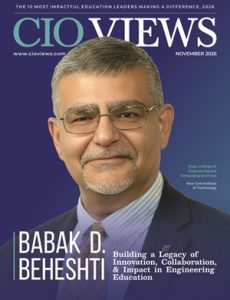

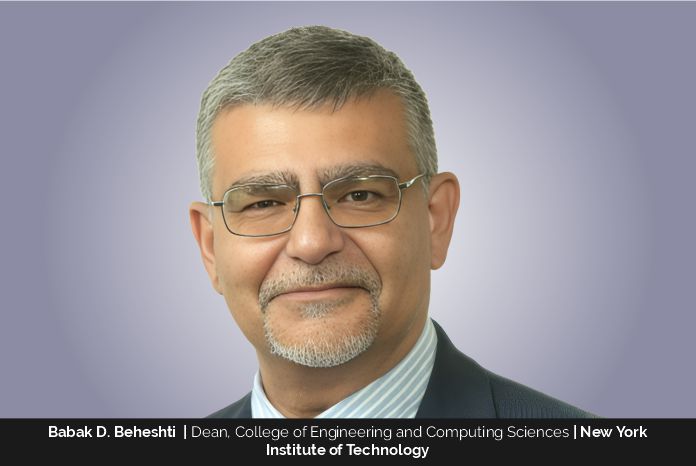
Engineering education is most powerful when it bridges the classroom and the real world. Few embody that principle as fully as Babak D. Beheshti, Dean of the College of Engineering and Computing Sciences at New York Institute of Technology (www.nyit.edu).
His journey began with a fascination for electrical systems and a drive to explain them to others, leading him from Stony Brook to a doctorate at UMass Dartmouth and into industry. Today he oversees seven departments, 14 research centers, and over 1,600 students.
Under his leadership, NYIT has climbed to #28 in U.S. News engineering rankings, expanded research, and launched AI and entrepreneurship initiatives. Yet his focus remains on the moment a student moves from confusion to confidence.
Where Technology & Teaching Meet
Beheshti’s path into education and technology began with a fascination for how electrical and communication systems work, and an equally strong pull toward explaining those ideas to others. His training in electrical engineering at Stony Brook University, and later his doctoral work at the University of Massachusetts Dartmouth, gave him the technical foundation.
“Teaching gave me the purpose. When I began as a faculty member at New York Tech, I discovered that the classroom is where technology and people truly meet. Watching a student move from confusion to confidence on a circuit, an algorithm, or a piece of code was deeply rewarding, and it still is today,” he recalls.
Beheshti’s parallel involvement in industry strengthened that passion. Developing wireless protocols, 3G software, and digital signal processing systems at multiple startup and established companies showed him how quickly technology evolves and how essential it is for education to keep pace. Those experiences convinced him that the most powerful engineering education is one that connects directly to real-world practice.
Beheshti credits Dr. Kenneth Short, his undergraduate microprocessor professor during the field’s early days, with profoundly shaping his career. The professor’s hands-on teaching and dedication to students’ success left a lasting mark on his decision to pursue this path.
A Mission That Shaped a Career
Beheshti joined NYIT because its mission resonated with him: a practical, career-focused education that opens doors for students from every background, grounded in a genuine commitment to technology. “That decision shaped my entire professional life. NYIT gave me room to grow in every direction. I advanced through the faculty ranks to full professor, then to Associate Dean, and Dean of the College of Engineering and Computing Sciences,” he recalls.
Just as importantly, NYIT supported Beheshti in staying active in industry throughout much of that time. That bridge between the classroom and the marketplace defined his approach to education. Serving as President of the Senate and as a representative of faculty on the Board of Trustees also gave him a view of the university from every angle, which proved invaluable in his role as Dean.
“Nearly four decades later, NYIT is more than my professional home. It has shaped who I am as an engineer, an educator, and a leader,” he affirms. Stepping into the role of Senate President was a defining moment for Beheshti. His experience over many years of shared governance as President of the Senate shaped a collaborative, transparent, data-driven leadership style.
“I learned that university leadership can only be effective if a transparent, consultative, and hands-on style is adopted. I firmly believe that people support what they help create, and that principle guides every major decision I make,” he observes.
“People support what they help create. Great leadership invites everyone to build the vision together.”
Leading Growth Across The College
As Dean of the College of Engineering and Computing Sciences, Beheshti oversees seven academic departments and 14 research centers and institutes, serving more than 1,600 students across its New York campuses, with an annual budget in the millions of dollars. His responsibilities span academic programs and accreditation, faculty hiring and development, research growth, enrollment strategy, industry and community partnerships, fundraising, and global engagement.
Each of these areas contributes directly to NYIT’s growth and reputation. The college has risen rapidly in the national rankings and is currently ranked #38 among the best engineering programs in the nation by U.S. News & World Report. Research output has grown significantly, and the college has launched new and industry-recognized undergraduate and graduate programs.
“Strong programs attract strong students and faculty, and they, in turn, elevate the entire institution,” Beheshti insists, adding that sustainable leadership depends on building a strong team and protecting time for what renews him.
“Investing in a capable senior leadership team allows me to delegate with confidence and focus on strategy. Outside of work, I recharge through personal travel and spending time with my expanding family. My volunteer work with IEEE also energizes me because it connects me with educators and young engineers around the world who share my passion,” he explains.
“The most powerful engineering education is built where the classroom meets the real world.”
Innovation Through Collaboration & Vision
Beheshti champions collaboration over competition. NYIT is a founding member of the Interuniversity Engineering Doctoral Consortium (IUEDC), which unites nine New York and New Jersey institutions, including NYU Tandon, Columbia, Princeton, Cornell Tech, Rutgers, Stevens, Stony Brook, and City College of New York. Doctoral students can take courses across member schools without additional tuition, giving students access to an extraordinary breadth of expertise.
Second, NYIT has made entrepreneurship a core part of engineering education. Through its Entrepreneurship and Technology Innovation Center (ETIC), it secured a multi-year grant from Empire State Development as a NYSTAR-certified incubator, established incubator spaces at the Digital Ballpark in partnership with LISTnet and at Launchpad NY in Huntington, redesigned its Technology Entrepreneurship Minor, and introduced a co-op program for every undergraduate major in the college.
Third, NYIT is preparing every student for an AI-driven world. It launched an Artificial Intelligence concentration in Computer Science, an AI Minor open to all majors, and an online M.S. in Artificial Intelligence launching in 2027.
Finally, Beheshti thinks globally, building student and faculty exchanges with Politecnico di Milano supported by EU Erasmus+ funding, developing articulation and dual-degree agreements with universities in Brazil, Turkey, Taiwan, and Mexico, and leading accreditation and licensing of NYIT programs in Canada and the UAE.
Industry and government partnerships, such as its six years of contracts with NASA, ensure that NYIT students graduate with skills employers need on day one.
“Collaboration, not competition, is how institutions multiply their impact.”
Preparing for the Future of Learning
Beheshti perceives several forces reshaping future trends in education. AI is becoming a foundational literacy, not a specialty. Learners increasingly expect flexible, online, hybrid pathways throughout their careers. Employers want graduates who have already solved real problems. And the most important challenges, from healthcare to energy to cybersecurity, sit at the intersection of disciplines.
“We’re preparing for these shifts deliberately,” he affirms. “Our AI Minor and AI concentration bring AI to students in every major, and our online M.S. in Artificial Intelligence will extend access to working professionals. Our co-op program and incubators ensure experiential learning is part of every student’s journey.”
New programs, including a B.S. in General Engineering and a B.S. in Civil Engineering, broaden the college’s offerings, while accelerated B.S./M.S. pathways and an Honors Program help students move faster toward their goals. “We aim to make NYIT a place where learners can keep coming back to grow as technology changes,” Beheshti reflects.
Much of Beheshti’s work extends beyond NYIT, influencing the broader academic community and impacting future generations of learners. For over three decades, he’s served IEEE, the world’s largest technical professional organization, at the section, regional, and global levels.
Today he serves as Vice President for Educational Activities and Awards of the IEEE Education Society, Awards Chair for IEEE Educational Activities, and a member of the IEEE Awards Board. Earlier, he chaired the Continuing Education Committee of the IEEE Educational Activities Board, served as IEEE Region 1 Director, and served as an ABET Program Evaluator, helping shape how engineering programs are assessed and improved.
“For future generations, I focus on widening the pipeline. Our Voya Foundation-funded STEM outreach programs have engaged middle and high school students, and our NSF Northeast Big Data Hub project promoted data literacy as a path to broaden participation in STEM careers. Models like the IUEDC also show other institutions that cooperation can expand opportunity for students everywhere. My goal is to help build an academic community that is more open, connected, and responsive to the needs of learners,” he elaborates.
Milestones That Defined a Transformation
Beheshti lists several milestones that reflect both success and transformation for him. He sees NYIT rise to #28 in the U.S. News & World Report engineering rankings as a testament to the collective work of its faculty, staff, and students. “The multi-fold increase in research output is another point of pride and a testament to our growth,” he observes.
Another achievement was NYIT becoming a founding member of the IUEDC, placing it alongside some of the most respected engineering schools in the region. Securing the Empire State Development grant for ETIC and opening the Launchpad NY incubator in 2025 turned its entrepreneurship vision into real spaces where students build ventures. “These recognitions belong to our whole community,” Beheshti declares.
He notes that the greatest test in his role has been leading meaningful change in an established college while keeping people engaged and united. “Change can create uncertainty, so I made transparency the foundation of every step. We shared data openly, held town halls, and involved faculty and staff in designing new policies for collaboration and accountability,” he shares.
Another challenge has been managing academic quality across multiple campuses and time zones, from New York to Vancouver, along with past work coordinating programs in Abu Dhabi and Nanjing. Strong leadership teams, clear policies, and consistent accreditation standards made that possible. “Every challenge reinforced a simple lesson: when people understand the reasons behind a decision and have a voice in shaping it, they become partners in its success,” Beheshti explains.
“Leadership is not a title; it is a commitment to helping others succeed.”
Building Ethics Into Engineering
Beheshti sees sustainability and ethics as central to how the college defines engineering excellence. Through its Energy and Green Technologies (ENTECH) Lab, students gain hands-on research experience in energy generation, storage, and conservation, while its M.S. in Energy Management prepares professionals to lead the energy transition. “I have also spoken internationally on education and workforce training in renewable energy,” he adds.
Ethical responsibility guides NYIT’s work in cybersecurity and data, where protecting privacy and trust is essential, and it guides its commitment to access. The STEM outreach and data literacy initiatives aim to broaden participation in engineering among underrepresented students. “In entrepreneurship, we emphasize low-cost, high-impact ventures that create real value for communities. For me, an engineer’s education is incomplete without a clear sense of responsibility to society,” Beheshti emphasizes.
A Legacy of Collaboration & Impact
Beheshti hopes that the legacy he leaves behind at NYIT is a nationally recognized, research-active, entrepreneurial college that’s deeply connected to industry and to the world, and, above all, has a culture of collaboration and transparency that endures beyond any one leader. “I want every student who passes through our programs to leave with the confidence and skills to turn ideas into impact,” he reflects.
Within the wider education sector, Beheshti hopes his legacy will demonstrate that institutions achieve more together than apart, whether through consortia like the IUEDC, global partnerships, or the professional communities of IEEE. “If I’ve helped open doors for students, empowered faculty, and inspired the next generation of engineering educators, I’ll consider my work well done,” he says.
Leading With Purpose & Perspective
Beheshti’s advice to aspiring leaders who want to make a lasting impact in higher education and technology is to stay connected to the real world. “Some of my most valuable lessons as an educator came from my years in industry, and they continue to shape how I think about curriculum and student success,” he recalls.
He adds these words of wisdom: Listen before you lead. Understanding the people and data around you builds the trust that every successful change requires. Invest in people, because no leader succeeds alone. Build strong teams and give them room to grow. Seek partnerships rather than competition, since collaboration multiplies impact.
Finally, Beheshti urges aspiring leaders to serve their profession. “Volunteering with organizations like IEEE has broadened my perspective, sharpened my leadership skills, and connected me to a global community. Leadership is not a title; it is a commitment to helping others succeed,” he insists.
Conclusion
Babak D. Beheshti’s legacy is already visible: a college that is nationally recognized, entrepreneurial, and globally connected. Through the IUEDC, IEEE service, and industry partnerships, he has widened opportunity for students and educators. But what he values most is a culture of collaboration and transparency that outlasts any leader. His goal is simple: to ensure every student graduates with the confidence to turn ideas into impact. He sees leadership not as a title but as a commitment to helping others succeed – and he has spent nearly four decades living that commitment.