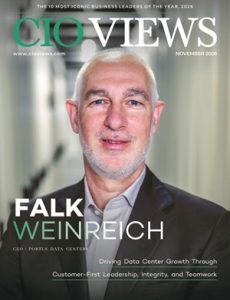

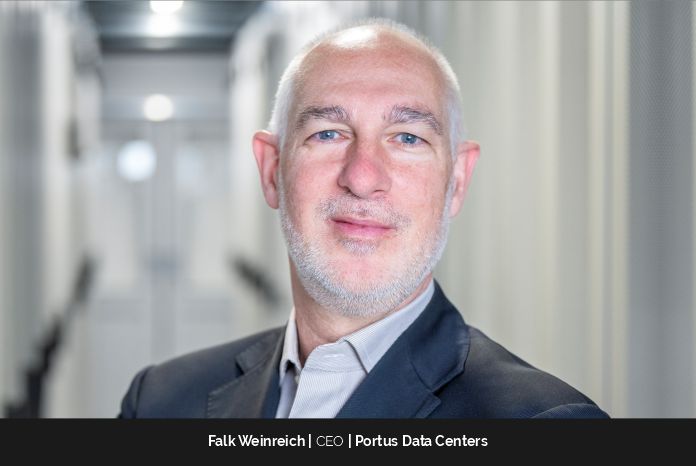
Falk Weinreich is the CEO of Portus Data Centers (portusdatacenters.com), a company he unified from three acquired businesses to serve secondary markets in Central Europe. A finance-to-telecoms-to-data-center leader, he champions integrity, delegation, and data-driven decisions while fostering a high-performance culture.
Under his leadership, Portus focuses on developing secure, scalable, and well-connected colocation campuses in the five-to ten-megawatt range, catering to customers with diverse capacity requirements. Its growth strategy combines greenfield development, acquisitions, and automation. He sees artificial intelligence, data sovereignty, and energy efficiency reshaping industry demand, while stressing the need for appropriate safeguards as AI adoption accelerates.
From Finance Studies to Data Centers
Weinreich originally studied finance and banking in Frankfurt and intended to become a banker. His path into technology began unexpectedly when a newspaper advertisement introduced him to the telecommunications industry.
The booming 1990s telecom market drew him in, and the startup mentality stayed with him. “I like innovation. I like to build something,” he says. He later joined OVH Cloud, where he opened the German market for enterprise business. Now at Portus, Weinreich describes a young company with three campuses, a unified brand, and rapid growth. “I’m still the underdog, but fast and growing, and that’s fun,” he remarks.
Curiosity & Standards Define Leadership
As a self-driven, competitive leader, Weinreich defines success by setting his own standards and meeting or exceeding them. He wants to be the best in the data center field, but there’s more to it than winning. “I sleep well knowing that our customers are happy.” Seeing the market from different angles, through experience across telecoms, cloud services, and data center infrastructure, taught him to balance the interests of customers, shareholders, the company, and employees – an achievement he’s proud of.
For Weinreich, the challenges of entering IT, data centers, and infrastructure arise from related but distinct markets with differing asset depreciation and service types. They share a service-based operating model: providers rent rather than sell and must retain customers long-term by serving them well so they return.
His career has been driven by curiosity and a desire to understand the full chain – why customers use telecoms, how that connects to data centers, what sits inside them, and why customers choose their IT. “I always wanted to understand the whole chain,” Weinreich says. “That continuous learning keeps me going.”
A Safe Harbor for Growth in Regional Markets
Portus Data Centers (named for the Latin word for ‘harbor’), offers customers a safe and secure environment – “like coming home” – with connectivity and scalability as core pillars. “Harbor means business,” Weinreich says, emphasizing that customers can grow and scale with Portus.
Portus focuses on Central European markets, with campuses in Germany and Luxembourg, serving regional and international customers. Its strategy targets underserved regional markets outside the largest established data center hubs, particularly areas beyond Frankfurt, London, Amsterdam, and Paris.
These regional markets, sometimes referred to as “tier-two markets,” offer opportunities driven by data sovereignty requirements, the need for low-latency AI inference, and growing adoption of private and hybrid cloud solutions. Here, “tier-two” refers to market geography rather than technical data center Tier classifications.
Portus targets data centers with capacity of five to 10 megawatts, not hyperscale 100-megawatt sites. The company serves a diverse mix of customers across its multi-tenant campuses, including enterprises, public-sector organisations and businesses deploying AI workloads. Its multi-tenant customer mix includes AI, government, and enterprise clients who want security, connectivity, and room to scale.
Weinreich calls the past year a turnaround. He brought three established businesses together under one brand, introduced common processes and created a consistent customer experience across locations. He introduced a new operating model, brand, and common processes, insisting customers should get “one experience” across locations.
After a year of integration, Portus has established a unified identity, with teams working towards shared goals and progress reflected in the company’s growth. Supported by emerging AI opportunities and favourable economic conditions, the business is on a positive trajectory, with shareholders, employees, and customers benefiting from the progress. Falk describes the growth as “very comfortable,” marking a promising stage in Portus’s development.
From One Megawatt to Gigawatt Sites
Weinreich calls the industry’s evolution “mind-blowing.” He helped open his first data center in Frankfurt in 1999, a 1.2-megawatt site that was then considered huge. At the time, power densities were typically one or two kilowatts per rack. Today AI workloads demand 20, 30, 50 kilowatts per rack and beyond, often requiring liquid cooling.
Data center infrastructure has expanded from facilities measured in single megawatts to campuses reaching hundreds of megawatts and, in some cases, gigawatt-scale capacity in the United States.
Data center design increasingly considers both energy efficiency and water use. Power Usage Effectiveness (PUE) measures total facility energy consumption relative to IT equipment energy consumption. According to Uptime Institute’s Global Data Center Survey 2026, average annual PUE declined from 1.98 in 2011 to 1.52 in 2026, although progress has slowed in recent years. Newer facilities can achieve substantially lower values, depending on their design, operating conditions and location. These industry figures are not measurements of Portus facilities, and PUE does not measure water consumption. (Uptime Institute (2026): Global Data Center Survey 2026, pp. 6–8.)
Weinreich highlights the efficiency benefits of consolidating IT infrastructure in professionally operated data centers. As AI increases demand for computing, he sees efficient infrastructure and responsible resource use as increasingly important. “AI is increasing energy demand, but well-connected, distributed data centers help reduce and scale that consumption more efficiently,” he emphasizes.
Competition Drives Innovation & Customer Tools
Weinreich sees competition as both a challenge and an opportunity. “It’s the driver of innovation. It keeps us going,” he affirms, adding that he likes competition and likes to win. He frames it as waking up to ask how the company can be more innovative and different for the benefit of customers. Portus operates resilient Tier 3 and Tier 4 data centers in Luxembourg and Munich, with infrastructure designed to support customers’ availability and business continuity requirements but Weinreich maintains that the product alone is not enough.
The company is investing in automation, transparency, and customer-first tools, and has introduced an online rack configurator that allows prospective customers to select their preferred location, configure their rack and supporting components. Customers can click a button to view a rack in 3D, add PDUs and connectivity, and design its size and scale. Customers can configure their requirements and submit an enquiry to receive their configuration and pricing details. Weinreich compares it to an Amazon-style e-commerce experience.
Portus also provides monitoring tools that give customers visibility into operating conditions and energy consumption. Temperature flow, humidity, and energy consumption are also visualized. The goal is to drive automation, speed to market, transparency, the customer-first idea, and push the limits of the market.
AI Needs Rules & Safeguards
Weinreich sees AI as a significant opportunity that also requires responsible adoption. For infrastructure providers, its growth brings greater attention to power density, cooling, energy efficiency and the handling of customer data. He believes effective safeguards and responsible governance must keep pace with AI adoption.
While AI can make life easier and more comfortable, he cautions it could also “go a little bit wrong.” He notes that society must be careful and that control mechanisms and rules are actually good things. “Just as highways without signals or rules would cause daily crashes, there needs to be a traffic light,” he maintains. He believes governance and safeguards must continue to evolve alongside AI adoption.
Reaching Key Milestones Ahead of Plan
During his first twelve months, Portus achieved key milestones from its longer-term plan, including progress in customer deployments, organisational efficiency and integration under one brand. Each single one of the KPIs was met, including data center fill rates, number and size of customer deployments, organizational efficiency, and driving the company forward under one brand without losing momentum.
“We achieved that in 12 months,” he observes, crediting the team rather than himself. “The integration has created a shared identity and a stronger platform for future growth.”
Portus is now growing fast, with many new projects on the radar. It has brought its businesses together under a shared identity and operating model, creating a stronger platform for future growth. Weinreich credits the team’s contribution to that progress.
Evolving Roles & Team-First Leadership
Weinreich’s role has shifted in phases: first organizational structure and change management, then commercial work closing large deals, and now product and capacity through greenfield development and brownfield M&A. “The focus shifted from fixing the organization, commercializing it, and now getting a base for the foundation for future growth,” he explains.
On personal values, Weinreich describes himself as a team player. “I lead the team, but I’m also part of the team,” he says, adding, “It’s never alone. It’s not me. It’s we.” He wants employees to look back one day and say, “I was part of that Portus story.”
Weinreich describes the role as demanding but rewarding. He particularly enjoys building the business and seeing the team’s work translate into progress for customers. “If it’s good work, if it’s rewarding, then it’s fun,” he says. He enjoys staying connected and checks in before his family wakes up.
Customer-First Keeps Team Motivated
Weinreich notes that his team’s daily motivation comes from the company’s customer-first mission. “We like to get the reward from the customer,” he explains. Customers ultimately “vote with their pockets” by spending more, which is good for business, but the deeper reward is seeing them happy and confident they made the right choice.
Weinreich wants customers to feel that choosing Portus Data Centers was the best decision they ever made. But while Portus earns money and pleases shareholders, the priority is serving the industry and the customer. “Seeing them happy – that’s why we do it,” he says, adding, “Customer first is one of our mission criteria.”
Young Talent Thrives in Diverse Culture
Weinreich notes that the company wants diversity in all senses, including age, religion, color, and gender. “We want it all. We embrace it all,” he says, arguing that a broad mix of talents is best for the company. Because Portus serves many international customers targeting German markets, English is its internal company language, including within its senior management team.
Weinreich sees the younger generation as a good reflection of change, of action, speed, and different thinking, and shares that Portus also hires people at retirement age. “All ages are welcome if they contribute and they buy in,” he declares. Hiring good talent remains a challenge with strong competition, but a diverse environment helps attract strong candidates who like the atmosphere “from young to old, from all genders, from all people of different countries and regions.”
A Balanced Leader Who Leads & Serves
Weinreich defines leadership as a balance between leading and serving. He describes his approach as “the right mix of motivation and freedom to decide,” combining delegation with control mechanisms for learning. He stays engaged and in detail, but not because he wants to be “the painful guy who knows everything better.” Instead, he stays close to the team’s work because he is interested in their progress and wants to support them. His approach combines freedom to make decisions with clear expectations and a shared review of results.
Weinreich recalls disliking bosses who had no time for him, which felt demotivating. He wants people to know that he cares about their work. At the same time, he gives them the trust and freedom they need to decide, then reviews outcomes together. He’s data-driven and wants results, but always with a team mindset. “Inspect what you expect, but not as a micromanager in a negative way,” he says, adding, “We’re in that together.”
Focusing On Growth Not Past Achievements
Weinreich believes that his future is about driving the company to success. Building on its three-campus platform, Weinreich’s focus is on expanding Portus’s capacity and customer reach while maintaining a consistent experience across locations in Germany and Luxembourg. He plans to focus on that over the next couple of years, adding that the industry moves so fast he’s never planned much further ahead. He wants to create value for shareholders, the company, and customers. “Once that’s done, then I’m happy,” he says. “What’s next? I don’t know.”
Weinreich still has a big list of things he wants to achieve. Using a hiking analogy, he notes that he’s not the type to look down at past achievements. “I’m always looking up. I want to reach the top.” He admits that he’s never really satisfied with what he’s done and is more interested in what comes next. His focus remains growing Portus, making it bigger, and reaching more milestones. He may look back when he retires, “but it’s not now.”
Integrity, Teamwork & Lifelong Learning
Weinreich urges aspiring business leaders to embrace integrity, teamwork, and a purpose beyond themselves. “It shouldn’t be just me, me, me,” he says, stressing that actions should benefit more than oneself. He describes values as an echo: “How you shout in the market, you get shouted back.”
Weinreich credits these values with helping him achieve what he has today and wants young leaders to adopt the same principles. He also advises leaders to stay eager and remain learners. “With technology accelerating, you cannot just stay where you are. Learning does not end after A-levels, university, or a master’s degree. “Just keep going,” he says. “Leaders must stay curious and keep learning.”
A Legacy of Shared Success & Belonging
Weinreich hopes that his legacy at Portus Data Centers will be one that makes people want to return. He recalls the satisfaction of former colleagues knocking on his door years later, asking for work and remembering the projects they shared. He wants to be remembered for creating a performance-driven environment built on integrity and the right values.
Most of all, he hopes that years from now, people will say they were part of the Portus Data Centers story – there when the company was created and grew. Echoing his early telecoms years, he wants the next generation to look back with the same feeling: “Wow, what a journey. What did we achieve? I was part of it.” For Weinreich, that’s how success is defined and passed on.
Conclusion
Falk Weinreich has unified Portus Data Centers into a customer-first operator poised for growth in Central Europe’s secondary markets. His leadership, rooted in integrity, teamwork, and continuous learning, defines success as much by happy customers and shared achievement as by results.
Above all, Weinreich hopes employees will look back with pride at what they built together and say, ‘I was part of the Portus story.’ For Weinreich, success means building a company that customers trust and employees are proud to be part of.