
If it works, don’t touch it—unless AI can help it work better.
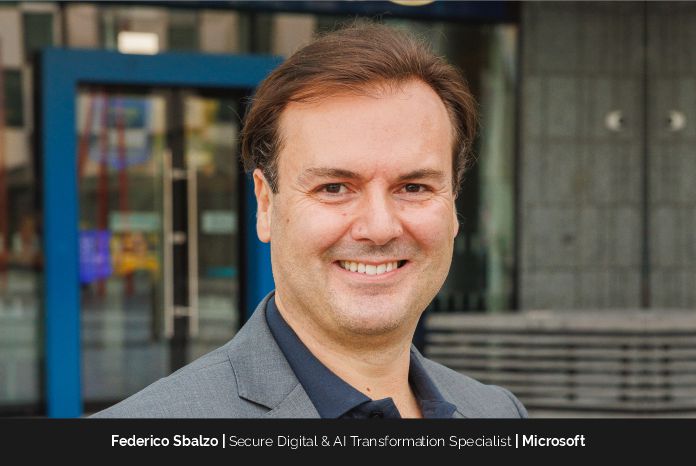
In an age when organisations are under pressure to adopt artificial intelligence, Federico Sbalzo approaches the question as an AI Matrix Planner: how can leaders match the right AI capabilities to the work, the people and the economics of the business? Drawing on experience across secure digital workspace solutions, automation and AI, he argues that adoption should start not with buying another tool, but with understanding existing capabilities, planning where they create value and weighing benefits against cost, risk and readiness.
His perspective connects two dimensions of AI adoption. Horizontally, AI can support individual productivity through tools assigned to named employees. Vertically, it can be embedded in end-to-end business processes, where capability is associated with a workflow rather than an individual. For CIOs, the challenge is to make these dimensions work together: establish a coherent, governed AI environment, differentiate capabilities where the work requires it, and measure whether the investment improves business outcomes. The VALUE test offers five questions to guide those decisions.
Learning to Understand Value Before Proposing Technology
Federico began his career in sales and later worked with secure digital workspace solutions. What started as a way to help people collaborate securely became more intelligent as automation and AI layers changed how information could be found, processed and used. That progression shaped his interest in digital transformation: technology creates value when it changes how work gets done, not simply when another capability is deployed.
When he first applied for a sales role in Ireland, Federico did not understand the compensation model and confidently quoted a fixed monthly salary without understanding on-target earnings. He did not make it past the initial screening. The experience taught him that growth starts by recognising what one still has to learn and that value can only be understood in the context in which it is created. Across markets and organisational cultures, he later saw technically sound proposals fail when they did not fit business priorities, timing, capacity or appetite for change. Foundational work such as data governance can be postponed not because its importance is invisible, but because its benefits are harder to demonstrate than immediate operational fixes.
Federico now believes that people do not buy technology alone; they buy confidence. They invest in people they trust and in partners who understand their challenges. That is why the first objection in a customer conversation is rarely the whole story. According to Federico, it may be an invitation to listen more carefully, test an assumption or uncover the business priority beneath the stated requirement.
For a CIO, the same principle applies internally. “Before asking a team to adopt another AI tool, understand what makes its work difficult today,” Federico says. “Is the bottleneck fragmented information, a slow approval chain, duplicated data entry, unclear ownership, or a decision that arrives too late to be useful?”
“Without that diagnosis,” he adds, “AI risks becoming another layer added to a process that was already struggling.”
AI Is Not Just Another Deployment
Federico’s transition towards AI and human-centred innovation was not the result of a carefully mapped career plan. It emerged while he was working in the digital secure workspace space, helping organisations rethink how people worked, collaborated and protected information.
At first, AI could look like an add-on to technologies and licensing models that organisations already owned. It soon became clear that it was more consequential than another feature release. AI could change how knowledge is created, shared and applied across the organisation. What interested Federico most, however, was not only the technology but the human dimension behind it.
Federico noticed two broad reactions among customers and partners. Some were energised by the possibilities and eager to experiment. Others worried about the future of their roles and whether AI would diminish their contribution. He says that these concerns are signals that technology adoption is also a question of identity, confidence and the social contract at work.
This changed his approach. “I stopped treating the conversation as a presentation about licensing and spent more time listening,” Federico says. “The objective became helping organisations make informed decisions about where AI could create meaningful value, and ensuring technology served people and business objectives, rather than the other way around.”
From Use Cases to Business Outcomes
The AI market often revolves around use cases. But, as Federico points out, most organisations are still trying to solve familiar business problems: improve efficiency, reduce costs, increase quality, accelerate decision-making, strengthen customer relationships or enable growth.
“A use case is not a strategy in itself,” he adds. “It’s a possible intervention in a particular business context.”
Sometimes a simpler change to a process, clearer ownership or better access to existing information will deliver more value than a new model. Sometimes AI is the right answer, but only if the organisation also changes the workflow around it.
An Italian fashion company offered Federico a practical example. Its AI rollout to information workers had stalled at around 50%, partly because some productivity applications were perceived as less capable than a competing offering. Activating Microsoft’s Frontier programme made newer capabilities available in a customer-ready environment and helped restart adoption. During the beta phase, use of Copilot Cowork expanded significantly while its additional consumption was not yet billed. As the prospect of a charge approached, the question changed: which capabilities should be part of the everyday AI experience, and which justified additional consumption?
The answer required looking at the work itself. Finance controllers consolidating complex Excel workbooks into a common view for the Chief Controller and CFO had different needs from junior controllers and BI colleagues working mainly within individual spreadsheets. Advanced AI collaboration could support the first group’s more integrated workflow; the fundamentals already included in the standard offering could be sufficient for the second. The company reassessed its approach, strengthening use of available AI capabilities while reconsidering where Cowork’s incremental value justified its cost. The lesson was not that advanced AI lacked value, but that adoption and sustainable value are different questions.
According to McKinsey’s 2026 survey, 80 percent of respondents say AI has improved individual productivity, while 37 percent report positive EBIT impact. Nearly three-quarters of its AI high performers say they have substantially redesigned workflows, compared with about one-quarter of other organisations. “These are survey findings, not a guarantee that workflow redesign alone causes financial performance,” Federico says. “Access and activity are not the same as enterprise value.”
For Federico, a serious AI proposal must connect the outcome to the work, the controls and the economics. The question is not how much AI an organisation can consume, but which capabilities earn their place in the business.
CIO’s Operating Model: Foundations, Ownership and Trust
The front end of an AI tool can look deceptively simple. Scaling it safely across an enterprise depends on less visible foundations: trusted information, clear data ownership, appropriate access controls, security, privacy, integration, monitoring and a clear understanding of who is responsible for the outcome.
“This is where the digital workplace returns to the centre of the IT conversation,” Federico says. AI needs access to relevant information, but access must reflect the permissions and responsibilities already established by the organisation. Poorly structured or poorly governed data cannot be repaired simply by putting a conversational interface on top of it.
Federico points out that the CIO cannot deliver this alone. IT needs to work with business owners, data leaders, security, HR, Legal, the Data Protection Officer, risk and compliance. These functions should understand the business purpose of the initiative, not just review it at the end. “The CIO’s role is to make the underlying complexity manageable, establish common foundations and ensure that the organisation can learn from deployment rather than repeat the same mistakes in separate silos,” he says.
As AI budgets and responsibilities evolve, governance should be collaborative rather than wholly centralised. The CIO should not make every operational decision, nor should every business unit invent its own standards. A useful model is to centralise enterprise-wide principles, such as architecture, identity, security, data handling, risk thresholds and measurement, while delegating decisions to the functions closest to the work within those boundaries.
This balance becomes more urgent as organisations adopt agents that can act across systems. An IBM Institute for Business Value study published in June 2026, based on 2,000 technology executives, found that 77 percent of surveyed organisations said AI adoption was outpacing current governance capabilities, while only 11 percent felt fully ready for the expected scale of AI-agent deployment. The underlying tension is highly relevant: accountability can move faster than visibility and control.
“Governance should not be treated as a brake applied after innovation,” Federico says. “It should be part of the design.”
ROI Is Not a Slogan
Federico notes that the question of return on investment (ROI) deserves more precision than it often receives in AI conversations. ROI is a result of how the organisation applies the model to a particular objective, with particular costs, risks and constraints.
There is a distinction between OKRs and KPIs. Objectives and key results describe the outcomes an organisation wants to achieve, while key performance indicators help monitor the performance of the process or service. According to Federico, the CIO’s task is to connect them: define the outcome, establish the baseline, select measures that reflect the business objective, and then test whether AI contributes enough value to justify its full cost and operating effort.
For example, if the objective is to improve customer service, a team might track first-contact resolution, time to resolution, customer satisfaction, re-opened cases and escalation rates. If AI helps agents draft responses faster but increases rework or produces less helpful answers, a single productivity metric could create a misleading impression of success. Federico says that a more balanced scorecard would look at speed and quality together, as well as the human review required and the cost of running the system.
The baseline must include the full cost picture: implementation, integration, data preparation, licences or usage, evaluation, security, change management, training, human review, ongoing monitoring and the cost of failure. Benefits should also be distinguished: some are direct cost reductions; others include capacity released, improved quality, faster decisions, risk reduction, better customer experience or new revenue opportunities.
“Benchmarks can help a CIO ask better questions, but they cannot substitute for an organisation’s own evidence,” Federico says. “External research can indicate what peers are attempting or which practices are associated with stronger outcomes.”
AI as a Multiplier of Human Attention
When Federico first began using AI capabilities, his working week did not suddenly become three or four days long. The administrative burden became lighter, but the time saved did not disappear. Instead of spending as much time summarising information, preparing follow-up notes or searching through fragmented knowledge, he could dedicate more attention to customers.
Rather than having two meaningful discussions in a day, he could have four. Instead of focusing on administration, he could focus on understanding blockers, defining next steps and helping people make better decisions. “That is why I think of AI as a multiplier of human attention, not a replacement for human value,” Federico says.
Federico notes that leaders want to expand output and improve service without increasing costs at the same rate. AI may help create that capacity, but the opportunity should not be confused with the sales urgency of a fast-moving market. The right question is where incremental value can be demonstrated, sustained and measured, not whether an organisation can claim to be using AI.
The analogy Federico sometimes uses is the internal combustion engine and the horse. As engines became widely used for transport, horses did not disappear; their role changed. They became associated with different forms of value, from sport and leisure to therapy and human wellbeing. The analogy is imperfect, as all historical analogies are, but it points to a useful possibility: when technology takes over repetitive work, human contribution can move towards areas where context, care, trust and judgement matter more.
Keeping Human Judgement Precious
Federico’s thinking about AI has been shaped as much by philosophy and culture as by technology. Saint Augustine’s “Love, and do what you will” speaks to the importance of intention: when the aim is genuinely to serve people and create meaningful value, many decisions become clearer, even if they do not become easy. The humanistic perspective associated with Brunello Cucinelli also resonates with Federico: “technology should be by our side, not in our place.”
Federico, however, does not take this to mean that human involvement is always better or that every task should remain manual. AI can process information at a scale and speed that people cannot match. In many situations, it should take on routine work. But the organisation must still decide what good looks like, which trade-offs are acceptable, how people are affected, and who is accountable for consequential decisions.
“AI is better understood as a paradigm shift than as another deployment,” Federico says. History offers many examples of technologies that changed not only how work was performed but how knowledge travelled and institutions evolved. The printing press is one familiar analogy: concerns about the spread and control of information did not prevent the long-term transformation of society.
The human question is therefore not whether machines can become intelligent. It is whether organisations will use that capability to elevate people, preserve dignity and create value that employees, customers and society can recognise and trust. “In a world where intelligence becomes more abundant, human judgement may become more precious,” Federico says. “It’s not because humans are always right, but because judgement involves context, responsibility, empathy and an understanding of what is worth doing.”
Note to the Next Generation
Federico encourages the next generation to learn how to work with AI while strengthening active listening, communication, critical thinking, business understanding, creativity and ethical judgement. He also draws a lesson from surfing on Ireland’s west coast: the sea does not reward certainty or force. It asks you to read changing conditions, accept that you will fall, learn from each attempt and try again. AI adoption works in much the same way. Leaders rarely understand the full value of a capability before putting it to work; they need to experiment, compare outcomes with a baseline, use A/B tests where appropriate, learn from failure and adapt before scaling. This is the VALUE test in practice: define the Value, check Appropriateness, redesign Lives and workflow, keep the system Under control, and Experiment with evidence. The point is not to deploy everything, everywhere, but to discover what genuinely helps people and the business move forward.
If future generations look back on this era, Federico hopes they will not say only that they built smarter machines, but that they used them to understand work and people better—and made careful choices about where human judgement matters most.
VALUE: Five Questions Before You Scale
The framework can be used as a short decision check before an AI initiative moves beyond experimentation:
V — Value: Which business outcome should improve, and what is the baseline?
A — Appropriateness: Is AI the right intervention, or would a simpler change work better?
L — Lives and workflow: How will the work change, and where will released capacity go?
U — Under control: Who owns the outcome, and how are data, actions, quality and cost governed?
E — Experiment: What can be tested, compared and improved before scaling?
Together, the five questions connect adoption to resource planning: use what the organisation already has, add capability where the work justifies it, and scale when evidence supports the investment.