

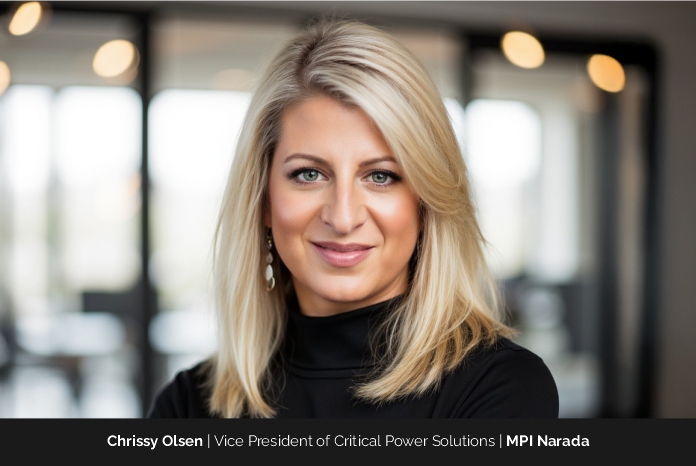
Chrissy Olsen, Vice President of Critical Power Solutions at MPI Narada, is an award-winning sales and leadership expert with 30+ years of impact in the data center and technology infrastructure industry, driving global, multi-million-dollar mission-critical projects and pioneering innovations such as liquid cooling systems.
A dynamic thought leader and sought-after speaker, she’s known for scaling businesses, building high-performing teams, championing women in the industry, and shaping the future of mission-critical environments through strategic vision and technical expertise.
Chrissy is also the host of The IconX Insights Podcast, where she brings together influential leaders and industry change-makers for candid conversations on leadership, innovation, and the future of mission-critical technology.
Guided by the tagline “Don’t Forget-Be Iconic”, the podcast explores defining career moments, bold decisions, and the emerging technologies shaping data centers, energy, and infrastructure. Listeners gain real-world insight from men and women who are driving iconic change across the industry.
Built Where Failure Isn’t Tolerated
Chrissy’s passion for mission-critical infrastructure and power solutions was shaped very early in her career, long before data centers became the strategic assets they are today. She began on the infrastructure and construction side of the business, where there’s no room for theory, and as she says, “systems either work, or they don’t.” That early exposure instilled a deep respect for reliability, precision, and accountability, especially in environments where downtime has real financial and operational consequences.
As she progressed, Chrissy founded and scaled her own technology design firm, which was later successfully merged into a larger organization. “That experience was formative,” she reflects. It forced her to think holistically, balancing design integrity, cost, execution, and long-term performance, while leading teams through complex, high-stakes projects. “It was during this period that I truly understood how power, cooling, and connectivity form the backbone of every mission-critical operation,” she notes.
Later, as she helped launch and grow multiple data center-focused business units on a global scale, her focus sharpened around power resiliency and infrastructure strategy. “Working directly with hyperscale, colocation, and enterprise customers made it clear that power is not just a utility; it’s a strategic differentiator,” Chrissy explains. Those early hands-on experiences, combined with executive-level responsibility, cemented her commitment to building resilient, future-ready infrastructure that organizations can depend on when failure is not an option.
Leading with Reliability and Responsibility
As Vice President of Critical Power Solutions at MPI Narada, Chrissy’s decision-making is guided by reliability, safety, and long-term value. “In mission-critical environments, power and battery systems must perform without compromise,” she says. Every choice must support uptime and trust while delivering solutions built to last, scale responsibly, and create value across their full lifecycle, not just at deployment.
She views energy transition leadership as a responsibility, not a trend. “Advancing new power technologies means balancing innovation with proven performance and real-world operating needs,” she explains. The goal is building resilient, safe infrastructure that supports both today’s demands and the future of mission-critical operations.
A defining milestone in Chrissy’s professional growth was founding and scaling her own technology design firm and successfully merging it into a larger organization. “That experience fundamentally changed how I lead,” she reflects. “It taught me to think beyond individual projects and focus on building sustainable systems, teams, and strategies that can scale, with accountability at every level – financial, operational, and cultural.”
Balancing Performance with Sustainable Leadership
Chrissy maintains energy and focus by being highly intentional with her time and priorities while managing global, mission-critical projects. Clear priorities, strong teams, and trust without micromanagement are essential, as is focusing on decisions that truly move the business forward while avoiding unnecessary complexity and fostering an environment where all ideas are welcome.
Equally important to her leadership approach is protecting personal boundaries. “Chronic over-achiever syndrome makes this challenging, but sustainability comes from making time for family, exercise, interests outside the industry, and relationships that keep you grounded,” she reflects. Chrissy believes balance is not about perfection, but endurance. When leaders protect their own energy, they think more clearly, decide better, and lead with consistency, even under pressure.
Powering the Shift to Strategic Energy
What excites Chrissy most about lithium battery systems in hyperscale data centers is the shift from viewing power as a simple backup to treating it as a strategic asset. These systems enable faster response, greater flexibility, and more efficient use of space, while supporting the scale and density that modern data centers require.
More importantly, lithium technologies are helping redefine energy architecture for the future. They allow operators to design power strategies that balance resilience, growth, and sustainability without compromise. “As demand continues to accelerate, battery systems will increasingly shape how hyperscale infrastructure is built, trusted, and scaled,” she predicts.
“Power is no longer just about staying online – it’s about enabling what comes next”.
When Alignment Tests Leadership Conviction
One of the toughest challenges in Chrissy’s career came from navigating a leadership environment where deep industry expertise was not valued at the decision-making level. She was hired to build and lead a data center strategy, but strategic direction was ultimately placed under leadership that lacked domain knowledge, experience, and an established network in the mission-critical space.
“I was brought in to build the strategy, but the decisions were made without understanding the market realities,” she observes. As a result, long-term plans were repeatedly redirected without regard for execution credibility or the strategy she was hired to develop.
When she raised concerns and challenged decisions that she believed would undermine credibility and execution, it created friction. “Honesty created tension, but silence would have compromised the work,” she says. Ultimately, that honesty came at a cost, and she was let go. At the time, it was a significant personal and professional blow. “I genuinely believed that role would be the final chapter of my career,” she reflects.
What she learned, however, is that alignment matters as much as opportunity. That moment forced her to recalibrate, trust her expertise, and move forward with clarity. “What felt like an ending became a turning point,” she notes, as it opened the door to roles and partnerships that fully value experience, integrity, and strategic leadership.
In hindsight, it reinforced a defining lesson for her leadership philosophy. “Strong leadership means standing by your convictions, even when it’s uncomfortable, and trusting that the right opportunities will follow,” she explains.
Building Trust Through Consistency and Care
Chrissy’s motto in business and life is “Show Up, Follow Up, and Care.” She insists that this, combined with consistency, is the most effective strategy for building trust and doing what you say you will do, every time. “In mission-critical environments, customers value reliability and transparency over salesmanship,” she observes. “Being honest about risks, timelines, and trade-offs builds credibility far faster than over-promising.”
Equally important is taking a consultative approach. “Long-term relationships are built by understanding a customer’s business, not just their immediate need,” she reflects. When leaders show up with insight, industry context, and a commitment to long-term outcomes, trust follows naturally. “In this industry, relationships endure because partners add value well beyond the initial transaction,” she explains.
“Trust isn’t built in a moment; it’s earned through every decision, every delivery, every time.”
Advancing Equity and Leadership for Women
As a board member advocating for women’s advancement, Chrissy says the most important change she wants to see is true equity, not just in opportunity, but in compensation, authority, and respect. “It is unacceptable that women are still being paid significantly less than men for the same roles and responsibilities,” she remarks. In today’s environment, that gap is not just outdated, it’s indefensible and deeply frustrating.
Equally concerning is the assumption, still present in many organizations, that men are inherently more qualified to lead strategy or make business decisions simply because they are men. “Capability, experience, and results should determine who leads,” she reflects.
The industry cannot afford to sideline proven talent based on outdated perceptions. Real progress requires transparency in pay, accountability in leadership decisions, and intentional sponsorship of women into roles with influence and decision-making power. “Advancing women isn’t about preference or optics,” she explains. “It’s about building stronger, more competitive organizations by fully leveraging the talent already in the room.”
“Equity isn’t a women’s issue, it’s a leadership issue, and the industry is past due to act on it”.
Leading with Awareness and Adaptability
Cultural differences across global teams have taught Chrissy to lead with awareness, adaptability, and respect. “What motivates teams, how feedback is received, and how decisions are made can vary widely by region,” she notes. Effective leadership means understanding those differences and adjusting communication and expectations without compromising standards or accountability.
At the same time, she observes that strong leadership principles are universal. “Clarity, consistency, and trust transcend culture,” she explains. By creating clear objectives, listening carefully, and empowering local leaders to execute within their markets, global teams can operate with alignment while still honoring regional perspectives. The result is stronger collaboration and better outcomes at scale.
Shaping the Next Generation of Leaders
Chrissy hopes her work influences the next generation of leaders to think differently about critical power, not just as infrastructure, but as a strategic responsibility. “As demand grows and systems become more complex, future leaders will need to balance innovation with reliability, sustainability with safety, and speed with long-term impact,” she explains.
More importantly, she wants to model leadership that values expertise, integrity, and collaboration. “The next generation deserves to see that success in this industry comes from building trust, asking hard questions, and making decisions grounded in real-world experience,” she notes. If future leaders take away one thing from her journey, it will be that “strong leadership is defined by accountability and courage, not titles or tradition.”
Mentorship as Guidance and Advocacy
Mentorship has played a pivotal role in Chrissy’s career, both in the guidance she received early on and in the responsibility she carries today to support others. “As a mentee, I benefited from leaders who were willing to share hard-earned insight, challenge my thinking, and open doors that might not have been accessible otherwise,” she reflects. Those moments of honest feedback and sponsorship helped shape her confidence and accelerated her growth.
For Chrissy, mentorship isn’t about giving answers; it’s about helping others build the confidence and capability to lead in their own right. As a mentor, she sees her role as both an advocate and a truth-teller. “Supporting emerging leaders, especially women, means providing practical guidance, sharing real-world perspectives, and helping them navigate complex environments with clarity and resilience,” she explains.
Building a Global Network of Trust
The achievement Chrissy is most proud of is the global professional network she has built over the course of her career. “It didn’t happen by accident; it came from consistently showing up, listening, and investing in relationships over time,” she explains. She has worked hard to engage with people across regions, roles, and organizations, always to create real, lasting value.
What matters most to her is being viewed as a trusted partner. “I strive to bring thoughtful perspective, industry insight, and genuine support to my peers and customers, so relationships extend well beyond any single role or company,” she notes. When people remain connected and collaborative regardless of where they are working, that’s when you know trust has been earned.
“Trust is the only currency that appreciates over time.”
Shaping the Future of Mission-Critical Power
From Chrissy’s view, the future of mission-critical environments will be defined by complexity, constraint, and responsibility. “Power scarcity is quickly becoming the real gatekeeper to growth, often more limiting than land or capital,” she notes. As data centers scale to support AI, cloud, and digital infrastructure, success will depend on how intelligently power is secured, managed, and optimized.
Builds are also becoming more complex at an unprecedented pace. “Higher densities, faster deployment timelines, and sustainability expectations require a new approach to infrastructure planning,” she explains. That’s why she’s particularly excited about her current path in lithium batteries and energy storage for data centers.
“These technologies are becoming essential to modern power architecture, and a key part of that evolution is education to help the industry understand that the right lithium solutions, when properly designed and deployed, are safe, reliable, and well-suited for mission-critical environments,” Chrissy notes.
Just as important is investing in people. “Advancing this industry means bringing in the next generation of leaders who understand both the technology and the responsibility behind it,” she reflects. Her role is to help bridge experience with innovation while mentoring the talent that will define what comes next.
“The future of mission-critical infrastructure will be led by those who can solve for power, complexity, and people at the same time.”
Conclusion
Throughout her career, Chrissy Olsen has consistently combined technical expertise, strategic vision, and a commitment to people to shape the future of mission-critical environments. From pioneering innovative power solutions and advancing lithium battery technologies to mentoring the next generation of leaders and advocating for equity and inclusion, she exemplifies leadership grounded in integrity, accountability, and collaboration.
With a belief in strong leadership defined by accountability and courage, not titles or tradition, Chrissy’s journey demonstrates how trust, consistency, and a focus on long-term value can transform both organizations and the industry as a whole. Her work continues to inspire confidence, drive innovation, and set a standard for excellence that will influence mission-critical infrastructure and the leaders who build it for years to come.