
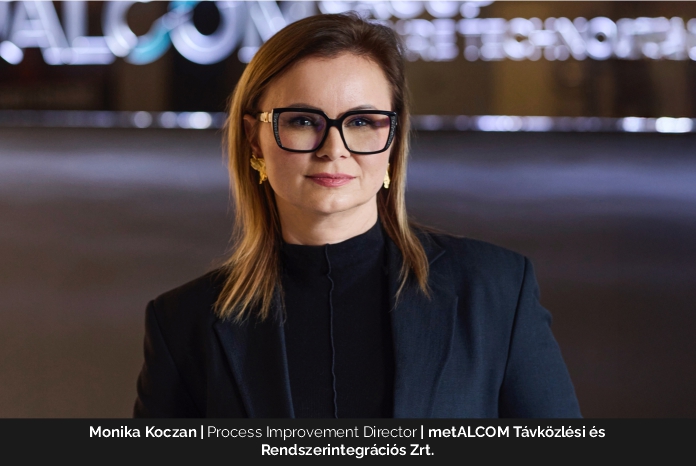
Meet Monika Koczan, a real force in Europe’s technical sector. She drives strategic operational efficiency, currently serving as the Process Development Director at metALCOM ZRT and Co-Managing Director of metALCOM GMBH in Austria. That’s a key subsidiary of metALCOM Távközlési és Rendszerintegrációs Zrt.
Her career began in procurement and supply chain management. Her journey into process improvement and strategic leadership is really founded on three core, interlocking values. What are they? Relentless curiosity, people-centred empowerment, and integrity.
Monika indeed views precision in processes and holistic, end-to-end thinking as absolutely essential. But she maintains that the actual engine of sustainable change is always found in people. This approach lets her seamlessly combine her deep systems insight with a clear, long-term strategic vision. It’s how she shapes both the processes and the broader organisational culture.
Cultural Shift and Measurable Transformation
Monika’s impact on metALCOM Zrt is evidence of a transition away from managing the daily tasks to a role in defining a collective culture and steering its long-term direction. “The greatest transformation at metALCOM was in people, not in processes,” she says. This cultural shift is the transformation she is most proud of, having successfully fostered an environment where teams moved from resistance to camaraderie. Now, people genuinely believe that change can be positive and proactively bring forward their own ideas and solutions, approaching tasks with a gung-ho spirit. This is critical for metALCOM, an organisation dedicated to innovation in the technical and infrastructure space.
While the cultural shift is paramount, Monika has also delivered significant, incontrovertible results to support implementation, most notably the assiduous implementation of the Competency Matrix. This tool provides a clear, annually updated overview of every employee’s qualifications and proficiency levels, covering everything from language skills right through to job-specific requirements. The Matrix serves multiple functions: it helps to identify skill gaps, defines objective development needs, and provides a transparent, objective foundation for selection, promotion, and succession planning, ultimately ensuring the company is future-ready.
Defining Influence in Europe’s Technical Field
Her inclusion as one of ‘Europe’s Most Influential Business Leaders of the Year 2025,’ is proof of the value Monika brings to the sector. For her, influence in a highly technical and operational domain goes way beyond managing processes or just hitting those targets.
She explains that being an effective leader is really about moulding the way organisations think and act. It’s about inspiring teams to embrace both innovation and rigour. In Europe’s diverse business sector, genuine influence is found in the ability to bridge cultures, disciplines, and perspectives, all while keeping a clear strategic vision in place.
In the highly technical worlds of telecom and infrastructure, leadership demands a deep understanding of day-to-day realities. A leader must know how to communicate complicated ideas. Their manner should ne easy and resonate with multiple stakeholders. Monika emphasises that influence is earned through competence, consistency, and transparency. Every decision must rest on solid data and insight. It also requires genuine respect for the people who put those decisions into action.
Ultimately, her style of influential leadership means combining technical credibility, operational insight, and human leadership. This balance allows her to deliver tangible results while actively shaping an organisational culture that is adaptive, inclusive, and forward-thinking. This comprehensive technique, in the end, creates a sustainable impact that successfully transcends the varied markets and regulations across the continent.
A Professional Challenge That Sets the Bar Higher
We asked Monika a tough question that she feels can be a stumbling block in her operational remit. She points out, “One of the main challenges at metALCOM was supporting a company that had grown from a small company into a 300+ person organisation, which was preparing for an important international expansion targeting several countries.” Many of the processes that once worked effectively no longer align with the company’s scale. The real challenge was not logistical but cultural. Changing the perception that process improvement means finding mistakes.
First, she had to focus on building trust and demonstrating that this approach makes everyone’s work easier and more efficient. By listening, involving the people in reorganisation, and demonstrating quick, measurable wins, they built credibility and engagement.
The Strategic Balance of Efficiency and Innovation
For Monika, integrating innovation and efficiency is quite simple. It starts with one imperative core principle. Every new idea just has to create measurable value. She stresses that innovation is not really about change for its own sake, but about making the value creation process overt. Instead, it revolves around thoughtfully rethinking processes. The goal is to make them smarter, faster, and more sustainable. And doing that without adding unnecessary complexity, jettisoning unneeded steps.
Matter-of-factly, she approaches process improvement using a kind of bifocal lens. On one side, she and her teams are busy rigorously analysing current workflows. They pinpoint bottlenecks and, yes, carefully measure outcomes. On the other side, though, they are actively encouraging experimentation and creative solutions. By combining these data-driven acuities with the innovative ideas generated by the team, they can implement changes that are both effective and operationally efficient.
Another key component here is definitely continuous feedback and iteration. They test things, learn quickly, and then assimilate the lessons to refine processes. They usually opt for smaller, incremental changes rather than large-scale, risky overhauls all at once. Benefits? It helps innovation to flourish while maintaining high efficiency and minimising risk. Ultimately, Monika considers these two concepts perfectly complementary. The former provides the foundation and discipline, while the latter pushes boundaries and unlocks new opportunities. When that balance is thoughtfully maintained, the processes become better, adaptable, resilient, and agile.
A Typical Day, Does it Exist?
This industry leader firmly states that no two days are ever the same. That’s exactly what she loves about her work. While there’s a natural flow, Monika thrives on the vibrant energy of her roles. She notes, “Even with a well-structured plan, there’s always that little ‘spice.’ A new challenge, an urgent issue, or an opportunity that makes the day unique.”
Her technique for prioritising across multiple projects is precise and practical. Monika’s focus is always on where her presence is most valuable in achieving results or keeping work on track. She always stays flexible, of course, to quickly address urgent issues or interventions.
When the workday concludes, her “second shift” with her family begins. Monika emphasises the deep importance of being truly present for her two sons and husband. Those family moments, whether helping with schoolwork or simply sharing stories, bring balance and meaning to everything she does. She regards this balance as essential to feeling complete.
Future-Readiness, Sustainability, and Social Impact
At metALCOM, sustainability and future-readiness aren’t separate goals, Monika confirms. They’re actually built right into how the company designs, operates, and grows. For them, it’s about creating systems and infrastructure that are resilient and adaptable for tomorrow, not just meeting today’s needs.
They’re constantly looking at ways to enhance ubiquitous digital connectivity while supporting a greener, more sustainable future for their communities. Monika highlights that, for metALCOM, this purports that their systems are being built to thrive in a rapidly changing world.
Sustainability at metALCOM also extends beyond a mere semblance of strict operations and into social responsibility. Monika mentions, “If we build the infrastructure of the future, we must also give back to the communities that rely on it.” They are committed to creating long-term value for society as a magnanimous corporate citizen. This includes supporting local initiatives, contributing to educational programs, fostering opportunities for future generations, and supporting a more convivial public life.
An Achievement That Stands Out
Looking back over two decades in diverse industries, Monika points to a defining professional moment: leading through the intense challenges of the COVID period. It’s important to note that this achievement took place while she was working as Procurement Director for Germany and Eastern Europe at a French industrial group.
It was a very taxing time that required enormous discipline and fortitude. Factories were either closing or barely functioning with strict safety measures. Monika focused on two things. First, keep the supply moving. Second, keep her people’s well-being safe. She put equal devotion to both. Teams started and kept the operations running while protecting personnel and caring for partners. More importantly, she reflects, they strengthened their unity and empathy as a company. Leading through that crisis taught her resilience.
On a personal level, Monika emphasises that her proudest achievement is having built a life where her career and family coexist in proper balance. This practice allows her to actively mentor young professionals who are now prospering in their own paths. “Watching them grow into strong, values-driven leaders is my true success,” she affirms. The key takeaway for her here is that it taught her purpose.
Cultivating Cross-Functional Collaboration
Talk about collaboration, you will find out that it is at the heart of delivering complex turnkey solutions. Monika firmly believes in creating an environment where every team, from engineering to installation and operation, fully understands the collective objective. And, of course, everyone must feel ownership of the final outcome.
Tools such as open communication, mutual respect, and transparency are key here. When people clearly see how their specific work connects to the bigger picture, she finds that collaboration just becomes natural. That’s precisely when different expertise aligns seamlessly. That is when real innovation finally happens across functions.
metALCOM’s Key Role in European Infrastructure
metALCOM plays a pivotal role in shaping the future of European infrastructure and digital transformation. It achieves this by bridging engineering excellence with innovation and sustainability.
Monika deeply values the team’s innovative mindset. A culture that is constantly looking ahead, adapting, and pushing boundaries. In the telecommunications industry, standing still isn’t an option. Every plan, design, and construction project they deliver creates tangible value.
“We are not just building infrastructure,” Monika states, “we are building communication bridges that bring people closer together.” Through metALCOM’s work, they enable technologies that make everyday life easier, more connected, and more inclusive, ultimately ensuring that distance is no longer a communication obstacle.
She concludes that the essence of leadership in this field is to combine strategic vision with human impact. metALCOM stands for progress, collaboration, and a deep belief that innovation is meaningful only when it improves how people live and communicate.
Advice for Aspiring Process Leaders
When asked what advice she’d offer to aspiring professionals entering the field of process improvement and systems integration, Monika emphasises a core mindset. “Stay curious, courageous, and collaborative,” she advises.
She specifies that this field sits squarely at the crossroads of technology, business, and people. Because of this, the best process leaders are those who can see connections where others only see complexity. Her guidance is to never be afraid to ask why, to challenge assumptions, and to learn continuously. Every process you analyse and every system you touch will teach you something new about how organisations truly function.
Monika reiterates a fundamental theme: “improvement isn’t solely about systems; it’s always about people.” The most successful professionals in this discipline are those who can listen, communicate clearly, and build trust across teams. Technical knowledge is, of course, essential. However, she stresses that empathy and integrity are what eventually make change sustainable.
Finally, she recommends patience. Change takes time, and so does mastery. If one approaches each challenge with genuine curiosity and a desire to make things better, one’ll naturally improve processes. Over time, that person also grows into the kind of leader who inspires others to do the same.
Staying Ahead of the Curve
In the fast-paced telecommunications and infrastructure industry, Monika underlines that staying up-to-date is absolutely essential. The speed of change is extraordinary, but that’s exactly what makes the field so exciting.
She explains that her continuous learning happens on numerous levels. First, she learns every day from the incredible professionals she works with. Her colleagues have deep, hands-on expertise across every part of telecom, from engineering to digital innovation. Being surrounded by such talent keeps her informed and constantly inspired.
Next, she attends international conferences and follows major technology forums. She explores best practices, tracks emerging trends through research and professional networks, and uses these insights to connect technology, strategy, and practical execution.
But most importantly, she believes that learning is simply a mindset. You need to stay curious and open to new ideas because innovation never stops, and neither should you.
A Legacy of People, Purpose, and Progress
The legacy Monika hopes to leave behind is one of lasting impact built on people, purpose, and progress. Her focus has consistently been on creating not just successful projects. Then? It centres on sustainable possibilities such as systems and teams that continue to thrive long after her direct involvement.
She also hopes her journey sends a powerful message to other women, especially mothers and those aspiring to leadership, that it is absolutely possible to find your place and your balance, regardless of the industry. “Leadership is not about fitting into a standard; it’s about creating your own path with authenticity and purpose.”
If her story inspires even a few women to believe in their potential and embrace both professional ambitions and personal lives with confidence, she will feel she has made a genuine contribution, not just to her industry, but to the next generation of female leaders.