

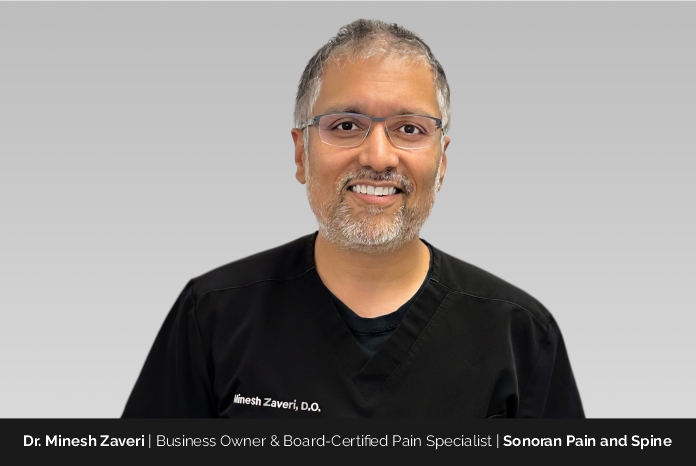
For many patients suffering from long-term pain conditions, Dr. Minesh Zaveri has become synonymous with relief. His patient-centered care model is setting a new standard for comprehensive, compassionate pain management that treats the whole person, not just the condition. As the Business Owner of Sonoran Pain and Spine and a Board-certified Pain Specialist, he makes sure that no patient feels unheard, overlooked, or without options. He has been successful in treating patients who had little hope of leading full, functional lives.
Dr. Zaveri is also the first physician to perform the dorsal root ganglion (DRG) procedure in Phoenix, Arizona. By offering this pioneering treatment that helps with crippling neuropathic pain, he has been able to wean patients off pain medications and restore their ability to function and return to work.
Establishing Sonoran Pain and Spine
Dr. Zaveri always intended to pursue a career in medicine, though he was initially uncertain about which field to choose. He eventually opted for anesthesia residency, during which he developed a fascination with pain management. He also became interested in the range of treatments available in this field.
“I was really good with my hands,” Dr. Zaveri says. “So, I felt that I could excel in the interventional aspects of pain management.” This realization set him on a career path in pain management that eventually led to the founding of Sonoran Pain and Spine.
Dr. Zaveri’s decision to establish Sonoran stems from his observations of prevailing practices in pain clinics. He noted that, in many cases, physicians saw patients only during procedures such as surgery, injections, and other treatments. He also noted that much of the care was delegated to ancillary staff and, in some instances, treatment plans were not always medically strong.
What he saw prompted Dr. Zaveri to build a model centered on physician-led, continuous care. “I felt that I had to see every new patient who comes into the clinic,” he says.
At Sonoran, he develops a treatment plan and is involved every step of the way. Every six months, he reassesses with the patient and determines where they are. Dr. Zaveri points out that his goals are always aligned with the patient’s goals.
Some patients who come to Sonoran have been living with chronic pain for years. As a result, they lead a dysfunctional life and are unable to seek the treatments they need. Dr. Zaveri says he engages with them to figure out their goals and discuss the steps to get them where they want to be. It can be returning to activities such as cooking once a week, going out a few times a week, or playing golf. This goal-oriented approach allows them to reassess and determine the effectiveness of treatments and medications.
“Not everything is opioid medication,” Dr. Zaveri points out, adding that there are other options available, such as nerve medications and advanced treatment modalities.
“Every treatment is geared towards the individual patient,” he says. “It is not like a cookbook that says, ‘one thing works for everybody.’”
Witnessing Exponential Growth
As a physician, Dr. Zaveri considers building Sonoran Pain and Spine as his most important achievement. He has built this practice from the ground up and has been involved at every step. “I got to mold it in the way I wanted to mold it,” he says.
For him, it has been quite an extraordinary experience, especially as he has progressed through his medical career, going from being a medical director at a hospital system to a non-private practice, and now to a private practice. Currently, he has full control over how he takes care of his patients. “This has probably been my greatest achievement,” Dr. Zaveri says.
Under his leadership, Sonoran has grown exponentially. Starting from only a few medical assistants and one nurse practitioner, the practice has grown to 15 employees and two nurse practitioners. “We are growing to a point where we will probably be adding another physician very shortly,” Dr. Zaveri says. He attributes this growth to doing things right, one patient at a time, as satisfied patients bring in other patients who experience the positive outcomes for themselves.
Facing Challenges as a Business Owner and Physician
Dr. Zaveri encounters challenges both as a business owner and a physician. He points out that one needs to understand the financial aspect of running a business as well as provide appropriate care to the patient. Initially, it was a struggle for him to find out what was the right thing to do. “I had to learn that there is a fine line between what is cost-effective and what is appropriate,” he says.
As a business owner, he learned that it does not always have to be about the financial aspect. Dr. Zaveri points out when one prioritizes patient care, it leads to better outcomes, and these outcomes lead to financial success.
Additionally, he encountered and overcame insurance-related obstacles. According to Dr. Zaveri, as a smaller practice, getting credentialed and onto insurance plans took time, as insurance companies often do not let new practices join their panels. He says that major insurers like Humana and United Healthcare will not let a new practice get on board with them, which means they cannot see patients who have those insurance plans, even though they are trying to give them access to care.
“It takes time to show that your outcomes and standards are appropriate before they will consider you,” Dr. Zaveri says. “It took me a few years to get on all the insurance plans.”
Most Challenging Case
Dr. Zaveri remembers the time when he had to face the administrative burden of trying to get patients the treatments he wanted to provide them. “We have a DRG spinal cord stimulator, and when I started doing them in 2018, getting these approved was challenging,” he recalls. He had to demonstrate that the patient needed this because they had failed multiple different treatment options.
One of his patients, who is still with him, had a knee arthroscopy, and unfortunately, the health system where she had it done used extremely hot water in the scope. Dr. Zaveri shares that they made a mistake that caused a severe burn to her knee and severe nerve damage.
“She was shaking incredibly when I would see her,” he adds. “We tried multiple different medications, and there were no injections that he could offer her.”
When the dorsal root ganglion system came out, she was one of the first patients he performed this on. She is still a patient at Sonoran and is functioning on minimal medications. Dr. Zaveri says that getting her to that point was a process, and now, seven to eight years later, she is doing amazing. “It is nice seeing her in the office and seeing how far she has come in her journey,” he adds.
Empowering Patients with Multiple Treatment Options
At Sonoran Pain & Spine, patients meet directly with Dr. Zaveri to develop a pain treatment plan. Each patient receives an individual, tailor-made plan. Dr. Zaveri reassesses the patient’s condition and discusses available treatment options. He explains, “It is a six-month plan. Let’s give it a go. These are the treatment options we will develop, and we will find the one that works best for you.”
According to Dr. Zaveri, they have multiple treatment options available that were not offered when he first began practice. There are minimally invasive spine surgeries that can take care of several issues. A key treatment they offer is spinal cord stimulation, which is appropriate for patients with neuropathic pain, including those with prior back surgeries, diabetic neuropathy, or amputations. Dr. Zaveri explains that it functions like a cardiac pacemaker and is for the nerves. “This innovative technology has allowed us to treat patients that we were not able to before,” he adds.
Dr. Zaveri says that he wants patients to be heard, feel respected, and understand their whole treatment plan. He wants them to be part of their treatment plan and empowered to share what they are feeling and what outcomes they desire. Unlike other practices, he wants patients to be fully aware of and involved in their care, not just be informed about what needs to be done
Because Dr. Zaveri is personally involved, patients always have someone they can turn to. They not only see him during surgery or injections, but they also get to come see him directly and get to know him. “I view this as a family. I have had patients I have been treating for 15 years, and I still have my first patient who has followed me through,” he says. “It is very important that they are able to continue their journey here.”
He also points out that chronic pain is a disease, just like high blood pressure or diabetes. The goal is to manage it, not necessarily cure it. “I am managing their disease state and giving patients different options because pain is never constant. There are days it is bad, and days it is good. I hope that I give them more good days than bad, and that is how you know your treatment is working,” Dr. Zaveri says.
Leader’s Routine and Leadership Style
Dr. Zaveri wears both the business owner and the physician’s hat. He keeps his administrative and clinical days separated. On Mondays and Thursdays, he is usually in the office to see patients. “I see all new patients and work with my nurse practitioners who handle follow-up care,” he says. “They always send me HIPAA-compliant messages, asking me questions about patients.”
Dr. Zaveri performs surgeries a couple of times a month at a surgery center, and he does minimally invasive injections in the office on Wednesdays and Fridays. Every other Friday is a non-clinical day focused on administrative work and running the practice. “Some days, I probably spend more hours on clinical work in the evenings and on weekends than I used to, but it is okay,” he says. “It is fulfilling.”
When it comes to leadership, Dr. Zaveri leads by example. He believes that if he expects someone to do something, he should be willing to do it himself. “I will never ask someone to do something that I would never do,” he says.
And Dr. Zaveri wants to be able to sleep at night and know that he has done things appropriately for his patients. As long as he is doing it right, and treating them the way he would treat his own family members, such as his mother or father, he feels that he has done the right thing.
The Roadmap Ahead
As the practice continues, Dr. Zaveri wants their treatment model to serve as a standard for pain management. He plans to expand it further and share his knowledge with younger physicians.
According to him, his next goal most likely is to hire a younger physician whom he can mentor or train in the same way he was trained earlier in his career. He adds, “We want the younger physician to come on board and continue this model, which has been effective.” It will lead to next growth pattern.
The Dream and Legacy
Dr. Zaveri does not wish to claim that he has achieved everything he once dreamed of, although he has reached the summit of the mountain where he wanted to be. He is happy with his practice, and his patients are doing well. This positive trend, he believes, is going to continue. He points out that the practice has stabilized and is performing very well in the region; it is located in an area that attracts many individuals. Other pain clinics refer patients to Sonoran because it offers services they cannot provide, a recognition that Dr. Zaveri greatly appreciates.
“I feel like I have made it to where I want to be,” he says, “but you are always striving for further growth and continuous improvement.” To him, claiming that he has achieved everything he dreamed of would suggest that he is approaching the end of his professional journey, and he is not ready to say that just yet.
Dr. Zaveri hopes to leave behind the legacy of a doctor who did things correctly and helped his patients improve their lives and their activities of daily living (ADLs). At the end of the day, he wants his patients to feel that their lives have improved as a result of the empathetic and empowering care he provided.
“I hope, one day, my patients can say they achieved things they could not do before because of the care they received,” Dr. Zaveri says. “This is the legacy I want to leave behind.”
Advice for Aspiring Leaders
“You have to be able to sleep at night,” Dr. Zaveri tells aspiring leaders in the pain management field. “If you can do that, you’ve done the right thing. If you can’t, if you find yourself fretting, then it’s probably not the best thing in the world to do, no matter how financially rewarding it is.”
He also advises them to continue to learn. “There is always something new that is coming and something that might better your skills,” he says.