
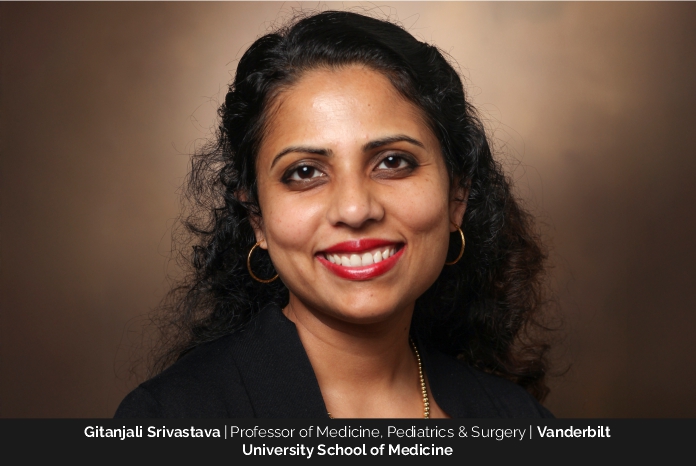
Gitanjali Srivastava, Professor of Medicine, Pediatrics, and Surgery at Vanderbilt University School of Medicine, is a pioneering leader in obesity medicine who defines success through the positive and scalable impact she creates for patients, colleagues, and society. Driven by personal experiences and a deep desire to help others, she has built programs, fostered innovation, accelerated novel research, and inspired teams while maintaining a human-centered approach to medicine.
Success as Growing Impact
Gitanjali’s idea of success evolved as her priorities and experiences changed, shaping how she defines achievement today. In high school, success was simply about marks and exam scores, yet she was already drawn toward discovery-tinkering with science projects, exploring ideas, and learning what truly inspired her. Now she defines it by her impact, questioning its value and reach. “What’s the impact on the people I work with, the environment, society, and is that impact positive and scalable?” she asks.
For her, success is philosophical, grounded in influence, empowerment, and engagement, shaped by every experience, not defined as winning or losing, but by the meaningful impact we create and the way we elevate others.
A Calling Shaped by Experience
Medicine was always Gitanjali’s field of interest, shaped by her early life experiences and the challenges her family faced. Growing up with meager financial resources or access to adequate treatment, she lost family members at a young age – experiences that deeply influenced her path. “Even at a very young age of six, it was embedded in me that I wanted to be able to be there and help people,” she recalls.
Her path into obesity medicine came before the field was formally recognized. She saw a growing problem in society that was not adequately addressed and witnessed it daily in hospitals and clinics, often feeling ill-equipped to treat a disease that was not yet fully acknowledged.
With an innovator’s mindset, she saw every problem as an opportunity to find solutions beyond conventional approaches. Her passion for delivering equitable, thoughtful care ultimately steered her to specialize in obesity medicine.
Adversity That Sparked Innovation
Early in her career, as she worked to establish infrastructure for obesity treatment, Gitanjali traveled across the United States, meeting with CEOs and hospital administrators to present her vision for recognizing and managing obesity as a disease. Despite having a clear plan and strategy, her ideas were often dismissed because they were considered too novel. “When you’re well ahead of the time, the world pushes back,” she muses.
Rather than seeing rejection as failure, she viewed it as clarity. The challenge was not only administrative but also within the medical community, where many peers did not yet understand the science or recognize obesity as a disease requiring treatment. “We had a lot of work cut out for us in this industry to break through and innovate,” she reflects.
That resistance became pivotal. It became clear to Gitanjali that true progress would require national guidelines, rigorous research, and well-designed clinical trials to advance the science and accelerate broader recognition of the disease.
Leadership Through Balance and Empowerment
As a woman leader in medicine, Gitanjali has largely been seen as equal to her male counterparts, while also bringing a unique strength in connecting with and inspiring her female patients. “I always think about that as an advantage rather than a disadvantage,” she says. Rather than seeing gender as a barrier, she sees empowerment and engagement as strengths that helped her grow personally and professionally. “I’m proud to be a woman leader,” she declares.
One of Gitanjali’s greater challenges was balancing leadership responsibilities with family and children, something no one formally teaches. It taught her that leadership is about managing competing priorities, diverse teams, and differing opinions while juggling professional and personal life. “Life is always a balancing act, and you have to keep both in check,” she reflects.
Building Innovation at Vanderbilt
When Gitanjali joined Vanderbilt, the medical weight management program was barely established, giving her the opportunity to build it into a fully realized, multidisciplinary service. Gitanjali took on the challenge-recruiting talent, restructuring operations, and developing training frameworks, all while aligning the team under a cohesive vision. The efforts demanded in-depth collaboration across technology, informatics, and multiple clinical disciplines to strengthen the program’s core pillars. “To implement a vision, it takes teams,” she observes.
From the outset, she believed growth required more than strong clinical care. She focused equally on education and research to create a sustainable and innovative specialty program, outlining clear plans for each pillar and expanding them steadily over time. The result was significant growth, national recognition, and a strong pipeline of trainees emerging from the program. “When you have diversity of thought and perspective, you’re able to solidify and strengthen the foundation,” Gitanjali reflects.
Medicine in the Age of AI
Reflecting on the early days of the internet in the 1990s, Gitanjali recalls how receiving an email address felt transformative. She sees AI as a similar inflection point, signaling another sweeping change already underway.
She believes technology is extremely important in medicine as it evolves just as people do, requiring constant adaptation, and notes that healthcare is undergoing a major transformation. “The way we practice medicine today is going to be very different in a few years from now, both in the United States and globally, as AI and digital innovation reshape the role of physicians and providers,” she predicts.
Gitanjali is working closely with AI and technology teams to drive innovation, with research funding, grants, and pilot programs such as avatar clinics already in development. In her view, the power of technology is often underestimated and must be embraced with forward thinking. “We have to embrace it and think outside of the box,” she explains.
Preserving the Human Touch
With AI transforming medicine, the one practice Gitanjali never wants to change is personal connection rooted in human empathy. While technology can assist diagnosis and care, compassion shown through bedside manner and genuine human presence remains irreplaceable. While AI’s ability to mimic conversation or creativity raises ethical questions about authorship and recognition, real understanding comes from human experience and intention.
For Gitanjali, the future of medicine may evolve in tools and methods, but the essence of care must remain human-to-human. “You can’t eradicate or change human touch or the impact you make when you hold a patient’s hand and comfort them,” she insists. “Even as technology advances, there will always be a difference between simulated empathy and real connection.”
Taking Pride in Family and Leadership
Gitanjali considers one of her greatest achievements to be a successful woman physician leader while raising two children who are doing well. She insists that professional success would feel empty if her children were not growing into good people, emphasizing how meaningful it is to see them learning, listening, and thriving in school.
“Of all my acheivements, my children remain my proudest, because they have taught me more than any role ever could. I could be the most powerful person, but if my own children weren’t thriving as people, would that really be success?” she reflects.
Despite balancing leadership, motherhood, and at times single parenting when her husband travels, she sees her journey as deeply fulfilling and defining. “My accomplishment is more as a working mother and professional, because balancing both has been very challenging,” she admits.
Wearing Many Hats With Purpose
Gitanjali juggles multiple leadership roles at Vanderbilt University Medical Center, where she serves as chief and medical director of obesity medicine and co-medical director of weight loss clinics across Tennessee, overseeing telemedicine and in-person care while building teams and programs.
She also founded the obesity medicine fellowship and a scholars program for faculty leaders, led clinical trials in obesity pharmacotherapy, mentored trainees, and worked nationally in fellowship education while serving as editor in chief of a new journal. “I wear many hats, but I love what I do,” she says.
Her work also includes postgraduate training in AI & ML, using technology and innovation in research and clinical care, but her daily routine depends on organization and prioritizing tasks rather than fixed hours. She balances major deadlines with daily tasks before attending to family responsibilities. “I try to stay extremely organized and work through my task list each day,” she explains.
Balancing work and life stems from passion and purpose; her love for her work drives her to stay motivated and make a difference, even during evenings and weekends. “If you love what you do, it’s not a job; it keeps you going the next day,” she reflects.
Passion, Trust, and Team Empowerment
Gitanjali and her team stay motivated through shared passion and creativity, fostering an environment energized by meaningful work. She believes motivation thrives when people care about their work and take ownership of their ideas.
She believes strong leadership means providing clear goals, flexibility, trust, and avoiding micromanagement to help teams deliver results while staying balanced and avoiding burnout. “Supported teams remain productive and happy. If you offer people flexibility with a goal and deadline, the job gets done, and people are happy,” she explains.
Gitanjali emphasizes that valuing every voice, regardless of seniority, empowers the team, sparks innovation, and fosters a shared sense of purpose. “Every person I work with has ideas that are valuable to creating something great,” she reflects.
Leadership as Vision and Service
Gitanjali views leadership and service as inseparable, guiding with vision while supporting her team’s needs to provide clarity and motivation. “You can’t lead without serving,” she says. She describes leadership as a symbiotic relationship: vision inspires others, while the leader stays accountable to the mission, focusing on advancing a shared goal and empowering others rather than serving personal gain. “You have to be well-versed in both to be able to be a good leader,” she explains.
When asked to describe herself in one word, Gitanjali playfully chooses “Supercalifragilisticexpialidocious,” inspired by Mary Poppins, saying it captures her energy, spirit, and extraordinary approach to life, leadership, and work.
Balanced, Evidence-Driven Leadership
Gitanjali’s values guide her leadership, emphasizing balance, collaboration, and accountability. She favors a middle-ground approach that fosters teamwork while providing clarity and firmness when needed. “I like to have a balance of collaboration and sternness,” she says.
She emphasizes making decisions based on evidence and strategy, weighing implications and diverse perspectives. For her, leadership means acting for the group’s best interest while remaining decisive and confident. “There needs to be an evidence-based approach to decision making,” she explains.
When challenges arise, Gitanjali focuses on understanding root causes rather than judging performance. By leveraging strengths, realigning roles, and providing thoughtful support, she helps both the team and individuals thrive. “You have to do what is best for the team and also for the benefit of that member,” she reflects.
Expanding Horizons and Transforming Healthcare
Looking ahead, Gitanjali hopes to explore cooking, dance, spirituality, travel, and even martial arts. Though she once performed salsa and Bollywood before having children, she now finds joy in watching them grow, reflecting on the early years of balancing motherhood and career with resilience. “Time is short, and I just love watching my children grow,” she shares.
Professionally, Gitanjali envisions a transformative future for healthcare, aiming to redesign outdated systems to reduce burnout and improve access in rural and underserved regions. She sees artificial intelligence, robotics, and advanced digital systems as key to extending care beyond physical boundaries. “We need to completely redesign how we deliver healthcare,” she urges.
Inspired by The Jetsons, she envisions physicians training intelligent systems or robots to extend their expertise, giving patients options like in-person visits, telemedicine, avatar consultations, or AI-assisted robotic care. She sees this future as an imminent reality fueled by innovation. “We’re not too far away from that era,” she predicts.
Leading with Passion and Purpose
Gitanjali’s message to aspiring leaders is clear: pursue your passion wholeheartedly, because true leadership is driven by deep, purpose-filled passion that makes a real impact. “Every success is fueled by passion,” she says, emphasizing that this passion must be meaningful – driving positive impact for people, society, and even across nations.
She urges leaders to establish a clear mission and vision, emphasizing that leadership is about understanding why you do what you do and where you aim to go. She also notes that ideas of success evolve through experiences and exposure to diverse people and cultures, shaping perspective and goals.
Another key lesson Gitanjali highlights is the importance of stepping outside one’s professional bubble. Exploring interests beyond your main field can broaden thinking and spark unexpected creativity. She cites technology history, noting how Steve Jobs’ study of calligraphy influenced digital design, illustrating how diverse experiences can later connect in meaningful ways.
Ultimately, her advice is to stay curious, stay open, and keep connecting the dots across experiences. By combining passion, purpose, and broad learning, aspiring leaders can create lasting impact and grow into leaders who inspire others.
Conclusion
Gitanjali Srivastava’s journey reflects a balance of vision, passion, and empathy. Through her leadership, innovation, and dedication to transforming healthcare with technology, she continues to shape the field of obesity medicine while mentoring the next generation of leaders. Her approach demonstrates that meaningful impact combines professional excellence with a commitment to humanity.