
When businesses are unable to develop and execute a strategy that can allow them to grow or follow a strategic plan, they normally search for the problem in terms of their strategy and modeling. But the true bottleneck is located inside the organization. It includes interpersonal relations, organizational culture, and empowerment of employees in their work. Business strategy will only work if people at all levels of organization are able to implement it in practice. The process of connecting business goals with success of individuals requires constant balance between business orientation, technological vision, and empathy.
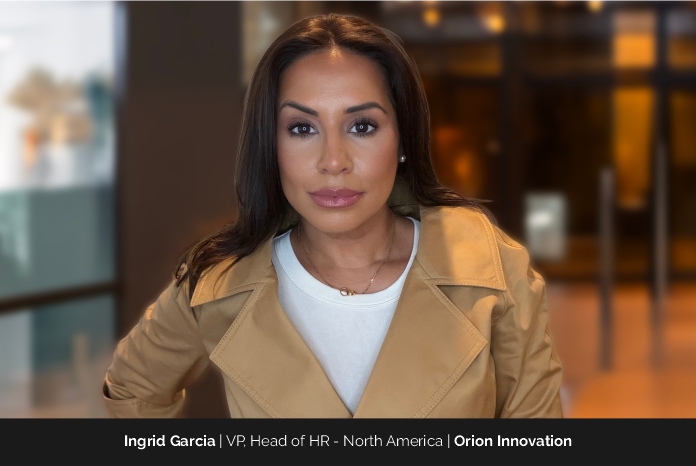
All these qualities are perfectly represented by Ingrid Garcia who is Vice President and Head of Human Resources for North America of Orion Innovation. Her extensive experience covers more than two decades of professional activities in such areas as financial services, healthcare, professional services, and technology. During her entire career Ingrid helped many companies to transform, expand globally, and restructure their business. At present, she is responsible for the development of workforce strategy for the US, Canada, and Mexico while contributing to implementation of new technologies and artificial intelligence in company’s processes. HRM for Ingrid means much more than just administrative compliance.
“Culture isn’t built through policies. It’s built through the decisions leaders make every day.”
Shaping a Vision for People-Centered Leadership
When she considers the factors that influenced her career, Ingrid highlights one particular experience which made her realize the functioning of organizations. “People have always been central to the defining events of organizations,” she says. “Very early in my career, I recognized that few companies were failing because they lacked a strategy. They were struggling because they had not yet tapped into the full potential of their people.”
This important realization led her to redefine her approach towards Human Resources. As someone who has worked with various organizations through phases of rapid growth, acquisition and change in financial services, healthcare, professional services and technology, Ingrid understands that the role of HR goes beyond administration. To Ingrid, people strategy is not just about creating a climate but a strategy for success of people, executives and businesses.
This people-centered outlook defines Ingrid’s approach to executive leadership. Her work demonstrates that when leaders invest in their workforce with clarity and purpose, the entire business benefits. “What continues to inspire me is the ripple effect of great leadership,” she asserts. “When you help one leader become more effective, you positively impact every employee they lead. Knowing that the work we do shapes both business outcomes and people’s careers is what fuels my passion every day.”
Building Culture Across Borders
Expanding a business internationally necessitates a culture that stands its ground but also adapts to the region. Being present across the United States, Canada, and Mexico creates a unique combination of cultural and business elements. As for Ingrid, a powerful corporate culture cannot be created simply by describing everything in an employee handbook; it should be shown through everyday leadership decisions, communication, and fair business.
Moving from the traditional corporate atmosphere to an executive position provided Ingrid with more opportunities to form the corporate strategy regarding the use of talent. “Being part of Orion Innovation at a time of transformation made me realize one thing: culture cannot just be described in a manual,” says Ingrid.
After many years spent working in big corporate systems, she deliberately switched to a place where she could have more impact on developing the long-term strategy regarding talent.
Consistency within different North American organizations does not involve imposing the same processes upon all regions. Instead, it involves the establishment of common values such as trust, accountability, and respect. “Managing HR in the United States, Canada, and Mexico has taught me that although culture must embrace local differences, it must be built on the foundation of consistent values,” says she. “While technology enhances how work is being done, it is the culture which defines the way work feels.”
To Ingrid, operational consistency implies that the principles should be applied by the leaders and not the processes of each particular region. In her view, artificial intelligence technologies will change the nature of modern workplaces and will make culture an increasingly important competitive factor for organizations.
“AI will transform how work gets done, but leadership will always determine how people experience work.”
Integrating AI and Elevating Workforce Systems
With digital transformation revolutionizing the way companies operate today, it becomes increasingly difficult to integrate AI into corporate practice while preserving the human touch which maintains the connection between workers. For Ingrid, business strategy and employee development are inseparable. Her approach to organizational change is as methodical as an approach to finance or operations would be.
Ingrid’s leadership philosophy is straightforward: business first, people always. “As an executive leader, I believe people strategy is business strategy,” she states.
According to Ingrid, businesses do not experience sustainable growth until they approach the selection of talent, leaders, culture, and technology with the same discipline used in making financial or operational choices. Her main area of concentration involves ensuring that general strategic initiatives within an organization are translated into effective strategies involving people that can be implemented by the executives of an organization and be supported by all employees.
Building Scalable Systems Through Strategic Collaboration
Ingrid has spearheaded some very important changes to the structure of the organization in terms of sustainability within the last year. This has included restructuring executive compensation packages, reforming sales incentives, building up regional operational structures, and creating enterprise-wide policies for efficiency. She has also restored employee reporting procedures, conducted people due diligence in mergers and acquisitions, supported an AI-based career development program, and aided in the deployment of a performance management system.
Ingrid emphasizes that these structural improvements require close partnership across every department. “None of these accomplishments happen in isolation,” she points out. “They are the result of a highly collaborative executive leadership team that shares a common vision.”
Through close collaboration with colleagues from Finance, IT, Legal, and the business leadership team, she has contributed to improving performance management practices, governance of compensation, workforce planning, leadership accountability, and enterprise-wide rewards and recognition programs. The outstanding instance of her work is her contribution to the successful migration of employee records globally, which not only involved technology, but also helped the company get better data and insights to grow.
“The future of HR belongs to leaders who understand business as deeply as they understand people.”
Navigating Growth and Fostering Engagement
One of the challenges that arise in growing organizations is how to make operational managers perceive the use of human resource tools as business enablers as opposed to administrative requirements. In circumstances where people are busy trying to do things quickly, there may be a temptation to bypass certain procedures. This challenge is solved by Ingrid through collaboration and data analysis.
“It’s important to understand that operational realities of the people you work with influence what will help you build consensus,” she reveals. “One challenge in growing organizations is to help business leaders understand that HR processes are business enablers and not administrative requirements.”
Instead of imposing a mandated top-down change, Ingrid takes a step back and understands the needs of executive leaders. Through understanding the challenges that come with compensation, work force management, organization design, or new technologies, Ingrid shows how a well-defined HR process will assist executive leaders in achieving their business needs while also managing future risks. Through consistently communicating data and partnering, Ingrid is able to create the trust needed to align even the most skeptical individuals.
Ingrid’s emphasis on data-driven communication also influences the way she manages employee engagement around the globe. Instead of conducting an annual survey for employees, Ingrid prefers continuous feedback.
She highlights how global trends require practical adjustments in employee communication. “Today’s workforce is increasingly global, digital, and skills-based,” she observes. “Leading HR across multiple countries has reinforced that employees everywhere want the same fundamentals: clarity, recognition, meaningful work, and opportunities to grow.”
Although these basic needs may be universally applicable, Ingrid argues that the approach to meet these needs has to change in accordance with the culture and business environment of the region. The concept was used in redesigning the global Voice of the Employee Survey program for Orion Innovation. Instead of conducting the survey every other year, Ingrid suggests using regular pulse surveys along with innovative communication tools. Technology must enhance the human experience at work rather than take away from the authentic human touch that leads to true engagement. She believes that meaningful recognition, paired with continuous listening and communication, strengthens engagement by reinforcing the behaviors and values organizations want to cultivate.
“People strategy is business strategy. The strongest organizations understand that one cannot succeed without the other.”
Embedding Responsibility and Trust in AI Transformation
Ingrid understands that ethics and responsible leadership are central to future success. Rather than viewing corporate ethics as an unchanging book on a shelf, Ingrid sees it as something which is developed through consistent and transparent decision-making. Since artificial intelligence will become a standard part of the business process, it becomes increasingly important to establish and maintain ethical standards.
“Innovative thinking cannot happen without responsible behavior,” Ingrid says. “Innovation without responsibility is risky. Innovation with responsibility builds trust.”
For Ingrid, corporate ethics are evident in how fair the decision-making process regarding compensation is, how transparent the handling of complex issues is, and if the accountability standard is applied to everyone in the company regardless of level. In the age of artificial intelligence being incorporated into workflow procedures, it is essential for executive leaders to demonstrate that the technology is being used responsibly, transparently, and free of bias.
Ingrid Garcia’s commitment to principled and proactive leadership was evident in her being invited to speak at an international technology conference in Singapore on organizational artificial intelligence change management. “Speaking from that stage was more than just representing my company and technology,” she says. “That was proof positive that executives charged with people strategy now had a voice in conversations on AI, innovation, leadership, and future work.”
To Ingrid, it confirmed what she had always believed in – the future would belong to business leaders who understood that people and technology were not competing needs but complementary forces of change.
“Innovation without responsibility creates risk. Innovation with responsibility builds trust.”
Sustaining Leadership Balance and Mentoring Future Talent
To be able to sustain the energy needed to do executive work, Ingrid turns to discipline, boundaries, and good support systems. “I guard the time I spend with my family and with my relationships as carefully as I guard the time I have with my company on my calendar,” Ingrid states. “For me, balance is not one technique. Balance is all about boundaries.”
Instead of aiming at a non-existent perfection each day, Ingrid tries to develop habits that will help her to sustain herself in the long run. She takes care of her health by exercising and engaging in women leaders’ communities.
When mentoring budding professionals, who wish to make an impact, Ingrid stresses the need for commercial savvy. “Learn your way around the business first before trying to shape it,” she says. “The best people leaders first win the trust as great business mentors.”
In Ingrid’s opinion, great workforce leaders should be well-informed about all that contributes to making money, to customer satisfaction, to innovation, and to taking risks. Professionals should combine their business knowledge with technological skills in order to engage in tough discussions with wisdom, tact, and information, along with creating mentor relationships with sponsors.
Defining a Lasting Legacy
As she looks into the future, Ingrid wants a work setting where human empathy and tech advances will positively contribute to one another. Ingrid’s vision is to see people strategy seen as a fundamental part of driving business success, making it possible for technology to take care of the mundane tasks so that the leader is able to coach and motivate others.
“I hope my legacy is that I was instrumental in elevating HR from its position as a support function to a business partner that is indispensable,” says Ingrid. “But more than anything else, I hope that I am remembered as a leader who practiced integrity, developed future leaders, built strong organizations, and made it clear that business success and people success are not competing but complementary.”
Finally, Ingrid Garcia judges herself successful when the systems and people she helps develop continue to flourish and think in a way that is human for years to come.