
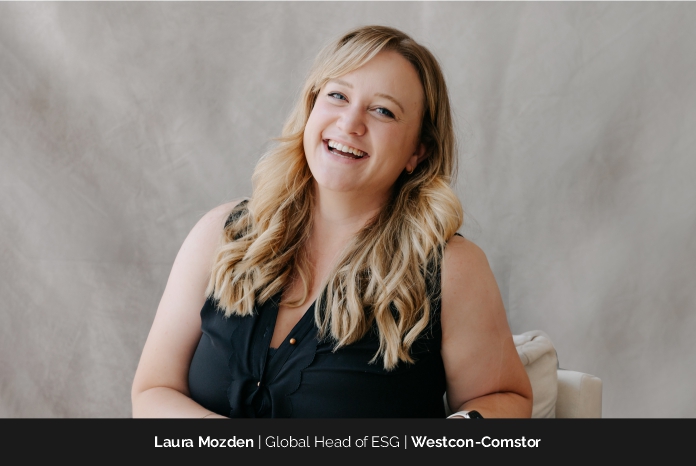
As Global Head of ESG at Westcon-Comstor, a global technology distributor in over 50 countries, Laura Mozden brings the precision of her legal training and a compliance professional’s pragmatism to a role she describes as “a leadership challenge capable of shaping how organizations build trust and prepare for the future.” Since 2025, she’s played a leading role in driving SBTi-validated climate targets, helping deliver a 42 percent reduction in Scope 1 and 2 emissions since 2022.
Laura leads with a pragmatic, impact-focused approach and the belief that ESG must not be siloed, but embedded into business operations.
From Ethics to ESG: A Journey of Leaps
Laura describes her career as “more of a jungle gym than a ladder.” After a university ethics module, she joined Cisco in HR, then pushed for a stretch assignment when she discovered the dedicated Ethics team, ultimately joining the Compliance & Ethics team full-time.
During a pivotal moment on her very first day when the Global Head of Ethics left the business, Laura suddenly found herself flying solo. “Looking back, that experience shaped me more than anything else. It taught me to think on my feet, embrace uncertainty and lean into opportunities before I felt completely ready.”
Years later, as a Compliance Manager at SoftwareOne, the Board entrusted her with leading the new ESG programme. Because her early experience at Cisco had given her the confidence to step into the unknown, Laura said yes. “To me, ESG felt like a natural evolution of good governance and compliance. They’re all ultimately about building responsible, resilient organizations that earn trust.”
She recalls a turning point in Zurich airport when, exhausted from travel, wedding planning, and moving, she hesitated when a board member asked her to return to Switzerland for ESG talks. Her colleague urged, “Laura, get on the rocket ship.” That phrase clicked. “ESG felt urgent, fast, and daunting – yet I’d long cared about environmental and social issues. On the flight home, I reflected on my compliance background. Rules don’t stop misconduct – they’re insufficient alone,” she observes.
Laura realized that ESG wasn’t just governance, but a chance to shift from risk prevention to value creation, answering new demands from investors, employees, and regulators. “By the time the plane had landed, I knew this was my path. That conversation transformed ESG from a compliance topic into a leadership opportunity to build trust and shape the future,” she says.
One mentor who had a profound impact on Laura was James Hackett, Head of Global Compliance Enablement at the time Laura was at Cisco. He took her under his wing, encouraged her to go to law school, and taught her that the best compliance programs are the ones employees barely notice. “Compliance shouldn’t rely on people constantly remembering every policy. It should be embedded into how the business operates, with the right controls, processes and culture in place,” she explains.
That philosophy stayed with Laura throughout her career, and continues to shape her approach to ESG today. “Sustainability can’t sit in a silo or be owned by one team. It must become part of how an organization naturally thinks, makes decisions and does business every day.”
Evolution of a Global ESG Leader
What excited Laura about joining Westcon-Comstor was that it already had the foundations of ESG. Her meeting with CFO & COO, Callum McGregor, made her feel that she could “make a real impact.” They shared the view that ESG should be embedded into how the business operates, not treated as a standalone initiative. “It was an exciting opportunity to turn ambition into action. Rather than building the case for ESG, we could focus on embedding it into the business and driving meaningful change,” she says.
Laura’s role has evolved significantly, largely because the ESG landscape has changed so quickly, and conversations have shifted from winning hearts and minds to preparing for increasingly complex regulatory requirements. “As someone with a compliance background, that shift felt like a natural fit,” she affirms.
What impressed her most was the commitment from senior leadership. As a newcomer, she was nervous about presenting a CSRD (Corporate Sustainability Reporting Directive) dry-run proposal to the Executive Leadership Team, unsure how ESG would be received. To her relief, instead of debating ‘whether’ to proceed, the conversation focused entirely on ‘how.’
“Rather than questioning the value, the discussion focused on how we could make it happen,” Laura recalls. “For me, that was a real milestone. It gave me confidence that I had joined an organization willing to invest in getting ahead of the curve and genuinely committed to continuous improvement.”
For Laura, that voluntary CSRD dry run for their Responsible Business Report demonstrated a genuine desire to understand where they were, identify where they could improve, and continue raising the bar. “That level of support creates an environment in which we can learn as we go and continuously strengthen our approach,” she reflects.
Turning Pushback into Partnership
Laura has never found it a challenge to convince people that ESG matters. Most leaders she works with understand the importance of topics like climate, diversity, ethics, and governance. “The challenge is often helping people see how change fits into the realities of their business, their teams and their day-to-day decisions,” she explains.
Early in her career, she assumed the best way to drive progress was to present the evidence and make the case. Over time, she learned that people rarely resist change because they disagree with the destination, but because they’re worried about what happens on the journey. One of her most valuable lessons was not to argue, but to understand – an approach that tends to work far better than trying to win the debate.
“I remember one senior leader telling me, ‘If you take away their petrol cars, I’ll lose my whole team.’ On the surface, it sounded like a complete roadblock. But underneath it was a legitimate concern about attracting and retaining talent,” Laura shares. “My response was, ‘You might be right. So, let’s not take the cars away. Let’s talk about how we can create more choice.’ People are much more willing to explore solutions when they feel their concerns have been heard.”
Her biggest lesson in sustainability leadership: progress rarely comes from telling people they’re wrong. It comes from finding common ground and helping people see a path forward that works for both the business and the broader objective.
Balancing Today’s Pressures with Tomorrow’s Priorities
Laura notes that sustainability leadership is less about being the expert in the room and more about helping organizations navigate complexity. Stakeholder expectations, economic conditions, and the regulatory landscape are all changing rapidly. The role of a sustainability leader is to help businesses make good decisions as the backdrop continues to evolve. One of the best pieces of advice she ever received was to think like a CFO – understand the commercial realities of the business, speak the language of value creation, and help leaders make better long-term decisions despite uncertainty.
“Sustainability leadership isn’t about having all the answers. It’s about balancing today’s pressures with tomorrow’s priorities,” she explains. “That means helping organizations understand risk, translating complexity into practical action, and identifying opportunities that strengthen both business performance and resilience. Because sustainability challenges are rarely solved in isolation, it also means building trust and bringing people together across functions.”
For Laura, sustainability leadership is all about answering two questions: First, “Will this make the boat move faster?” and second, “How do we make sure the boat still exists when the storm has passed?” The most effective leaders are those who can deliver both – immediate value and long-term resilience.
Discipline, Prioritization, and Perspective
Laura’s greatest daily discipline is prioritization. Expectations from regulators, customers, investors, suppliers, and employees keep growing, but resources remain finite. She takes a risk-based approach, focusing on where impact will be greatest while balancing strategy, stakeholder engagement, reporting, and implementation.
One of her biggest challenges is finding the right balance between talking about the work and doing it. While the constant demand to present progress, share metrics, and explain strategy is important, she knows that real value comes from embedding change, delivering initiatives, and creating measurable outcomes. “The discipline is knowing when to step back and communicate, and when to put your head down and execute,” she emphasizes.
Before motherhood, Laura equated success with being constantly available, working long hours, and proving herself through effort. Becoming a mother fundamentally shifted her perspective. Joining Westcon-Comstor fresh from maternity leave meant no one knew the “old” her – which became a gift. Today, she finds working four days a week incredibly challenging, but incredibly rewarding.
“Motherhood didn’t make me less ambitious – it made me more intentional. For the first time, I wasn’t measuring myself against a previous version of me. Today, I focus less on how much time I spend working and more on the value I create, the outcomes I deliver and the impact I make. That mindset has been invaluable in ESG, where competing priorities are constant,” she observes, adding, “Time has become my most precious resource, and I’m far more protective of it. I’m more focused when working, more deliberate about where I invest my energy, and much clearer on what success looks like.”
Laura’s strategy for balancing ESG initiatives with personal priorities comes down to being intentional about what matters most, having the courage to let go of what doesn’t, and recognizing that impact is not measured by how busy you are. “Becoming a mother isn’t the only way to learn that lesson, but for me, it has been the most challenging, rewarding, and transformative,” she declares.
Outside work, Laura’s proudest personal achievement is completing her law degree while working full-time. “It was probably the hardest thing I’ve ever done. Working for an American company allowed me the flexibility to complete my studies in the morning and work in the evening. It was not easy, but crossing the finish line after several years of commitment gave me a huge sense of achievement and remains one of the things I’m proudest of,” she shares.
Leading with Optimism and Quiet Confidence
Laura hopes her leadership has shown that “influence doesn’t have to come from having the loudest voice, but from having the confidence to use your voice.” Throughout her career, she’s often walked into a room feeling out of her depth and had to remind herself that she deserved a seat at the table.
“I’ve learned that confidence is often something you build by doing, not something you wait to feel first,” she says. “I also try to lead with optimism. Perhaps sometimes to a fault. I’ve always believed that most people want to do the right thing. They care about their colleagues, their communities and the future. Starting from that assumption has helped me build far more progress than approaching conversations expecting resistance.”
Laura wants the next generation of sustainability professionals to be brave enough to take up space and optimistic enough to believe people will meet them there. “ESG is incredibly broad, and there’s no single route into it. It touches finance, procurement, HR, legal, compliance, operations, sales and almost every other part of a business. That’s what makes it so exciting,” she states.
Early in her career, Laura assumed the people leading ESG would have studied environmental science or sustainability. In reality, some of the most effective leaders she worked with came from finance, procurement, HR, risk or legal backgrounds. Their expertise became their superpower because they understood how to drive change within the business.
“My advice would be to stay curious and find mentors. Learn how businesses impact people, communities and the environment, but also understand how those same issues can affect business performance. The strongest ESG leaders are often the ones who can connect those dots,” she observes.
Laura notes that ESG is evolving so quickly that nobody has all the answers. Having people who can challenge one’s thinking, share their experiences and open doors to new opportunities can make an enormous difference. “ESG needs people from different backgrounds, perspectives and disciplines. Your route into the profession may be different, but that difference is often what makes you valuable,” she concludes.
Conclusion
Laura Mozden’s key strength is her ability to make compliance and sustainability less intimidating and more practical – like the guardrails on a bowling lane – not meant to stop people taking risks or aiming high, but to create the confidence to move faster, knowing there are clear boundaries in place. Never afraid to take up space in the room, challenge assumptions, and advocate for change, Laura hopes to be remembered as someone who turned those conversations into practical solutions that helped the business move forward.