
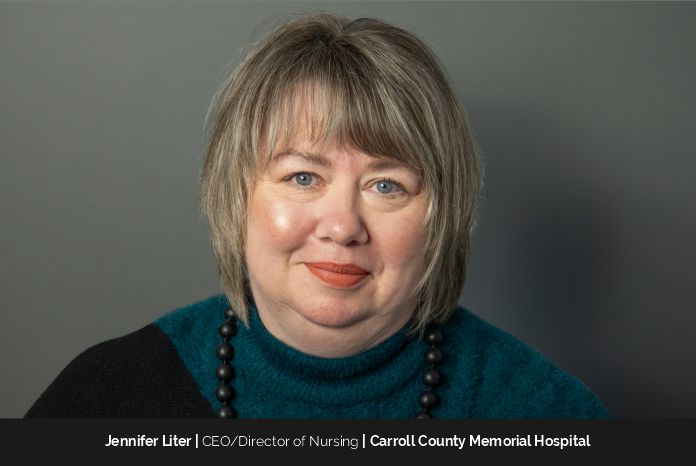
Dr. Jennifer Liter’s journey in healthcare began at age 14 when she volunteered at Carroll County Memorial Hospital (CCMH). What started as a volunteer role has come full circle, as she now serves the hospital as CEO and Director of Nursing. CCMH has been serving the communities of Carroll, Trimble, and Gallatin Counties for over seventy years through the mission of being dedicated to the health and well-being of all.
Jennifer grew up in Carroll County and graduated as a proud Panther in 1992 from the local high school. She recalls trips to the CCMH Emergency Department as a teen and knows firsthand the importance of having healthcare in rural communities.
Jennifer proudly leads with a patient-first mindset, focused on improving patient outcomes and experiences.
“Without patients, we do not have a hospital,” she says. “The business component of care delivery will follow when the patient experience is exceptional.” It is an honor to care for those that I grew up with.
Jennifer wants to be remembered as someone who put patients, families, and team members at the forefront of all decision-making. She hopes employees feel that she truly cares about them, values their contributions to the mission, and is committed to helping them achieve their goals. Dr. Liter works with nurses that she went to college with early on in her career, and she was honored that prior colleagues joined her at CCMH.
The Journey: From Volunteer to CEO
Dr. Liter’s parents, Richard and Barbara Garriott, still live in the area and seek healthcare at CCMH. At 14, when she volunteered at Carroll County Memorial Hospital, she remembers doing whatever the nurse asked her to do, such as getting water for patients or talking with them. She talks about how rewarding it was to connect with the geriatric population at such a young age, noting that one could learn a lot if they just took the time to listen.
In 1996, she returned to Carroll County Memorial Hospital to work in the lab as a phlebotomist. This offered her the opportunity to learn on the job. She also worked in the rural health clinic and took care of patients as a medical assistant. She remembers working with an amazing doctor named Katherine Marshall. Jennifer recounts that she did not have enough money to buy a car to attend nursing school. Katherine gave her the car that had belonged to her late mother. “Dr. Marshall believed in me, and that is how I was able to transport myself to school,” Jennifer says. Dr. Liter noted that she looks forward to the day she could pay it forward to another student in need in a similar capacity. Until then, Dr. Liter and her husband, Glenn, provide a scholarship for a practical nursing student each year.
She enrolled in a Licensed Practical Nurse (LPN) program in 1997. She shares that her mother, who had always wanted to be a nurse, attended nursing school with her. They both graduated in 1998. During her time at Kentucky Tech, located in the high school vocational school, Jennifer continued working in the lab and explored transcription. Later, she spent about a year as an LPN at Carroll County Memorial Hospital, on the night shift, honing her bedside skills on Med/Surg. In 1999, she decided to go to the city to grow her career. “I wanted to learn more and do more work,” she says. She then began working thirty to sixty miles away, across several different health systems and hospitals.
Dr. Liter credits most of her success to the female mentors she has had throughout her career. Many of whom she met in the 90’s, while working at CCMH. Although some have passed away or retired, she now works with some of those same mentors today, right where she began her career.
In 2013, Dr. Liter was working as a nurse manager on a cardiac intervention unit for a healthcare system in Louisville, KY, boasting over 17,000 employees and 11,000 providers. A window of opportunity opened for mentorship in a Nurse Executive Leadership Program, spearheaded by SOAR®. Jennifer noted that 145 applicants interviewed for 15 seats, and she got into the program. Over the course of the next two years, Dr. Liter learned from some of the most successful nurse executives in the field.
As Dr. Liter grew in her profession, she felt the need to be closer to her aging parents. In 2016, a position opened for the Vice President of Nursing at King’s Daughters’ Health, now called Norton King’s Daughters’ Health. She applied for the position and was hired. As time went on, Dr. Liter’s parents continued to have health issues, and she felt as though it was time to go back to her hometown, where her parents lived and her career began.
Dr. Liter returned to Carroll County Memorial Hospital as Director of Nursing in May 2023. When the CEO left in March 2025 to take a new job, Jennifer stepped in as interim CEO. She was named the permanent CEO in May 2025, a position she has held since then.
Working at Carroll County Memorial Hospital
Since its establishment in the 1950s, Carroll County Memorial Hospital, a 25-bed critical care hospital, has been serving people in Carrollton and surrounding counties, aiming for improved patient outcomes and overall health. In 2024, CCMH received the prestigious Kentucky Community Star Award, which recognized its exceptional contributions to rural healthcare and significant impact on the lives of those it serves through evidence-based practice.
In 2025, Carroll County Memorial Hospital received the American Heart Association’s Get With The Guidelines® (AHA-GWTG)–Coronary Artery Disease Rural Recognition Silver recognition. This honor acknowledges the hospital’s commitment to offering rapid, research-based care to patients experiencing a specific type of heart attack known as an ST elevation myocardial infarction (STEMI). Additionally, CCMH received Gold recognition for the work around stroke care that aligns with the AHA-GWTG best practice(s).
For the county residents, Carroll County Memorial Hospital is the nearest healthcare provider. “When I think of the hospitals in our most immediate area, they are about half an hour away in any given direction, and a larger system is hour, either way, toward Louisville or Cincinnati,”. Coming to the emergency department at CCMH tends to be a much shorter wait than going to the city. This is just one advantage to having local healthcare, given we are just off I-71.
Dr. Liter credits much of the success of the hospital to the board of directors. She notes that the members reside in the counties CCMH serves, and some of their parents have previously served on the board. “It’s a generational board,” she says. “They are committed to the success of this hospital. They could sell this hospital to a larger system, but they don’t want to do that. They want to keep health care close to home.”
Jennifer also points out that the board is the most invested and understanding she has ever worked with. Along with being patient-driven, they are also employee focused and want to do what is best for the staff. “The other boards I have sat on never really mentioned employees in the conversation,” Jennifer says. “It was generally about finances, with a little bit about patient care.” The CCMH board puts patients and employees first, then the finances.
“I think what makes me a little bit different in the CEO capacity is that I am proud to be from here,” Jennifer says. “I never forget my roots or where I came from. I respect those that have shaped me through mentorship and education. Everybody wants to give back to the community, and you couldn’t ask for anything more as a nurse.”
Great Achievement as CEO and DON
As CEO and even as DON, Jennifer considers her greatest achievement to be opening the pipeline for transparency. When she came back in 2023, employees did not feel empowered to speak up or challenge processes. They didn’t feel empowered to practice at the top of their license, to share opinions, or to make suggestions. “It’s slowly happening, and you can see a lot more transparency in this organization now,” Jennifer says. “When you do that, you eliminate error and waste.”
“In July 2023, I started the Daily Safety Huddle. There is somewhat of a learning curve when being so transparent with errors and near misses; it takes time. We celebrate the small wins and look for process improvements while promoting patient and employee safety.”
Just this year, Dr. Liter highlights that to support the swing bed program (rehabilitation with smaller nurse patient ratios) and the growing Emergency Department, a million-dollar renovation is nearing completion. The Emergency Department at CCMH services over 7,500 patients per year, and moving from 8 to 13 beds allows for additional growth. Jennifer notes that this is the first ER renovation in twenty-six years, and she credits the prior CFO for the financial management that allowed this to happen!
Plans for the Future
Dr. Liter hopes to retire from Carroll County Memorial Hospital, though that milestone is over a decade away. According to her, she never wants to become complacent, both personally and professionally. “If I feel that I can no longer make a change, I’ll move over and let somebody else do the work,” she says. The care that the hospital provides to the community is the most important.
Dr. Liter is committed to supporting a culture that lends to the community choosing CCMH first for healthcare. “I don’t want them to drive 30 minutes down the road, having chest pain or being in pain,” she says. “They can come here, and we can take care of them, and do so with a smile.” CCMH works closely with CCEMS, PHI, and Air Methods, and when the illness is more severe, patients can be transported to a higher level of care with ease.
Dr. Liter goes on to note that specialists travel to CCMH to deliver care locally, such as ortho, cardiology, urology, and GYN services. The three clinics, Carroll County Family Practice, Warsaw Family Practice, and Bedford Family Practice, often refer patients to the Specialty Center, affording care close to home.
Dr. Liter is a bold, future-focused leader and an out-of-the-box thinker as she shapes the next three to five years of sustainable transformation. Among the initiatives she is proud of is her partnership with AingelusCustos (AC)®, a pioneer in applying next-generation AI to streamline and elevate healthcare operations. AC harnesses advanced algorithms to analyze vast volumes of clinical and operational data already moving through the system, transforming complexity into clear, real-time decision support.
What makes this collaboration especially groundbreaking is AC’s ability to identify emerging risk patterns before they become errors—and to support corrective action before consequences develop. Instead of reacting to issues after the fact, healthcare teams can anticipate problems, intervene early, and prevent harm long before it reaches the patient.
Through this partnership, Dr. Liter aims to empower healthcare teams to anticipate challenges proactively, strengthen patient safety, and usher in a new era where AI-driven foresight becomes a core pillar of high-quality, resilient care.
Advice for Nursing Professionals Aspiring to Executive Roles
“Be open-minded” is Jennifer’s advice for nursing professionals seeking to transition into executive roles. I surround myself with strong individuals that challenge me everyday.
“It is important to embrace learning from others, even when you disagree with their decision-making,” she adds. It is important to find a mentor that is loyal and trustworthy. Dr. Liter notes that it is equally important to network and maintain relationships throughout your career, challenge processes, encourage the heart and consistently model the way (Kouzes & Posner).
What Is Success?
Jennifer wears many hats. She is a nurse, a clinical nurse leader, and a CEO. According to her, she defines success differently in each role. As CEO of a hospital, her priority is patients, and she focuses on clinical quality data. When there are good patient outcomes, good patient experience(s), and alignment with evidence-based practice, then the hospital is successful. Sustainability as a stand-alone critical access hospital takes tenacity, forward thinking and collaboration at all levels of the healthcare continuum.
“First and foremost, we’re here for the patients,” Jennifer says. “The benefits of the business model and finances come later.” She points out that anyone who comes to the hospital wants to get rid of something, as they are sick or have an illness. “Anytime we can make that happen for them and improve their quality of life or even extend their lifespan, that is success,” Jennifer says.