

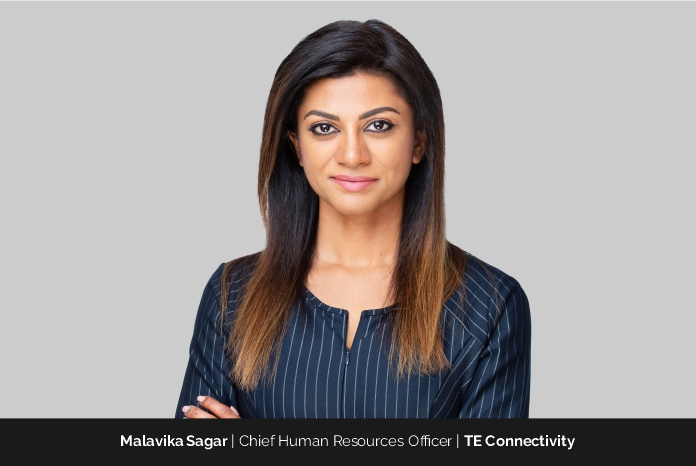
The world of work is changing fast, shaped by technology, evolving employee expectations, and the growing need for organizations to stay flexible and resilient. In this environment, human resources is no longer a behind-the-scenes function; it directly influences how companies perform, adapt, and grow. At TE Connectivity, that responsibility sits with Malavika Sagar, Chief Human Resources Officer.
In her role, Malavika leads the company’s global people strategy, covering succession planning, leadership and talent development, organizational design, culture, change management, and compensation. But beyond the scope on paper, her work shows up in very practical ways across the business. On any given day, she may be partnering with senior leaders to shape leadership pipelines, helping teams navigate trade-offs during periods of transformation, or designing people systems that support both performance and long-term growth. Each decision connects people strategy to real business outcomes while ensuring the organization has the right leaders, skills, and structure to succeed in a complex, global environment.
With extensive experience partnering with senior executives in complex global environments, Malavika has led large-scale HR transformations that align people strategy with business priorities. She is deeply committed to advancing women and underrepresented talent and to developing the next generation of leaders, building systems that help both individuals and the organizations move forward with confidence.
The Roots of a People-Centered Leader
Long before boardrooms and global organizations became part of her daily life, Malavika was picking up lessons about leadership at home. The strongest influence came from her grandfather, who arrived in a big city with very little and went on to build a respected business rooted in trust, discipline, and a sense of responsibility to the people around him.
What stayed with her was not only what he built, but how he built it. He set high standards, took the time to develop others, and earned confidence through what he did, not just what he said. Watching this shaped her understanding of leadership early on. It taught her that leadership is less about titles and more about helping others do their best work by being clear about expectations, offering support, and creating an environment where people feel challenged, trusted, and able to grow.
That way of thinking still guides her today. It reflects the values she champions at TE Connectivity, including accountability, integrity, teamwork, innovation, and inclusion. Roles and responsibilities may evolve over time, but for Malavika, the heart of leadership remains the same: creating the conditions for people to succeed and grow, wherever they are in the organization.
Finding Purpose in Influence: The Journey to CHRO
Human resources was not part of Malavika’s original career plan. Her move toward the function was a conscious one, shaped by a growing sense that HR could influence much more than policies or processes. She began to see it as a way to connect people decisions directly to how a business performs but only if those decisions were rooted in a real understanding of how the organization works from end to end. That belief led her to build experience across people, culture, talent, and organizational design, so her perspective in HR would always stay close to the realities of the business and what it needed to achieve.
Her career has since spanned the full range of HR work, from operational roles and talent strategy to leadership development, mergers and acquisitions, and global assignments. Each step gave her a clearer view of how organizations function day to day and where thoughtful people decisions matter most.
Over time, a pattern took shape. Her work consistently centered on building environments where both individuals and the business can do their best work. That sense of direction, shaped over years of experience, eventually led her to the role of Chief Human Resources Officer at TE Connectivity. It reflects not only professional growth, but a long-standing commitment to helping organizations and the people within them thrive.
HR in Motion
As workplaces continue to evolve, shaped by technology, shifting roles, and ongoing uncertainty, Malavika has seen how these forces change what people need from their organizations. Employees look for clarity, support, and fairness, while leaders are often asked to make decisions in conditions that rarely feel settled. This reality shapes how she approaches her work, keeping people strategy closely tied to both human needs and business priorities.
In that environment, she sees HR as a steady presence. Its role is to help leaders make thoughtful choices, prepare teams for change, and build organizations where learning and adaptability are part of everyday work.
Technology can remove friction and improve decision-making, but people remain at the center. Careers are less linear than they once were, and skills now matter more than titles. Creating clear ways for people to grow across functions has become essential.
In global organizations, this focus also strengthens internal movement. When development is built around capability, talent can move to where it is most needed, bringing fresh perspective and deepening the leadership bench. For Malavika, this is one of the most practical ways to help organizations prepare for what comes next.
Looking ahead, businesses will need adaptable, skilled people to support growth. HR’s role is to stay close to the business and design systems that help people move forward with clarity and confidence.
Staying Grounded at the Top
Senior roles bring sustained demands, and Malavika approaches them with a focus on intentional energy management rather than the pursuit of perfect balance. A metaphor she has shared in conversation and often returns to captures this mindset well. Balance, she reflects, is like rock climbing. You stay steady by maintaining three points of contact, creating enough stability to keep moving even as conditions shift. The strength comes from those anchors themselves; having clear, reliable points of connection that hold you in place while everything else is in motion. What matters is being clear about priorities, understanding the trade-offs, and directing energy where it matters most, rather than trying to hold everything at once.
For her, those anchors are family, work, and wellbeing. They are the constants she returns to, even when the pace accelerates. She acknowledges that all three cannot be held with equal strength every day. Some days, two are firm while the third feels less secure. What matters is awareness and intention.
Small, deliberate choices help her stay centered. Exercise plays a key role, whether it is a walk during a work call while traveling or a short workout in a hotel room between meetings. These habits are not about rigid routines, but about preserving energy and clarity.
Her approach is rooted in acceptance rather than perfection. The goal is to build enough stability to show up fully, both for the people she works with and the people she cares about most at home.
Anchored in Purpose
When she faces complex decisions, Malavika comes back to a small set of guiding ideas. Purpose comes first. People need to understand both what is being decided and why it matters. Close behind that is accountability, and a willingness to stand behind the choice and the results that follow.
Intent matters just as much. The way a decision is made, and how leaders carry it through, often shapes how it is received. Outcomes still count, of course. Leadership has to be connected to results, not just good intentions.
Underneath all of this is mutual respect. Even in difficult moments, people deserve fairness, clarity, and care. A decision loses its weight the moment leaders forget the people affected by it.
For Malavika, the strongest decisions are those that connect people strategy to where the business is going, not where it has been. Effective HR leadership depends on truly understanding what the organization needs and making choices with that reality in mind.
Building Pathways, Not Barriers
Malavika sees leadership as a responsibility that goes beyond short-term results. For her, leaving an organization stronger means putting systems in place that spot potential early, support people as they grow, and remove barriers that have held others back in the past.
Her work has focused on making those systems part of everyday practice. Leadership development pathways have been strengthened, policies updated, and succession planning shaped with the long term in mind.
The changes are visible. Programs for women returning to the workforce have grown, parental leave policies have evolved, and targeted development initiatives now help women step into leadership roles earlier and with greater confidence.
Sponsorship plays an important role in this effort. TE has introduced a tiered model in which senior leaders sponsor the level below them, creating a steady flow of access, advocacy, and shared ownership. Opportunity is no longer concentrated at the top, but moves through the organization.
Malavika stays closely connected to the women and other emerging leaders involved in these programs, listening to their experiences and adjusting systems when needed. In her view, progress comes from pairing intention with structure, and influence with ongoing involvement. If the next generation of leaders can move forward with fewer obstacles and more confidence, the results will endure well beyond any one role or moment.
Lessons from a Defining Crisis
One of the most demanding periods of Malavika’s career came during the global pandemic, when she led HR for TE Connectivity’s largest segment. She was supporting a $9 billion business with nearly 45,000 employees across dozens of countries, each facing different realities.
Factories were redesigned to meet safety requirements, regulations changed constantly, and parts of the workforce moved into furloughs while others shifted to remote work almost overnight. Every decision affected employee safety and livelihoods, while Malavika navigated the same uncertainty in her own life. There was no precedent to follow.
She focused on facts, aligned quickly on priorities, and acted decisively. Solutions were built country by country, factory by factory, with a consistent focus on employee safety, maintaining continuity of operations, and communicating clearly. The experience reinforced a belief that still guides her leadership: in the hardest moments, clarity and steadiness matter more than perfection.
Where the Work Becomes Personal
The moments that matter most to Malavika are often quiet ones. They come when a discussion or conversation gives a leader confidence to move forward. HR may work behind the scenes, but its impact shows when leaders embrace coaching and take actions to support their development.
Developing leaders is a source of deep fulfillment. Helping someone step into greater responsibility or navigate complexity can shape their career in lasting ways. Watching people grow into roles they have earned remains one of the most meaningful parts of her work.
She is also closely involved with employee resource groups, including the Young Professionals ERG. Early-career employees want to build long, varied careers across functions and industries. Helping create systems that make that possible is work she finds both purposeful and energizing.
What matters most to Malavika is knowing that today’s decisions are building confidence, capability, and opportunity for the future.
Learning Across Cultures
Working across cultures has reinforced Malavika’s view that leadership is never one-size-fits-all. People come to work with different expectations and ways of communicating, and effective leadership starts with understanding those differences while staying anchored in shared values.
That lesson took shape early in her life when she moved to the United States. Adjusting to a new environment called for both flexibility and a strong sense of self. Learning how to adapt without losing authenticity continues to influence how she leads global teams today.
This balance is reflected in how TE Connectivity shows up around the world. Its purpose and values remain consistent, while the way they are expressed reflects local culture. Even onboarding is approached with care and local partnership, recognizing that early experiences shape how people come to understand an organization’s culture.
For Malavika, global experience sharpens leadership. It deepens how leaders listen, improves how they communicate, and strengthens their ability to lead with clarity and purpose.
Evolving HR at TE Connectivity
For Malavika, innovation starts with paying attention to where work slows people down. It might be time lost to manual processes, unnecessary complexity, or decisions that take too long to reach the right owners. Rather than jumping straight to tools or trends, she encourages teams to first ask a simple question: what problem are we actually trying to solve? From there, ideas are given enough space to explore different ways of removing friction before being shaped into practical solutions.
In that context, tools like AI become enablers rather than the point themselves. They are applied where they can reduce effort, improve clarity, or speed up decisions, with impact measured quickly and lessons carried forward to the next challenge. The focus remains on making everyday work easier and more effective so leaders and employees can spend less time navigating systems, and more time delivering results.
At TE, this mindset has led to practical changes. AI-supported goal setting helps bring focus and alignment. Feedback tools support clearer communication across languages. Stronger analytics allow teams to understand employee sentiment more quickly.
These capabilities continue to grow. AI-enabled compensation planning and a digital HR assistant are being developed to help employees manage everyday needs with ease. The goal across all initiatives is the same: reduce complexity so leaders and teams can focus on delivering results.
For Malavika, innovation in HR is not only about scale or speed. It is about solving real problems and building systems that help people work well.
Defining Success Through Impact and Growth
Beyond titles and milestones, Malavika measures success by what she helps others become. For her, it shows up in moments when someone gains confidence or sees new possibility in themselves.
One memory has stayed with her over the years. Early in her career, a colleague reached out after a conversation they had shared. The message was simple, but it meant a great deal. Something Malavika had said helped her feel more confident at a moment when she needed it most. She kept that note, not as a symbol of accomplishment, but as a reminder of the kind of difference she hopes to make; quiet, personal, and lasting.
Reflection is part of her own routine as well. At the end of each year, she writes a letter to herself. It is both a way of setting intentions and a way of taking stock. When she opens it again a year later, it gives her a rare pause to notice how far she has come before turning to what lies ahead.
Success, as she sees it, is not a fixed point. It changes with time and experience. But it always comes back to the same idea: what you leave behind in the work, in the people around you, and in the person you are becoming.
Guidance for the Next Generation
Malavika’s advice to aspiring HR leaders begins with really understanding the function. Leading HR calls for experience across operations, talent, business partnership, compensation, and organizational design. That range builds the judgment that sits at the heart of strong HR leadership.
Staying close to the business matters just as much. HR is most effective when it understands what leaders are trying to solve, how decisions are made, and where the pressure truly sits. Credibility grows when guidance reflects business reality, not just theory. She also encourages professionals to seek out experiences before titles. Stretch roles build both skill and confidence, and once capability and readiness are in place, titles tend to follow. As responsibility increases, pace becomes important but progress comes from moving with purpose, not simply speed.
For Malavika, careers are shaped as much by people as by the choices they make. True HR leadership is built over time, through capability, courage, and consistency, long before the moment arrives when it is needed most.