
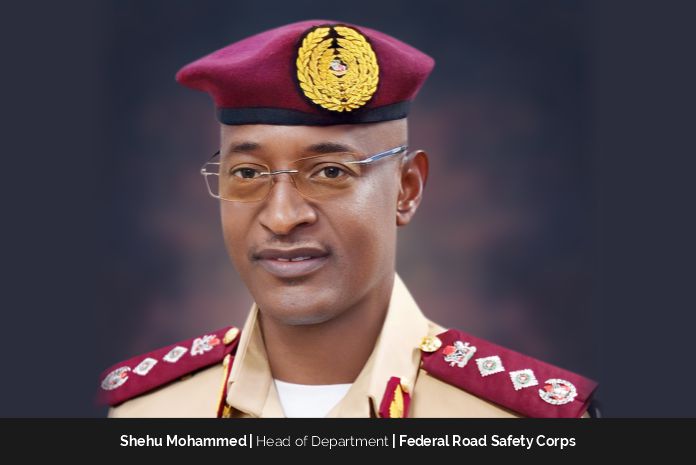
“Humility is the solid foundation of all virtues.” This perspective on leadership did not come from a textbook for Mallam Shehu Mohammed, the Corps Marshal and Chief Executive of the Federal Road Safety Corps (FRSC) in Nigeria. It began in a traditional town in Zaria, Kaduna State. As he grew up, he watched his father, a respected Mallam (a learned man), interact with people in the community with humility, fairness, and dignity. It taught him early on that a leader’s strength is often anchored in how they treat others with respect.
As he moved up the ranks, these lessons in character stayed with him. Even today, with the traditional title of Sulukin Arewan Zazzau, he regards it as a symbol of the trust his immediate community reposes in him.
When he entered the professional world, he found those principles aligned with the FRSC’s mission. He realized a strong organization flourishes with a clear framework for behavior. Within the FRSC, discipline is anchored in values, rewarding competence and compliance while maintaining an uncompromising stance against deviance from established standards.
For Mallam Shehu, road safety is not a theoretical concept. It is a daily responsibility measured in human consequences. In line with the clear mandate of the Corps, his vision is simple and uncompromising. As he puts it, “I am committed to making our roads safer for all road users.”
Servant Leadership & Ethics
At his core, Mallam Shehu is a servant leader, someone who isn’t one for the heavy robes of ‘office.’ He sees his position more like a tool for building goodwill and addressing challenges. The legacy he’s planting is one of transparent leadership and public trust. He likes to lead by example, enforcing standards and clearly defined job objectives, among other things. “It is better to do what is right,” he adds, “even if the right thing is wrong, rather than doing what is wrong even if it feels right.” That sentiment captures the takeaway from someone responsible not just for systems, but for lives. In the pages that follow, he shares the thinking, choices, and lessons shaping that outlook.
The Human Side of Enforcement
Rules are only as effective as the people they are meant to serve. For Mallam Shehu, leadership in traffic protection is about balance. The enforcement of traffic laws is non-negotiable. However, the human side can’t be overlooked. Mandates must be exercised with empathy for the people those laws are designed to protect.
Experience, he says, has revealed one important reality. Many road users are not defiant. The only stumbling block is that they are uninformed. Education, therefore, becomes a core responsibility of enforcement. The FRSC advances this through public awareness campaigns, appropriate warnings, and continuous driver sensitization.
“When citizens understand that regulations exist to protect them, not to oppress them,” he emphasizes, “compliance improves sustainably.”
Leading Through Evolution and Strategy
Over the years, Mallam Shehu has shifted his focus toward creating a workspace where people feel empowered, supported, and genuinely cared for in their work. Micromanagement has no place in his playbook. It only stifles innovation. Instead, he believes in motivating personnel and giving teams the confidence to take ownership of their responsibilities.
Since stepping into the role of Corps Marshal in May 2024, he has worked closely with his team to build a ground plan that feels both modern and practical. This vision is built on six key pillars that guide every decision they make.
These priorities begin with the need to rejig and reposition operational strategies, with a heavy emphasis on staff training and retraining. He also places great importance on strategic partnerships and on digital transformation in operations to stay ahead of modern trends. At the same time, he keeps the fundamental human elements in focus, ensuring that discipline and welfare remain major to the mission.
Traditional administrative structures have become less effective in contemporary contexts, making adaptability essential. These policy thrusts have guided the administration and delivered milestone achievements.
The Roadblocks
The journey toward safer roads is rarely smooth. Mallam Shehu speaks candidly about the challenges confronting road safety authorities. Breaking entrenched habits, addressing an “above-the-law” mindset, low literacy levels, and prevailing economic conditions all complicate enforcement efforts.
In response, the FRSC has intensified road safety education in schools, strengthened standardized driver licensing processes, improved patrol operations, and deepened advocacy and strategic partnerships nationwide. One of the most pressing recent challenges, the backlog of unprinted and uncollected driver’s licenses, has now been addressed through the deployment of technology.
This drive for progress is rooted in a deep personal commitment. Mallam Shehu affirms, “Whatever I feel in my spirit to do in the best interest of this organization to succeed, I will do it.” It is this paradigm of doing whatever it takes that has transformed a slow-moving bureaucracy into a better-engaged, proactive agency.
Management Through Results and Transparency
This industry veteran prioritizes actual inputs and outcomes over simple policy statements. To keep things on track, he ties every initiative to measurable performance indicators. This includes monitoring crash-reduction rates, fatality indices, and the speed at which teams respond to emergencies. By conducting regular audits and public reporting, he ensures these plans deliver real results on the road. The process is very hands-on. Mallam Shehu meets with his management team every Tuesday to stay up to date. He also holds quarterly meetings with state executives from all 37 Nigerian State Executives (Sector Commanders) to brainstorm and refine strategies to keep the public safe.
A Digital Transformation for Public Safety
Technology and data have become central pillars of modern road safety under Mallam Shehu’s leadership. Digital tools now underpin accuracy, transparency, and operational efficiency across the FRSC.
Key initiatives include the FRSC Mobile Application, which provides access to core services, and the National Crash Reporting Information System, which enables unified road traffic crash data across relevant agencies. Internally, the Electronic Document Management System has reduced reliance on paper communication, while virtual platforms and social media channels have strengthened public engagement.
On the operational front, body-worn cameras provide real-time visuals that ensure enforcement is based on clear, transparent evidence rather than guesswork, strengthening public confidence. Staff performance evaluations are also conducted electronically. These initiatives have earned the FRSC national recognition as the best government agency in technology deployment. Through the Duty Room Information Management Systems, the Corps now maintains comprehensive data on offenders and offenses, further reinforcing evidence-based enforcement.
Building for the Future
A good name is better than gold. Mallam Shehu lives by this idea. He believes, “Compliance leaders are custodians of institutional integrity.” It is not just about the here and now. Their main job is to build sustainable, resilient, ethical, and citizen-focused systems that will continue to save lives long after they leave.
Professional Excellence and Institutional Reform
One of the accomplishments he holds most dear is leading reforms that enhanced operational efficiency, reinforced financial discipline, and embedded data-driven enforcement across the Federal Road Safety Corps (FRSC). His leadership philosophy is anchored in professional rigor, reflected in his standing as a Fellow of the Institute of Chartered Accountants of Nigeria (ICAN) and a Fellow of the Chartered Institute of Taxation of Nigeria (CITN). His intellectual and policy grounding is further strengthened through his memberships in the Association of Project Management (APM), the Nigerian Institute for Policy and Strategic Studies (NIPSS), where he holds the mni designation, and the Chartered Institute of Public Finance and Accountancy (CIPFA), UK. Beyond the Corps, he contributes at a national level as a Board Member of the Federal Roads Maintenance Agency (FERMA), a role he has held since December 2023.
His commitment to transparency, innovation, and public value has earned him wide recognition. In 2025, he received the Nigeria Excellence Award in Public Service (NEAPS) for outstanding performance in digital innovation. He was also honored with the Distinguished Gov-Tech Trailblazers Award at the Nigeria Gov-Tech Public Service Awards in October 2024, acknowledging his role in advancing technology-driven governance. His people-centered leadership has been recognized through the Most Supportive Chief Executive Officer for SERVICOM Activities Award at the 2024 SERVICOM Awards, alongside multiple commendations from the FRSC Management. He is also a double awardee of the FRSC Anti-Corruption and Transparency Monitoring Unit, reinforcing his belief that sustainable, safe mobility begins with accountable systems and ethical leadership.
Staying Grounded Under Pressure
Leading a major agency is never easy. The weight of public expectation is heavy, and it follows you home. For Mallam Shehu, handling that kind of pressure is not about a secret formula. It comes down to a few basic things that keep him steady when things get loud.
A clear sense of purpose helps him absorb the strain without losing direction. He leans on his faith to stay centered. It is the foundation that keeps him from getting swept up in the chaos of the day. He also lives by a strict personal routine. He does not leave his schedule to chance because he knows that discipline creates the room he needs to think. He is the first to admit that he does not have all the answers. He makes it a point to keep learning and stays curious about new ways to solve old problems.
He does not carry the load by himself. His family is his primary support system, and they provide the balance he needs after a long day at the office. He also trusts his colleagues. He strongly believes that leadership pressure is best managed through teamwork, shared responsibility, and collective ownership of outcomes. He values their perspective and relies on their honesty to keep him sharp. By staying grounded in these relationships, he finds he can make better choices when the stakes are high. He keeps his feet on the floor so the pressure of the job never gets to his head.
Advice for the Next Generation
If there is one lesson Mallam Shehu wants to pass on to young officers, it is the value of patience. In his line of work, a single second of impatience can lead to a lifetime of regret through a road crash. He encourages emerging leaders to master their professional disciplines and always uphold their ethical conduct. He reminds them that true leadership is not about personal status. It is about service and sacrifice. Mastering their professional discipline is the need of the hour.
A Sharper Mandate Ahead
We ask Mallam Shehu how he envisages the role of compliance leadership in a rapidly changing world. He offers a clear, practical view. According to him, it will become even more strategic, focused on technology and citizens. The road ahead, he notes, allows no room for complacency. He believes future leaders must be ready to act before problems surface. They must leverage innovation, collaborate across borders, and anticipate risks before they happen.
In the complex machinery of national safety, Mallam Shehu is the steady compass, reminding us that while technology may provide the pulse, it is character that provides the heartbeat. He is a principled leader who understands that the safest road for a nation is the one where progress and humanity travel at the same speed.