
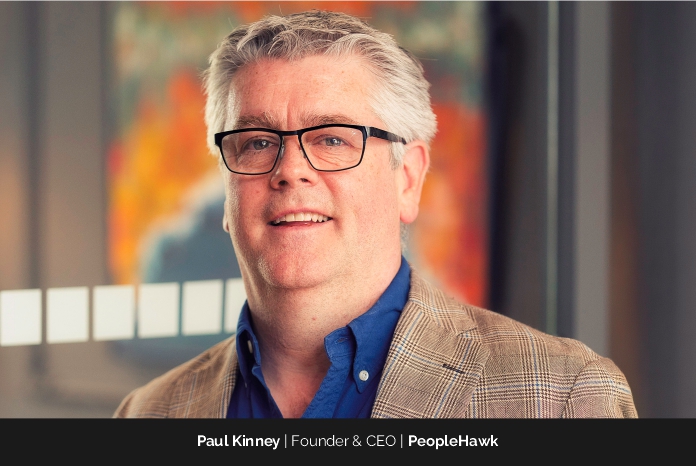
Paul Kinney, Founder and CEO of PeopleHawk, is building a global platform that connects education, employability and opportunity. A regular speaker on employability, future skills and education-to-employment pathways, Paul is an advocate for more responsive systems that help people understand their potential and connect it to real opportunity. PeopleHawk helps students and career changers discover their strengths, build digital career profiles based on character and skills, and connect with employers hiring for potential, not pedigree. With over 500,000 young people assessed across 19 countries, PeopleHawk is turning self-discovery into a curated journey from skills and work experience to live opportunities.
From Family Values to Leading Change
Paul’s leadership was shaped by growing up in Ireland, working in his father’s wholesale business alongside four siblings. “It was a practical education in responsibility, resilience, and work ethic,” he recalls. His mother valued education, discipline and learning. “Between them, my parents shaped two beliefs: effort creates opportunity, and education gives people the power to use it.”
As a Advisory Partner in PwC, Paul saw that people determine success – talent drives performance, culture, and growth. At PwC and through building businesses, Paul saw that people determine success – talent drives performance, culture, and growth. He also learned that potential doesn’t arrive perfectly packaged. “Some people have the confidence, polish, or networks to present themselves well. Others have just as much ability, but need the right insight, support, and opportunity to showcase it.”
“Potential does not always arrive perfectly packaged. Some people need the right insight, support, and opportunity to show what they can offer.”
Closing the Future-Readiness Gap
PeopleHawk originated from a disconnect between education, self-understanding, and employment. Students and career changers are expected to make choices before understanding themselves. Educators lack time, tools, and data. Legacy platforms offer disconnected experiences, ignore modern tech use, and overlook disadvantaged contexts.
PeopleHawk is a mobile-first, cloud-based platform connecting self-discovery, skills, and opportunities into one journey. With 262 million young people globally not in employment, education or training, PeopleHawk’s VIPS (Values, Interests, Personality, Skills) framework helps close the future-readiness gap.
“The biggest mistake education systems make is asking people to choose a future before helping them understand themselves.”
Success Measured by Impact, Not Just Growth
Business growth helps PeopleHawk reach more people, but Paul measures success by impact. It is reflected when an uncertain young person begins to see a meaningful future, a student discovers a career path aligned with their VIPS, or a career changer gains confidence in a new direction.
Success also means expanding access to quality career guidance, particularly for disadvantaged learners and those in specialist settings. Paul believes guidance should be practical, accessible, and confidence-building, supported by user-friendly assessments, mobile access, and live opportunity boards.
For Paul, future readiness is not a single decision but a continuous journey through education, employment, and career transitions. “Impact must go beyond choosing a course or career. When people choose pathways that fit their values, interests, personality, and skills, they’re more likely to feel engaged, confident, and fulfilled.”
PeopleHawk helps reduce career mismatch by enabling individuals to make better-informed choices and helping employers better understand talent. For Paul, commercial growth serves one purpose: helping more people move from uncertainty to direction, from direction to action, and from action to opportunity. “If PeopleHawk helps more people achieve that journey, that’s success.”
“Future readiness is not a one-off conversation, lesson, or report. It’s a connected journey that should support people throughout education and beyond.”
Purpose, Discipline, & Simple Innovation
Leading a purpose-driven company is demanding and never feels finished. For Paul, balance comes from perspective, discipline, and trusted people. “I stay close to the purpose, but don’t let every operational challenge become personal. The key is to return to the mission while keeping leadership sustainable.”
His discipline comes from an upbringing that valued work ethic, education, reason, and judgment. He leads by working hard, thinking clearly, solving problems, and keeping perspective. Clarity drives wellbeing – when vision and priorities are clear, leadership becomes focused. “Stepping back helps me think clearly and return with more energy. Leadership is not about being constantly available, but consistently purposeful.”
One unexpected challenge: simplifying a complex idea without losing depth. PeopleHawk blends education, psychology, technology, and employment into an intuitive mobile experience. UX is central. If the platform does not engage them, it cannot guide them.
Some platforms push a single job title on a 14-year-old. Paul believes in structured exploration, not premature limitation. PeopleHawk uses broader career families and then connects users to courses, skills, and opportunities. “The best innovation feels simple to the people using it.”
“For young people, user experience is not cosmetic. If the platform does not engage them, it cannot guide them.”
Protecting the Mission Above All
Paul’s first responsibility: protect the mission. PeopleHawk helps young people and career changers understand themselves, explore pathways, and build confidence and skills. Second, he ensures the platform works in the real world – for educators, schools, employers, governments, and individuals. “It must be powerful enough to provide insight, yet simple enough to scale.”
Third, he focuses on quality and integrity. PeopleHawk combines self-discovery, skills, AI, career exploration, course matching, and opportunities. “We spent considerable time seeking out eminent psychologists and experts globally to develop, test, and refine our assessments. Results had to be engaging, accurate, credible, and capable of supporting meaningful guidance conversations.”
Paul also keeps PeopleHawk relevant to the wider economy because education and employment can no longer be separate worlds. Employers need better ways to understand talent. Governments need skills insight. Charities need scalable support. Individuals need better tools. “The technology will continue to evolve, but the mission remains constant: helping people make better decisions about their future.”
“The people most at risk of being overlooked are often the people who benefit most from clearer insight, better guidance, and a stronger way to present their potential.”
Connecting Education to Employment Intelligently
Paul notes that for too long, guidance has been treated as something that sits alongside education, rather than being central to it. He hopes his work encourages leaders to think more broadly about future readiness, as the future of education must connect learning, self-discovery, skills, employability, and opportunity.
PeopleHawk gives young people self-awareness and educators scalable tools, creating a bridge between education and employment. “LinkedIn is about who people know, and CVs are about what people have done. PeopleHawk is about what people are capable of. A person’s potential is often much broader than their current CV suggests.”
This bridge matters because recruitment is slow, fragmented, and CV-dependent, with average time-to-fill exceeding 40 days. PeopleHawk reduces friction by giving employers richer insight into a candidate’s values, interests, skills, and readiness. “This is not about replacing human judgment, but helping employers make better-informed decisions while helping candidates present a fuller picture. Guidance should not be a final-stage activity, but part of a more responsive education-to-employment system.”
“Career guidance should not be a collection of disconnected tools. It should be a curated journey from self-discovery to real opportunity.”
Start With the Problem, Not the Technology
Paul’s advice to edtech entrants: start with the problem, not the technology. Education is complex. Institutions don’t need new tools for novelty’s sake – they need solutions that respect their pressures and create measurable value. Listen to educators, students, parents, employers, and communities. The best ideas come from understanding real difficulties, not assuming tech alone fixes systems.
Take credibility seriously. PeopleHawk worked with leading psychologists to develop and refine assessments because the platform had to be trusted, not just engaging. Be patient and resilient. Education is a deeply human sector. Trust, evidence, and relationships matter. Adoption takes time – educators need to know a product is safe, ethical, and aligned with their values. Keep ambition high, but language simple. If you can’t clearly explain your solution to any stakeholder, it needs more work.
From Idea to Global Impact
One of Paul’s most rewarding achievements: seeing PeopleHawk grow from an idea to a global platform. Over 500,000 young people across 19 countries have taken its assessments. “Young people everywhere need better ways to understand themselves and connect education to opportunity.”
At the University of Johannesburg, one of Africa’s largest universities with more than 50,000 students, PeopleHawk helped fast-track employability. At St Ronan’s College in the UK, students built digital career profiles and a local job board connected them to traineeships and apprenticeships. The work was later featured by the OECD, a recognition that reflected the full PeopleHawk model: a connected journey from self-discovery to digital profiles, guidance, support, and live opportunities.
Another impact area is alternative provision, like Meadowbrook College in the UK, where PeopleHawk helps young people rebuild confidence and explore realistic pathways. “What stands out is not a technical milestone, but the practical human impact. When self-understanding connects to concrete next steps, that’s what PeopleHawk was built to do: help people move from insight to action, and from action to opportunity.”
Innovation Anchored in Purpose
At PeopleHawk, innovation and accountability go hand in hand. The team’s ambition is about what the platform can become, but innovation only matters if it improves user outcomes. “We don’t add features just because technology allows it. We ask whether each development removes friction, improves insight, or helps users move confidently from self-discovery to action.”
Mobile-first design and UX are critical. If a young person can’t access the platform easily or feel the experience is relevant, the technology has failed, no matter how sophisticated. The team constantly asks: Is it simple enough? Will educators and students use it? Will employers value it? “Those questions keep us grounded. Accountability comes from clarity – everyone needs to understand what we’re building and why.”
The culture encourages bold thinking, constructive challenge, and ownership. “In a rapidly changing industry with AI, we must move quickly but stay disciplined, evidence-led, and anchored in the mission. Innovation isn’t chasing trends – it’s building a platform that’s trusted, useful, and capable of meaningful difference at scale.”
“AI should not replace human guidance. It should help make personalized guidance available to every learner at the moment they need it.”
Data Should Widen Possibilities, Not Narrow Them
Paul predicts data and personalization will be central to education’s future, but only if used responsibly. “Every individual is different. Yet systems have provided broad guidance because personalization at scale was difficult. That’s now changing.”
Good data helps educators understand learners deeply – highlighting patterns, identifying needs, and supporting pathway exploration. For institutions, it helps governments and workforce partners understand skills gaps. PeopleHawk sees data as a way to strengthen human guidance, giving teachers and employers richer insight into a person’s values, interests, personality, and skills.
“The future should not use data to narrow choices. It’s not acceptable to imply a 14-year-old should follow a single job title when many careers exist. Data should widen possibilities and improve self-awareness. That’s why PeopleHawk directs users to broader career families before specific careers – structure without closing doors.”
“The future should not be about using data to narrow choices or limit options. It should be about widening possibilities.”
Staying Close to the Problem
Paul stays inspired by staying close to the problem. “The world of education and employment is changing rapidly – AI, skills gaps, disengagement, shifting expectations. That change is challenging but energizing.” He learns by listening to educators, students, employers, and charities. “The most valuable insights come from people facing the problem directly. They remind you where the real needs are.”
He also looks beyond education to technology, psychology, economic development, and human behavior. “As a leader, you have to keep joining those dots.” He’s inspired by PeopleHawk’s reach, from universities to alternative provision. “Future readiness is not a niche issue. It’s a global need.”
What inspires him most: helping people make better decisions at moments of transition. “If we can give them better self-awareness, information, skills, insight, and tools, we can help them approach the future with more confidence.”
A Global Future-Readiness Platform for All
Paul’s long-term vision: PeopleHawk as a global future-readiness platform for young people and career changers. While historically focused on institutions, the business is now broadening to a B2C model, allowing anyone to access the platform. “A global future-readiness platform cannot depend on every learner having a desktop computer, a well-equipped IT suite, or a scheduled lesson slot. It has to be available wherever people are, whenever they’re ready to engage.”
Scalability means reducing barriers to access, making future readiness a connected journey of self-discovery, pathway exploration, skills development, and meaningful opportunities. PeopleHawk supports educators, governments, charities, and employers. “The traditional CV shows where someone has been, but often says little about who they are. LinkedIn is shaped by networks. PeopleHawk is designed to help people demonstrate capability, not just connections.”
The digital career profile and live job board connect users to traineeships, apprenticeships, and jobs. This is especially important for less advantaged young people, immigrants, returning workers, offenders, learners with SEND, and those in alternative provision. “A more intelligent digital profile can help make potential more visible.” The long-term opportunity is to improve career fit – increasing job satisfaction, well-being, and stability, while reducing turnover.
“Better career fit matters. It can support confidence, well-being, job satisfaction, and stronger retention for employers.”
Conclusion
Paul Kinney founded PeopleHawk with the belief that every individual should have access to insight about who they are, what they can offer, and where they can go next. Through his work with educators, employers and workforce development partners, as well as his ongoing contribution to skills, opportunity and social mobility, he continues to champion a world where personalised guidance is normal, not exceptional. His ambition is to build a legacy where more people leave education, re-enter employment, or change direction with greater confidence, self-awareness and opportunity. For him, the mission remains constant: helping people make better decisions about their future.