
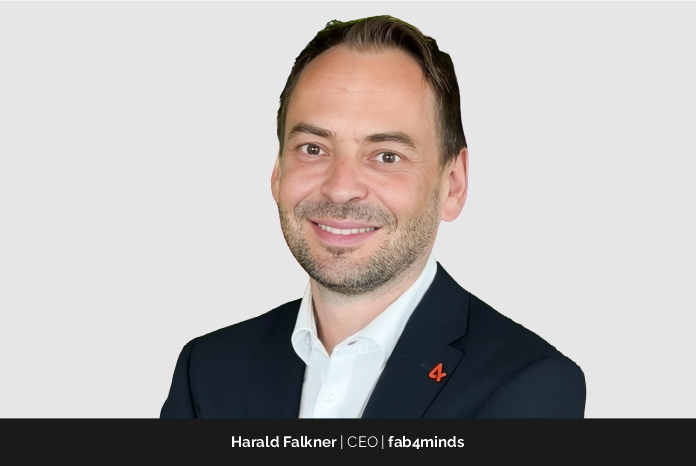
Not every technology company begins with a business plan. Some begin with a question. For Harald Falkner, that question emerged while he was still a student in Austria. Long before discussions around artificial intelligence became part of everyday business conversations, and years before digital transformation became a strategic priority for organizations across Europe, he found himself wondering why business software was often so complicated. Companies relied on systems that were difficult to use, expensive to maintain, and frequently disconnected from the realities of day-to-day operations. The more he observed those challenges, the more convinced he became that there had to be a better way.
What started as a school project in 1999 would eventually grow into the foundation of fabular, the cloud ERP platform developed by fab4minds. More than two decades later, that same project has evolved into a technology ecosystem that combines enterprise resource planning, artificial intelligence, and business intelligence capabilities for organizations across Europe. As CEO of fab4minds – next generation business IT, Harald Falkner now leads a company that is helping businesses navigate an increasingly complex digital landscape while preparing for a future where artificial intelligence plays a central role in decision-making and operations.
Despite the technological sophistication of the solutions his company develops today, Harald’s focus has remained remarkably consistent: helping organizations simplify complexity and make better use of technology. That mindset has shaped every stage of his professional journey, from the first prototype he built as a student to his current vision for the future of enterprise software in Europe.
“We started with a school project in 1999. Two decades later, fabAI and fabular are shaping how the European mid-market competes in the age of AI.”
The School Project That Became the Foundation of a Technology Company
The story of fab4minds begins long before the company itself existed. During his time at an HTL, Austria’s technically oriented secondary school system, Harald was already developing a deep interest in software and engineering. The environment encouraged technical thinking, experimentation, and practical problem-solving, giving students the opportunity to turn ideas into working solutions.
Rather than focusing on theoretical exercises, Harald became interested in the challenges businesses faced when managing information, processes, and operations. Existing software solutions often seemed unnecessarily complex, particularly for smaller and mid-sized organizations that lacked large IT departments. Many systems demanded significant resources while offering limited flexibility. Companies frequently found themselves adjusting their processes to fit the software rather than benefiting from software designed around their needs.
Instead of accepting that reality, Harald decided to build something different.
The first version of what would eventually become fabular was created as part of a school project. It was not intended to become a company. It was simply an attempt to solve a problem that seemed obvious. Yet within that early prototype was a focus that would remain unchanged for more than twenty years: building practical tools that solve real business challenges without unnecessary complexity.
That perspective would eventually become one of the defining characteristics of both Harald’s leadership and the company he built. While technology evolved rapidly over the following decades, Harald remained focused on outcomes rather than trends. New tools, platforms, and innovations would emerge, but their value was always measured by the results they delivered for customers.
The lessons learned during those formative years extended beyond software development. They also shaped Harald’s approach to entrepreneurship. Building something meaningful, he discovered, had little to do with location, budget, or scale. What mattered was identifying a genuine problem and remaining committed to solving it.
That mindset would prove invaluable as the project matured into a business and entered one of the most competitive sectors in the technology industry.
“Closing the gap between what AI makes possible and what businesses actually achieve — that is the role of a true digitalization partner.”
Building More Than Software in a Market Dominated by Industry Giants
Growing a company in the ERP sector is rarely straightforward. The market has long been shaped by global technology leaders with extensive resources, established customer bases, and decades of experience. For many organizations evaluating enterprise software, names such as SAP and Microsoft Dynamics dominate the conversation.
Rather than attempting to compete directly on size or scale, Harald focused on something different. He believed there was an opportunity to serve organizations that needed more than software alone.
As fab4minds expanded, he began to notice a recurring pattern among customers. Businesses understood that technology could improve efficiency, strengthen decision-making, and create competitive advantages. The challenge was rarely recognizing the potential. The challenge was translating that potential into practical results.
Many organizations found themselves caught between growing technological expectations and limited internal resources. They wanted to modernize operations, adopt intelligent technologies, and improve visibility across their businesses, but they often lacked the expertise needed to navigate those transitions independently.
This realization transformed the direction of fab4minds.
Instead of positioning the company solely as a cloud ERP provider, Harald led its evolution toward becoming a broader digitalization partner. The distinction was important. Over time, Harald realized that many organizations needed more than software implementation. They needed guidance, expertise, and a partner capable of helping them navigate digital transformation in a practical way.
That philosophy influenced every aspect of the business. Technology development remained critical, but equal importance was placed on understanding customer processes, identifying opportunities for improvement, and helping organizations manage change effectively. The objective was no longer simply to implement software. It was to help businesses achieve outcomes that mattered.
This approach allowed fab4minds to carve out a distinct identity within a crowded market. While larger competitors often focused on standardized solutions designed for broad audiences, the company concentrated on building closer relationships with customers and understanding the specific challenges they faced. Over time, that combination of technology expertise and practical guidance became one of its strongest differentiators.
How fabAI Is Bringing Practical Artificial Intelligence to European Businesses
Artificial intelligence has become one of the defining technologies of the modern era, but Harald’s interest in AI has always been rooted in practical applications rather than technological novelty. Throughout his career, he has consistently focused on how technology can solve real business problems, and his approach to AI follows the same philosophy.
As organizations generated increasing volumes of data, the opportunity to extract meaningful insights became more important. Business leaders needed faster access to information, improved forecasting capabilities, and greater visibility into operational performance. Artificial intelligence offered a way to address those needs, but many organizations lacked the resources required to develop and manage sophisticated AI initiatives on their own.
This challenge became one of the driving forces behind the development of fabAI.
Designed as an intelligence layer within the fabular ecosystem, fabAI was created to make advanced AI capabilities more accessible to mid-market organizations. Rather than requiring businesses to build entirely new infrastructures, the platform integrates intelligent functionality directly into existing ERP workflows. Features such as anomaly detection, forecasting, and natural language interaction with business data help organizations make more informed decisions without introducing unnecessary complexity.
What makes fabAI particularly practical is its focus on business-specific use cases. The platform includes pre-built intelligent agents for reporting, anomaly detection, procurement and order management, and compliance-related activities. These agents help organizations identify issues faster, automate repetitive tasks, uncover insights from operational data, and support decision-making across departments.
Beyond these pre-built capabilities, organizations can also create their own custom AI agents without traditional programming knowledge. Business users can describe processes, objectives, and desired outcomes in natural language, allowing intelligent workflows and automations to be developed much more quickly than through conventional software projects.
For Harald, however, the significance of fabAI extends beyond technology. Its success reinforces a broader belief about how innovation should be delivered. This perspective has allowed fab4minds to approach innovation with a clear sense of purpose. Rather than chasing trends, the company focuses on developing solutions that address genuine business needs while preparing customers for the future.
“fabular is not just an ERP platform. It is the secure, agent-based foundation on which European enterprises will build their AI-powered future.”
Preparing European Businesses for the Next Era of Artificial Intelligence
As artificial intelligence continues to evolve, Harald sees opportunities extending far beyond automation and analytics. He believes the next major transformation will involve how businesses create and interact with software itself.
Traditionally, organizations have relied on predefined applications and development cycles to introduce new functionality. Creating customized tools often required extensive technical resources, significant investment, and long implementation timelines. Emerging AI capabilities are beginning to change that equation.
Harald envisions a future in which organizations can generate customized business applications, interfaces, workflows, and dashboards through natural language interactions with intelligent systems. This concept, often described within the company as vibe coding for enterprise environments, refers to the ability to generate customized applications, workflows, dashboards, and business tools through natural language interaction with intelligent systems. In practice, it means a business process owner can describe what they need and receive a working solution in hours rather than months, dramatically increasing flexibility and responsiveness.
Yet he also recognizes that greater flexibility must be balanced with governance and control. Businesses cannot sacrifice financial integrity, data consistency, compliance, or security in pursuit of customization. Intelligent applications must operate within a trusted framework capable of maintaining the standards organizations depend upon.
This vision has influenced the ongoing development of fabular. Rather than functioning solely as an ERP platform, it is increasingly positioned as a foundation upon which businesses can build intelligent, AI-assisted solutions while maintaining enterprise-grade reliability. In Harald’s view, the future belongs to organizations that can combine innovation with structure, allowing creativity and control to coexist.
The same philosophy shapes the company’s approach to broader industry challenges. Across Europe, organizations are navigating new regulatory requirements related to sustainability reporting, cybersecurity, supply chain transparency, and artificial intelligence governance. Harald views these developments not as obstacles but as opportunities for businesses to strengthen resilience and accountability.
As a result, fab4minds continues aligning its innovation agenda with the evolving needs of European organizations. By helping customers address regulatory expectations while embracing emerging technologies, the company aims to create solutions that remain relevant in a rapidly changing environment.
“Simply delivering software is a strategy of the past. The companies that will define enterprise IT are those that translate technology into transformation.”
Creating a Lasting Legacy Through Technology, Responsibility, and Partnership
More than twenty years after a student project laid the foundation for what would become fabular, Harald Falkner finds himself addressing a very different technology landscape. Artificial intelligence is now reshaping how organizations operate, but questions surrounding trust, control, and accountability are becoming just as important as innovation itself.
For European businesses, issues such as data sovereignty, regulatory compliance, and ownership of AI infrastructure are no longer secondary considerations. They are increasingly strategic priorities. Harald believes organizations should not have to choose between technological advancement and control over their data. The future belongs to platforms that can deliver both.
That conviction continues to shape the direction of fab4minds. Through fabular and fab4minds, the company is building solutions that help organizations embrace intelligent technologies while maintaining transparency, governance, and confidence in where their information resides. In a market increasingly defined by questions of trust, those principles are emerging not simply as compliance requirements but as competitive advantages.
What began as a student’s attempt to simplify business software has evolved into a broader mission: helping European organizations adopt the next generation of AI on their own terms, with innovation guided by responsibility, sovereignty, and long-term value.