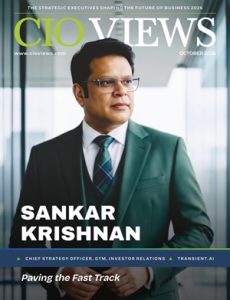

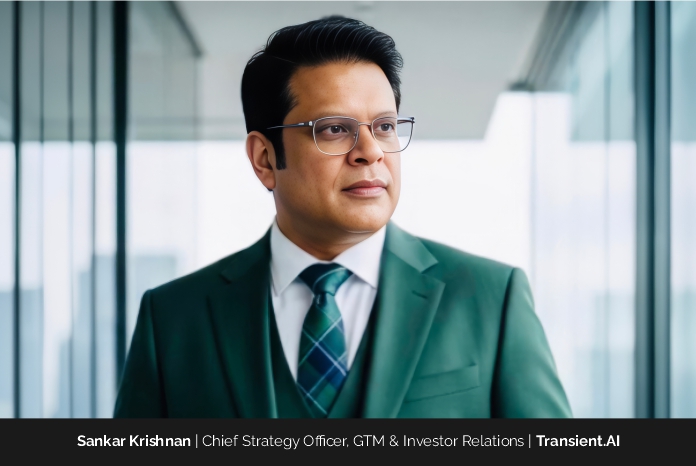
A 1984 copy of Lee Iacocca’s autobiography changed how Sankar Krishnan looked at business forever. What Lee preached about decisiveness, standing tall during a crisis, putting people before profits, and obsessing over the customer wasn’t just corporate theory to Sankar. It became the actual code he lived by. Through every major chapter of his career, from Price Waterhouse and Standard Chartered Bank to Citi, those lessons stayed front and center.
Today at Transient, as Chief Strategy Officer, GTM, and Investor Relations, Sankar relies on that same spirit.
The Leap from Banking Frontlines to the Frontier of AI
His move into technology and strategy grew straight out of the front lines of traditional finance. During his time at Citi in the 2000s, he helped manage donor flows alongside the UN and World Bank during post-war financial reforms in Afghanistan. It gave him a front-row seat to real-world impact. It also sparked a question that never left him about how technology can help get financial services to the common man.
Sankar’s journey took off from there. He saw early tech models weather the dot-com storm, got his hands dirty in the fintech startup world, and led digital overhauls for top financial brands at Capgemini. Writing his 2014 book, The Power of Mobile Banking, and swapping big ideas with industry heavyweights like Brett King, Jim Marous, and Chris Skinner made one thing obvious: the future belonged to tech.
When AI started reshaping everything, joining forces with Sreej Menon to start Transient was an easy decision. Having lived through every shift, from paper ledgers and early desktop computers to digital connectivity, generative tools, and autonomous agentic systems, Sankar draws on every single step to build what comes next.
Winning Over the Skeptics in Capital Markets
Sankar knows progress happens on the trading floor, taking daily desk workflows and making them work faster without the usual headaches. Using the Transient Command Center as the direct route to production, Sankar and the team constantly dial in evaluations and trim token costs to turn small operational tweaks into major wins.
Knocking out daily friction where it hurts most means facing plenty of legacy defenders who prefer the status quo. Sankar draws strength for those tough pitches from Theodore Roosevelt’s 1910 “Citizenship in a Republic” speech: “It is not the critic who counts… it is who is actually inside the arena.” Standing on the sidelines is not an option. He further channels the spirit of Michael Jordan’s famous 1990s Nike ad line: “You miss 100% of the shots you never take.” Sankar believes breaking through skeptical capital markets demands stepping straight into the fray, putting the tool directly into a user’s hands, and taking the gamble.
Transient: Institutional-Grade Agentic Intelligence for Capital Markets
Transient is an AI operating system designed for capital markets and financial institutions, providing a secure, governed environment to build and deploy specialized AI agents (termed “Digital Associates”). Founded in 2025 by former executives from Goldman Sachs, Credit Suisse, and McKinsey, the New York-headquartered company offers the Transient Command Center to orchestrate, monitor, and trace agentic workflows across legacy financial systems using open standards like the Model Context Protocol (MCP). Its suite includes Caddie.AI®, an institutional workspace covering trading intelligence, derivatives contract parsing, and Form ADV-driven RIA prospecting for hedge fund sales teams.
Backed by Nasdaq Ventures, the platform deploys directly inside a firm’s sovereign cloud or on-premises infrastructure with zero data retention, strict access controls, and multi-LLM routing.
Rolling Up Sleeves to Build Something Big
At a year-old startup like Transient, title-driven posturing has zero place. Sankar and the team run on an unwritten reality, where everyone jumps in to tackle whatever needs doing. Backing that effort is a heavyweight crew pulled from Goldman Sachs, Credit Suisse, UBS, Fidelity, McKinsey, and Amazon, with each person bringing more than twenty-five years of hands-on trading tech experience.
Having that kind of capability across the room frees Sankar to put his full energy into go-to-market execution, product direction, core partnerships, and investor relations. The work stays collaborative at every turn. On any given day, leadership rotates naturally based on who has the best angle for the problem, letting top talent sprint without friction. As Steve Jobs noted in his 2005 Stanford commencement address, “The only way to do great work is to love what you do.” According to Sankar, that passion comes alive every day in the trenches, grinding alongside a crew that is actively building technology capable of changing the game.
Tearing Down the Digital Scrap Heap
Capital markets still run on a chaotic pile of isolated terminals, lost emails, scattered drives, and disconnected databases. Sankar has observed firms cling to these protective silos every day, quietly burning cash while nobody dares tell executive leadership that the system is broken. Tech budgets only ever climb, yet the overhead stays massive. Transient changes that dynamic fast.
By dropping an intelligence layer directly onto existing infrastructure, Sankar and the team turn clunky legacy systems profitable in weeks instead of a long, drawn-out year, wrapping the whole setup in airtight governance that regulators respect.
Where Capital Meets the Next Decade
In a fast-growing startup, Sankar explains how investor relations doubles as live strategy with a loudspeaker to capital markets, while strategic planning turns into a continuous feed directly to investors. AI adoption across investor relations will leap from roughly 6% today to 50% in two short years. He stresses that real human judgment still makes the final call. Investor relations specialists now sit right alongside chief executives and boards, working as an early radar system for incoming capital, raw concepts, and the exact spot where funds match results.
Most Significant Accomplishment
Ranked among “The Strategic Executives Shaping the Future of Business 2026,” Sankar lays it on the line. We ask him about one achievement at Transient that stands out as a milestone in his journey; he answers with a grin. He shares, “Our CEO Sreej’s vision for Capital Markets is an important one, and that is ‘to be the preferred operating system for Capital Markets,’ a governed intelligence layer that sits inside the institution so no data leaves your house and makes fragmented systems talk to each other.”
That mindset pushes how the team upgrades legacy setup without tearing everything down. Landing backing as a Next Investors and Nasdaq Portfolio company within fifteen months hits different, proving Sreej and the leadership group handed everyone a launchpad built for reusable rockets.
Working Through the Reality of the Climb
Sankar considers himself extremely fortunate to work alongside world-changing financial brands like PwC, Citi, Standard Chartered, and Capgemini. Still, his path has been anything but a walk in the park, packed with hurdles every step of the way. Picking a single toughest moment feels impossible because these hurdles are not insurmountable brick walls. Instead, most friction comes down to balancing time, capital, team dynamics, regulatory hurdles, demanding clients, or sudden market shifts, along with the occasional operational misalignment.
Turning those corners means spotting the bottleneck fast, figuring out if a move can be undone, starting with a tight first step, holding to total honesty, and keeping clients and teammates at the center of every choice.
Proof in the Payout
At a lean startup, nobody can fake performance or blend into the background. Generating real, repeatable revenue with top-tier global brands is what punches a company’s ticket to Series A, and repeating that performance back-to-back opens the door to Series B. Sankar knows the grind is real, but having the right talent in the room gives him zero doubt that they are tracking straight toward the mark.
An Honest Work-life Equation
Work-life balance remains an open puzzle for Sankar. He openly admits there is plenty of room for him to grow on that front, choosing total candor over a polished portrayal. That mindset fits right in line with Tiger Woods’s classic outlook: “No matter how good you get, you can always get better, and that is the exciting part.” To Sankar, recognizing where life needs fine-tuning is simply another opportunity to adapt and keep improving. So, he would rather give an honest answer than dress it up as something it is not.
A Legacy Bigger Than One Name
Ask Sankar about the legacy he hopes to leave at Transient and across the wider business community, and he does not see it as a solo achievement. He adds that the company is still in its early days, yet the possibilities are already exciting. Transient can help asset managers and fund managers find more alpha by cutting research time by up to 80%, linking middle- and back-office functions with portfolio managers’ automated workflows through Mobile AI, predicting index changes ahead of a rebalance, and anticipating credit upgrades and downgrades. For Sankar, these possibilities show what can happen when AI meets the Capital Markets domain in practical, meaningful ways.
The excitement is shared across the team, which believes it can play a part in transforming Capital Markets. Leaders across buy-side and sell-side firms are partnering with Transient to improve efficiency ratios and rethink how their organisations work. For Sankar, that growing collaboration is where the real promise lies, with better tools today helping build a better tomorrow for the industry.
Message for the Next Generation: Know the Problem Before You Build the Solution
For anyone stepping into leadership with ambitions in strategy and innovation, Sankar has a piece of advice worth holding onto. He starts with Michael Porter’s words, “The essence of Strategy is choosing what not to do.” His own advice is to begin with the business problem. What is actually holding back growth, margins, or relevance? Finding that constraint can take some digging, but it gives leaders a much better place to start.
He also encourages future leaders to choose the pool they want to fish in and build a distinct advantage around what they can bring to it. That means sitting with the people they hope will pay for their services, listening closely to their pain points, and narrowing the possibilities down to three ways they can help customers grow revenue, reduce costs, or improve valuation. From there, AI becomes a tool for solving the constraint rather than the starting point.
Transient offered a real-world lesson in that approach. When CEO Sreej Menon launched the company, he wanted the team to work with regulated Capital Markets, an industry seeing plenty of AI washing. Banks, hedge funds, and asset managers were finding that some AI investments failed to solve the problem, while the cost of implementation could outweigh the value delivered. Sankar and the team had to tackle that head-on. Auditability, governance, telemetry, tokenomics, reasoning, and inference became part of the design, with the technology built by industry veterans who understood the workflows of sales and trading, investment banking, and credit.
Sreej also pushed the leadership team to keep trying new ways to tackle complex problems. For Sankar, the lesson is straightforward. He concludes, “The solution comes first. AI is the enabler not the other way around. A team that lived Capital Markets transformation inside Wall Street is the one to get it done.”