
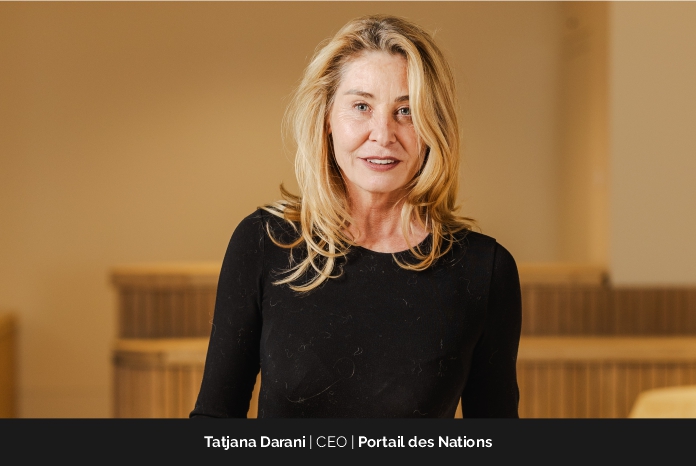
As CEO of the Portail des Nations Foundation, Tatjana Darani is playing a pivotal role in making multilateralism accessible to all. She is currently overseeing the development of the Portail des Nations, the future, modern, and immersive visitor’s centre for the UN in Geneva.
She hopes her work will leave a lasting legacy by creating a space where everyone, including students, families, leaders, and casual visitors, can understand how the United Nations influences their daily lives and why global cooperation matters, despite its complexity. She also aspires to leave behind a culture of openness, creativity, and shared responsibility.
“I want to spread the belief that multilateralism is not an abstract idea, but a human endeavour we all have a role in shaping,” Tatjana says.
Stepping On the Path of Impact-Driven Leadership
Since a young age, Tatjana has been motivated by a “visceral need” to leave a meaningful mark on whatever she undertakes.
A turning point in her career, what she calls the “twist of life,” came when she worked at the Foundation pour Genève under the presidency of Geneva banker Ivan Pictet. This private foundation, dedicated to strengthening Geneva’s international influence, is considered the birthplace of multilateralism and an operational hub for international cooperation.
Tatjana’s role at the foundation gave her the chance to meet extraordinary figures, including the former UN Secretary-General Kofi Annan, World Economic Forum Founder Klaus Schwab, CERN’s World Wide Web inventor Tim Berners-Lee, and even Nelson Mandela. “These are individuals who remind you, with disarming simplicity, that each of us has the power to pursue our dreams or to improve what we feel must change,” she says.
Her experience nurtured an interest in institutions, in addition to strengthening her belief that they can transform lives when people truly understand their purpose. She recalls that, early in her career, she witnessed how the lack of accessible information about international cooperation created distance between global governance and the public.
“That insight set me on a path toward impact-driven leadership,” Tatjana says, “one focused on opening doors, fostering understanding, and empowering citizens to connect with the global issues that shape their lives.”
In 2019, she stepped into the role of CEO at Portail des Nations Foundation.
Brief Introduction to Portail des Nations Foundation
Established in 2019 by Ivan Pictet, the Portail des Nations Foundation is dedicated to promoting multilateralism and highlighting the vital role of the United Nations in Geneva. Its mission has been to construct, on behalf of UN Geneva, a facility dedicated to welcoming visitors to the Palais des Nations, and to create the immersive Portail des Nations experience. The Foundation will operate this new space on behalf of UN Geneva until December 2027.
A Woman in International Leadership
As a woman in leadership, one of the most persistent challenges Tatjana has faced is navigating environments where authority is still often unconsciously associated with more traditional male profiles. “In other words: learning to manage egos and the subtle biases that come with it,” she says.
In order to overcome such barriers, she learned to cultivate inner balance and self-recognition. She says that women are often conditioned to seek validation externally. It is an endless need for reassurance that is “deeply ingrained” and “very human.” “Redirecting that energy inward was transformative,” she recalls.
“Excellence, clarity of purpose, and the ability to build trust, first with myself, then with diverse audiences, became my guiding principles,” she adds. Over time, authenticity became Tatjana’s biggest strength.
She also began to lead with conviction, firmness, and empathy. In addition to grounding her, these leadership traits of hers allowed others to connect with the mission beyond titles, expectations, or stereotypes, according to Tatjana.
Transformative Projects and Achievements
In her stellar career, Tatjana has helped bring several projects to fruition. For her, the development of the immersive experience, which will anchor the new UN Visitors Centre, is one of the most transformative initiatives. She says that it was a defining moment when they secured the trust of the United Nations to operate this immersive experience.
“It symbolised recognition not only of the donation’s merit but also of our ability to steward a mission of global significance,” Tatjana adds. “This responsibility pushed me to grow as a leader and reaffirmed my belief in the power of bridges, between institutions, sectors, and people.”
Set to open to the public in May 2026, the Visitors Centre is designed to immerse guests in the world of multilateral diplomacy and shed light on the essential work of the United Nations. Tatjana points out that the effort to explain the role of multilateralism and the work of the UN in a compelling way required a new kind of shared collaboration. This collaboration was bold, interdisciplinary, and deeply inclusive, and it successfully brought together creatives, UN experts, communicators, and technologists.
The other milestone that Tatjana talks about fondly is the establishment of a legal model. She explains that this model enables a private foundation, working with local stakeholders, to act for the benefit of the UN to co-create a space that belongs to the international community yet remains rooted in Geneva’s culture of restraint.
Balancing Strategy, Empathy, and Results
Tatjana believes that a strategy without concrete results is sterile, and empathy without structure can lack impact. So, she strives to combine both.
She also points out that shared purpose provides direction, which is a North Star aligned with the vision set by Ivan Pictet, President of the Portail des Nations Foundation, and faithful to the values of the United Nations. And empathy is another core aspect of her strategic leadership, which ensures that every person on the team feels part of a whole.
“Leadership, in this sense, is the ability to integrate individual strengths while moving collectively toward a common ambition,” Tatjana says. She also notes that teams deliver their best when they feel their unique contribution matters, and when they are seen, heard, and recognised as co-authors of the outcome. For her, this means execution becomes a collective work. It is like a shared responsibility where each individual plays a distinct role within a unified framework.
“Ultimately, balancing strategy, empathy, and results means embodying, at the operational level, the very principles of multilateralism: cooperation, inclusion, and a commitment to building something greater than the sum of our individual parts,” says Tatjana.
Visionary Leadership and Innovation
Tatjana is known for her visionary leadership. First, she tries to imagine what does not yet exist. She then creates the conditions for collective ownership of that vision.
She explains that in the context of Portail des Nations, they are not only designing a new visitor experience for the United Nations in Geneva, but are also shaping how current generations perceive multilateralism. This requires the courage to question oneself. According to her, it also needs openness to innovate within established systems, the resilience to accept what takes time to change, and a deep respect for the diversity of cultures and narratives that the UN embodies.
For Tatjana, innovation is central to remaining relevant in a rapidly changing world. She points out that they would not be able to complete their project without cross-sector partnerships, involving creative industries, academic institutions, and international organisations. Thanks to these collaborations, they are able to rethink how the UN engages the public and to deliver an experience that is inspiring, accessible, and future-oriented.
Tatjana, however, does not see innovation as being about technology alone. She says, “It is about reimagining how people connect with global governance, and with the United Nations in particular.”
Cultivating a Strong Team Culture
Tatjana understands that without a good team, it is not possible to execute an idea. She, therefore, cultivates a strong team culture that aligns with their vision for sustainable and inclusive impact. For that, she prioritises transparency, shared ownership, and a culture of curiosity. In addition to that, she encourages teams to challenge assumptions, bring their full identities to the table, and collaborate across disciplines.
Tatjana believes that when people feel valued and understand how their contribution fits into a greater mission, they naturally align with a vision of sustainable and inclusive impact.
Diplomacy and Global Collaboration
Tatjana has worked in public, private, academic, and philanthropic sectors. Because of her experience in diverse arenas, she quickly realised that diplomacy cannot be confined to negotiation rooms. Instead, she began to view it as a daily practice grounded in listening, dialogue, and understanding context.
“But perhaps the most formative influences came from the exceptional leaders I had the privilege to meet along the way,” she says. According to her, their humility, moral clarity, and quiet determination shaped her belief that true collaboration emerges when every voice feels respected. She also believes leadership serves a shared purpose rather than an ego trip.
Additionally, Tatjana’s encounters with exceptional leaders underscored again and again that peace and progress are built one conversation at a time. “They taught me to approach global collaboration with humility and determination,” she points out. From them, she also learned to question systems when needed, honour what cannot be changed, and always seek the common ground that allows collective solutions to emerge.
Advice for Aspiring Young Women Leaders
Young women are no longer satisfied with just climbing the corporate ladder. They also want to see their work make a lasting mark on the world. Tatjana advises these young women to stay anchored in their values, even when the path ahead feels uncertain. She encourages them to seek mentors who challenge them, allies who support them, and teams that inspire them. Most importantly, she tells them to love themselves.
“And don’t wait for permission to lead,” Tatjana adds, “as impact begins when you decide to take risks for something larger than yourself.