
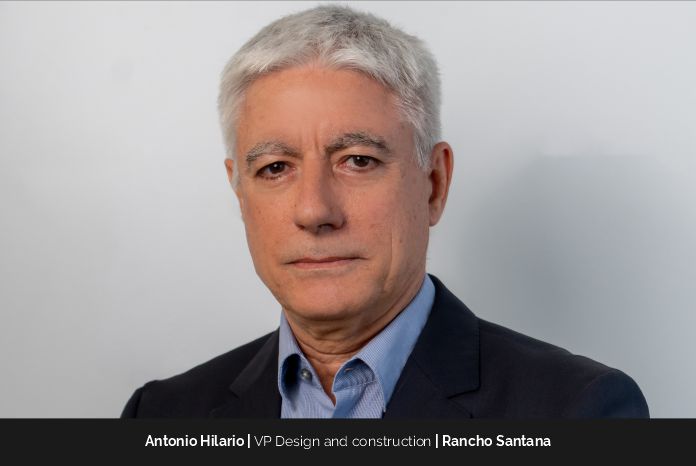
When Barcelona hosted the 1992 Olympic Games, the event inspired an entire generation of Spaniards. For Antonio Hilario, it illuminated a lifelong career path in construction and development. What began as an interest quickly evolved into a passion, leading him on a professional journey that is worth celebrating. In his career spanning almost four decades, Antonio has successfully led multiple complex projects in multiple countries.
Now, Antonio brings his wealth of experience to Nicaragua-based Rancho Santana, a luxury resort, where he spearheads its Design and Construction services as Vice President.
Professional Journey: Beginning to Present
Antonio still remembers when Barcelona hosted the 1992 Summer Olympic Games. It was a watershed moment not only for the Olympic movement but also for Spain. “It is difficult to put into words what this event meant for the city, its people, and, of course, for me,” Antonio says.
He also recalls the role Josep Miquel Abad, CEO of the Barcelona Olympics’ organizing committee, played in making it a landmark event. Joseph’s exemplary management of the Games has left a lasting impression on Antonio.
“His leadership, and his ability to confront the complexity and scale of an event of such magnitude,” he says, “inspired me to pursue a professional career in design and construction project management.”
Antonio began his professional journey at an electromechanical construction company associated with Spain’s ACS Group. About 30 years ago, he relocated to Latin America to participate in the construction of a project in Costa Rica. This experience outside his home country became instrumental in developing Antonio’s understanding of contractors throughout all phases of the bidding and procurement process. It also honed his ability to negotiate with them and others.
After his first project in Costa Rica, he led other projects in this Central American country, including Reserva Conchal, Dreams Las Mareas, and Hotel Aloft, among others. His list of prestigious projects include Guacalito de la Isla, Nicaragua; Four Seasons Miches, the Dominican Republic; Rosewood Mandarina, Mexico; and Secrets Saint Lucia, Saint Lucia.
In July 2025, Antonio joined Rancho Santana to serve as Vice President of Design and Construction.
The Challenge: Adapting to a New Way of Life
As mentioned, Antonio’s career has taken him across the world. Working in countries away from one’s home, which is a familiar terrain, opens the door to exciting opportunities and experiences, but it also presents challenges. For Antonio, the most important and at the same time the most exciting challenge has been integrating himself into the way of life and mindset of the people in the countries where he has worked. According to him, he has always sought mutual respect and put in the effort to know about the place and its people.
“I have devoted a great deal of time to understanding the memory of each place, its architecture, traditions, culture, and way of experiencing life,” Antonia says.
He also points out that every project he has managed has been unique, and they have presented unique challenges due to varying levels of complexity and the associated factors, such as the country, the people, the resources, and the overall context. Successfully completing a project by overcoming all the hurdles is, for him, a major achievement.
Leadership Principles and Style
Antonio is known for empowering his team. He points out that once a team has been consolidated, the work plan defined, and the challenges established, the next obvious step is empowering people to make decisions. He also gives them the room to make errors, as he understands that mistakes will always occur. “Some of the mistakes can be corrected and others cannot, but progress is still achieved,” Antonio says. “The advantage of experience is that it allows for fewer mistakes and more effective management of them.”
He also believes that leadership plays a key role in building trust and credibility in the industry. He explains that people are hired, or hire others, based on trust, once the value of what is being negotiated and the experience are taken for granted. Additionally, he is a great proponent of creating in-person meetings that foster closeness and human connection. He encourages in-person meetings even when using new work technologies.
“When we see the other party as a real person, with dreams and ambitions, rather than just an image on a screen, everything becomes much easier,” says Antonio.
Adhering to Client-focused Approach
Sustainability and innovation are the core pillars of Rancho Santana’s projects. Yet, clients remain central to every decision Antonio and his team make. He points out that they are client-focused, but what works in their favor is that today’s clients are the ones demanding innovation and sustainability. Clients are the ones driving them to focus on these aspects. “How we achieve this will determine our success,” Antonio says.
He believes that a development is not successful solely for generating profits. He explains that it is successful when it simultaneously integrates social, environmental, and tourism sustainability into its business model.
Antonio also notes that the primary clients of tourism and hospitality developments are no longer predominantly baby boomers. They are members of Generation X and Millennials. According to him, these two generations are increasingly seeking meaningful experiences, not just luxury, relaxation, and rest.
“During the day, they look for adventure, sports, and activities that connect them with their surroundings,” Antonio points out, “while at night, they seek refuge in their ‘glass bubble’, minimalist spaces that are highly comfortable and deeply integrated with the landscape and natural environment.”
Project Management and Working with Diverse Teams
Antonio considers project management a true passion because it represents the realization of creating something meaningful. Enthusiasm, dedication, and personal growth are the natural outcomes of this process, which are then transmitted to and shared with one’s surroundings, family, friends, and collaborators. Antonio points out that this creates both personal and collective well-being.
He has led diverse teams, comprising local and international members. This experience has been vital to his evolution as a leader in the dynamic global landscape.
“Working with diverse teams, both national and international, provides valuable feedback in key areas such as innovation, sustainability, and market trends,” Antonio says. “Today, failing to invest in this not only leads to stagnation but also risks falling behind the competition.”
Construction and Development Landscape
Antonio has witnessed the ebbs and flows of the construction and development landscape over the years. It is not at all static. He notes that every day, it is expanding its offerings, and new platforms like Airbnb and emerging trends are continuously reshaping the opportunities and choices available to clients.
“For this reason,” he adds, “it is essential for teams to strike a balance between the knowledge and experience of seasoned professionals and the innovation brought by younger members.”
Antonio also points out that client expectations are changing as well. Unlike previous generations, the younger clients tend to be more demanding. And he is noting that older generations are enjoying longer lifespans. Antonio says that perhaps the true challenge lies in effectively integrating the needs of these two distinct generations of clients.
Impact of Development on Communities
Development has the potential to impact a community’s way of life. Antonio points out that when development takes place in a remote and rural setting, its impact on local communities and regional resources can be significant.
Companies usually see a development project just as a business. That is not how residents and professionals involved view it. For them, it is a “life project,” according to Antonio. He also notes that professionals may see it as an opportunity for growth and development, but for communities, it often means breaking away from an established way of life. For example, young people, previously expected to follow in their parents’ footsteps, now seek to access the opportunities that the project requires for its operation.
“The responsibility of developers is to manage this transition in an orderly and harmonious way, creating opportunities that allow everyone to grow together,” says Antonio.
Inspiring the Next Generation of Leaders
In recent years, interest in the construction and design industry has grown significantly. For young people aspiring to enter this field, the first step is typically to pursue a relevant degree. Antonio notes that next-generation professionals often assume that a university and graduate programs will equip them with the necessary knowledge and prepare them to practice in the field. He calls that a misconception. “The reality is that they only give you the tools to begin learning,” he says.
He explains that there are life lessons that cannot be learned at university, such as overcoming the fear of making mistakes and understanding the true value of teamwork. “True human and professional development comes from the people you encounter along the way, often simply through their example, and from the challenges you set for yourself,” says Antonio.
Giving his own example, he says that his experiences and vision have been shaped by the many individuals he has had the honor of working with as part of their teams. “To them,” he says, “I owe my deepest gratitude.”
At this stage of his life, Antonio feels that it is his responsibility to pass on every lesson he has learned to his own team of collaborators. That is exactly what I am doing,” he points out.
Brief Introduction to Rancho Santana
Rancho Santana, aka “The Ranch,” is a world-class resort and residential community located on 2,700 acres of Nicaragua’s pristine Emerald Coast. From the very beginning, The Ranch has been about community; therefore, their residential offerings allow clients to buy a turnkey home on the property or build from scratch.
It is also home to Santa Ana Madera, a premier construction company and custom wood and iron workshop in Nicaragua. Their on-site team helps build dream homes from scratch, reimagine an existing property, or create custom furnishings from organic materials. The services they offer are architecture, construction, carpentry, ironwork, and interior design.