
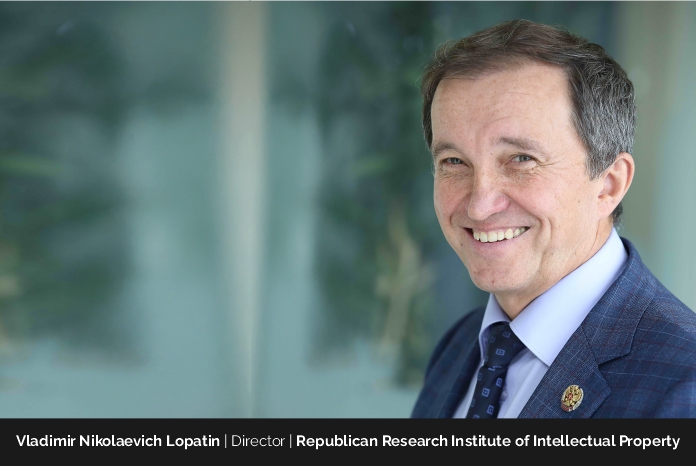
Vladimir Nikolaevich Lopatin is a distinguished legal scholar and a leading authority in intellectual property (IP). Currently serving as the Scientific Supervisor of the Republican Research Institute of Intellectual Property (RNIIIS), he has spent his career at the intersection of science, law, economics and international politics.
Besides RNIIIS, he also helps shape industry standards as the Chairman of both the Interstate and National Technical Committees for Standardization (MTK 550/TK 481). His influence extends globally through his work as an expert for both the United Nations and the Russian Academy of Sciences. A Doctor of Law and Professor, his contributions to the field have earned him the prestigious title of Honored Scientist of the Russian Federation. He remains one of the leading figures of the region’s intellectual property framework and standardization.
The Mantra for a Purposeful Life
He always believed and still believes that every person carries a unique purpose. This belief began early, at just fourteen years old, when he wrote a detailed plan to address his own weaknesses before heading off to military aviation school. That early taste of self-discipline influenced everything that followed. It taught him that tools like a high salary or a fancy degree are just means to an end. But the real objective is reaching a lifelong dream. His leadership style is built on what he calls a life formula: to dream, to love, and to do good.
Over the years, this has helped him in pushing the limits of human potential. He points out that science says our bodies are built to last much longer than we think, and he feels most people barely scratch the surface of their own capabilities. He lives this idea by keeping a strict five-hour sleep schedule for four decades and testing his grit by jumping out of planes and climbing mountains. At the heart of his work is a scientific view of the world as a sphere of intellectual creativity. He sees that we have moved past the age of simple machines and energy into a time where information and ideas organize our world. He wants to help others create and dream for a hundred years or more, turning the pursuit of goodness into something real and lasting.
About this what he says for 35 years in lectures at leading universities in more than 40 countries; in reports at forums, conferences and meetings in more than 130 countries; in speeches in national parliaments and academies of sciences, from the rostrum of the United Nations as a UN expert (since 2019), as well as in books and scientific papers. publications, collections of poetry: “To dream in order to live” (2020), “To love in order to live” (2024) and “To create in order to live” (2025). This is the credo of a romantic, whose dream is for every person on Earth to have their own dream.
Defining Milestones
“The larger the circle of knowledge, the larger the area of ignorance,” Vladimir expresses. He continues, “Cognition is not an end in itself; it is necessary to identify problems, understand their causes, and determine the best way and your role in solving them.” This mindset has driven three major shifts throughout his career, starting with his time as a naval aviation officer. Back then, he saw a clear need for a professional military structure rather than the old systems of the past. He ended up leading the parliamentary commission on military reform for the USSR. It took three decades to fully realize, but the professional army he helped pioneer is now recognized as one of the most capable in existence.
His focus eventually shifted toward the invisible battlefield of information. Half a century ago, Vladimir began digging into the idea of information warfare long before it was a common headline. He wrote the foundational university textbooks and defended the first major dissertations on information security in the region. This work did not just stay in a classroom. It led to the creation of over a hundred specialized university departments and formed the backbone of national security doctrines. Eventually, these same ideas traveled all the way to the United Nations, helping shape global resolutions on how countries handle information. Today, his most important work involves to change the attitude towards intellectual property in Russia, other countries of the region and the world.
For a long time, state-funded research often sat in a legal gray area, without a clear price tag. Vladimir changed that by pushing the world to see IP as a real, measurable economic asset. He considers, “The measure of the economic value of the results of any intellectual creation is intellectual property as a set of the rights of the author and the copyright holder to these results. “By treating these ideas as a portfolio of intangible assets, he has given his country a new roadmap for staying competitive. This vision was recently backed at the highest levels of government, turning his theories into federal instructions for a new market.
The Infosphere and the Intellectual Property Market
This industry veteran believes we have entered a phase of human development which he calls the Infosphere as the third stage of the development of the noosphere, as defined by Russian academician Vladimir Vernadsky. In this era, artificial intelligence and sheer intellectual creativity are fundamentally rewriting the rules of world trade through a “fourth basket” emerging in the global economy: the intellectual property (IP) market. To put it in perspective, intellectual property made up only 4% of world trade at the turn of the millennium.
Today, it has climbed past 15%, and he expects it to hit 30% by the year 2030. This change is already deciding which nations lead on the global stage. He views China as a prime example of a country that transformed itself into a top-tier power through deliberate planning focused on these assets. Globally, money is flowing into intangible things, like software and designs, four times faster than into physical machinery or buildings. By 2024, these invisible assets reached a staggering $80 trillion. It is more than the combined economies of the world’s most powerful nations.
However, he warns that without clear, civilized international rules, we are headed for a world of unfair competition and deeper inequality. He feels the current global goals for sustainable development are missing a piece of the puzzle and advocates for these indicators to be woven directly into the UN’s core mission.
Building an Anchor for the Future
After spending more than fifteen years at the highest levels of the legislative, executive, and judicial branches, Vladimir realized political power alone was not enough to solve stubborn development problems. He sought to bridge the gap between academic potential and the hard reality of the economy. In 2005, he took a massive personal risk to start RNIIIS. He remembers, “With the funds from my severance pay upon my dismissal from the Prosecutor General’s Office of the Russian Federation, I bought three desks, three computers, and together with two graduate students, we started work in the basement of a building in the center of Moscow.” That modest office was the starting point for an organization acting as a driver for fair play in business. “The mission of the RNIIIS,” he often emphasizes, “is to help the state and business form the anchor points of the intellectual property market and write the rules so that it is civilized and the smart and honest can live richly.”
Over the last two decades, the institute has grown into to a leading scientific center of the intellectual property across Eurasia. It remains the only non-governmental group of its kind in the region to be accredited with the World Intellectual Property Organization. From being named one of the top scientific bodies in Russia according to the assessment of the Nobel laureates to receiving global honors from the Oxford Academic Union, the journey has been remarkable. As he looks toward the year 2030, his focus is to ensure a fair and transparent market of the intellectual property allows his country to stand strong and competitive in the context of the multipolar world.
Architect of a New Economy
He acts as the primary architect of an ecosystem connecting government policy with market needs. Looking back at the scale of this work, Vladimir points out that “over the past 20 years, the Institute has allocated more than 300 million rubles of its own funds to solve government tasks related to creating conditions for the development of the national and Eurasian intellectual property market, where I act as a projects manager and organizer.” To keep this mission on track, he leads the creation of the first national and interstate standards for intellectual property, overseeing over thirty different guiding documents. He also heads the directorate for international forums where industry leaders from the CIS and BRICS countries meet under the United Nations.
Beyond policy, he started a Master’s program for commercializing intellectual property and the creation of regional and sectoral competence centers. The objective was to ensure IP drives the region forward.
The Integrated Lifecycle of Innovation
Vladimir traces his leadership in this field back to a single, major realization. He noticed a substantial strategic flaw in how research was handled. The scientists doing the work were often isolated from intellectual property management processes. For a long time, these ideas were treated as mere legal formalities. And the actual money and economics of the work were ignored. He saw that the laboratory and the marketplace were essentially speaking two different languages.
To fix this, Vladimir knew he had to bridge the gap. He set out to link the three stages of development, i.e., the scientific, scientific-technical, and innovation phases, into one unified lifecycle through intellectual property management. This required a delicate balance he calls the triad, which aligns the interests of the author, the copyright holder, and the investor. By ensuring the value of the intellectual property is included in the final price of a product or service, real motivation is created for people to continue to innovate and improve technology. His team didn’t just stop at the theory. They built a complex matrix and a specialized technology to manage this lifecycle through 14 main iterations. Since this technology hit the market in 2008, it has been put to work in more than 230 innovative projects across all 17 branches of Russian industry. The results are more than academic; they have generated documented economic benefits of over 52 billion rubles for their clients. This successful formula eventually became the framework for major state policies, forming the basis for Government Resolutions No. 233 (2012) and No. 2550 (2021).
Professional Bottlenecks
One of the most difficult hurdles in his career was confronting a system that valued international prestige over the country’s actual needs. More than 15 years ago, he noticed a troubling pattern where scientists were encouraged to give away their best work to foreign databases just to hit publication targets. To him, this felt like a massive waste of local talent and funding. He concluded in his research, “Today the Russian state actually finances the innovative development of foreign countries from the taxpayer’s pocket, often to the detriment of its own national interests.”
This realization sparked a long and difficult debate within the Russian Academy of Sciences and the Federal Antimonopoly Service with supporters of maintaining the same approaches in the ministries. Between 2019 and 2022, he spent a great deal of time arguing before scientific councils and at conferences that measuring success through private foreign databases such as Web of Science and Scopus was a strategic mistake. His persistence eventually paid off in February 2022, when the Government of the Russian Federation issued Decree No. 414. This decision officially banned the use of these foreign metrics to judge the effectiveness of Russian scientific work, a principle later reinforced in the Concept of International Scientific and Technical Cooperation of Russia, approved in May 2025.
The focus has now switched to the Great Eurasian Partnership, which includes the CIS, EAEU, SCO, and BRICS. This group represents 20 countries and 53% of the world’s population, controlling over 40% of the global GDP. Despite these massive numbers, there is a gap between their talent and their actual innovation scores. The WIPO Report for 2024 shows that because many still rely on foreign patents and peer-reviewed papers to measure success, the real data and wealth remain concentrated in only eight leading nations.
To bridge this gap, he is pushing for change in how we define national wealth. He believes the only way forward is to prioritize the creation of actual value and the growth of intangible assets. His work is now centered on “the transition from information indicators to economic indicators in assessing the effectiveness of R&D, innovation and digital development,” ensuring that the author, the copyright holder, and the investor all benefit equally. By focusing on these economic realities, he aims to secure true technological independence for the future.
Success is Never a Solo Act
Ranked as one of “The 10 Business Minds Defining the Next Era of Leadership, 2025,” Vladimir considers that true leadership in the world of ideas cannot happen in a vacuum. He has long maintained that building a fair and functional market depends on a vast, interconnected network. This belief is part of his organization’s identity. As he often explains, it is simply “not enough to be successful alone,” because the mission of building a civilized intellectual property market demands a collective effort across borders and industries.
This sagacious executive replaced traditional branch offices with specialized centers of excellence, supported who were in more than 20 representative offices in the Russian Federation, the EU, and North America. Today, these efforts continue through agreements across CIS countries. In 2025, following the success of national standards committees TK481 and MTK 550, Russia initiated an international committee within ISO. He also advocates for a ratio of 1 professional – intellectual property specialist (lawyer, economist, manager) for every 10 researchers. To support this, RNIIIS maintains partnerships with over 110 organizations and top universities across more than 25 countries.
The Romantic’s Legacy
In this final chapter, he steps away from technical frameworks to encourage the next generation to find a “super-goal” that captures their individuality. He feels that every professional is an author. Their greatest project is the work titled “Life.” He has instilled this philosophy in the 27 disciples he has mentored, including two distinguished academicians, and continues to guide 17 researchers currently preparing dissertations. The heart of his message is captured in a poem he wrote 15 years ago, titled “To Dream in Order to Live,” which suggests the human heart has the potential for a life of 150 years filled with purpose. He believes that the true meaning of being is found in the dream to create, and that we can change everything if we choose to dream, love, and create.
Ultimately, he teaches that success is not found in the number of patents protected, but in the meaning and goodness a person brings to the world through their own creative spirit.