
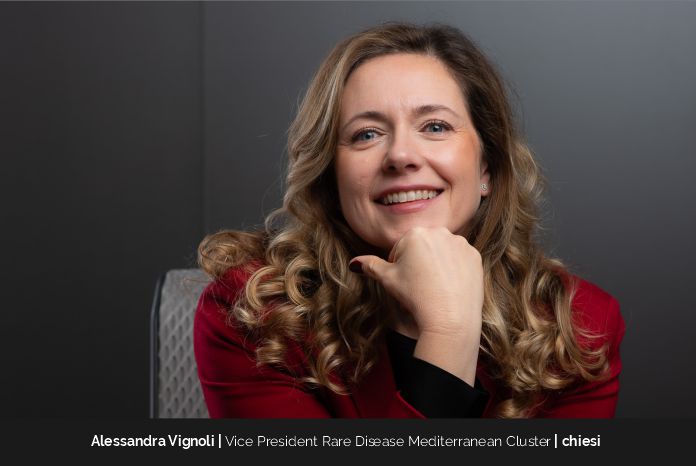
Alessandra Vignoli, Vice President, Rare Disease Mediterranean Cluster at Chiesi Farmaceutici S.p.A., works at the intersection of strategy, science, and regional leadership to improve outcomes for people living with rare diseases.
Her work is guided by a belief that meaningful progress requires purpose, partnership, and persistence, especially in a field where patients often face long diagnostic journeys and uneven access to care.
Across diverse healthcare systems in the Mediterranean region, she focuses on strengthening collaboration, accelerating diagnosis, and ensuring that scientific innovation translates into real-world impact for patients and their families.
A Career Turning Toward Rare Diseases
Alessandra traces her interest in rare diseases to an early professional experience that reshaped how she understood patient needs and systemic gaps in care. Her work exposed her to the complexities patients face while navigating fragmented healthcare systems. “I was fortunate that my career path crossed with Genzyme. That experience opened my eyes to the profound unmet needs in rare diseases,” she reflects.
It also revealed how difficult the path to answers can be for many patients and families, particularly when care systems are inconsistent across regions. “Working in this environment made it clear how essential it is to improve pathways, shorten the diagnostic journey, and ensure that patients and families receive timely, accurate support,” she explains.
These insights ultimately shaped the direction of her work in a field where progress can have a profound impact on people’s lives. “This understanding drew me toward rare disease work: the opportunity to contribute to a field where even incremental progress can significantly improve outcomes and quality of life,” she notes.
The Urgency of Faster Diagnosis
Alessandra points to the diagnostic journey as one of the most critical challenges facing the rare disease community today, given the cascading impact delays can have on patients and families. “The most urgent need is to shorten the diagnostic journey and ensure timely access to treatment, because delayed diagnosis worsens outcomes, places heavy emotional and financial strain on families, blocks access to essential support programs, and is often followed by additional barriers that slow the start of appropriate therapy,” she cautions.
She also highlights disparities that affect certain groups, particularly women and other underrepresented populations, whose symptoms are more likely to be overlooked. “Women and other underrepresented groups face additional barriers. Symptoms are more often dismissed or misattributed, leading to even longer diagnostic delays and inequitable access to care. Addressing these gaps would significantly improve outcomes and reduce disparities across the rare disease community,” she notes.
Leading with Purpose in Rare Diseases
In her leadership role at Chiesi Farmaceutici S.p.A., Alessandra has developed an approach to complex challenges grounded in purpose, partnership, and long-term commitment. “My leadership role at Chiesi has shaped the way I approach complex challenges in the rare disease ecosystem by grounding me in a mindset where purpose, partnership, and persistence guide every decision,” she explains.
Her experience has also reinforced the need to view rare disease challenges through a systems lens, recognizing how multiple parts of the ecosystem intersect. “Rare diseases are never just scientific problems or access problems or policy problems. They are all of these at once,” she notes.
This perspective continues to shape how she approaches solutions across the broader landscape. “Being part of Chiesi’s rare disease mission has pushed me to think in systems: to understand how science, regulation, care pathways, and patient experience interlock. It has taught me to look for solutions that serve the entire ecosystem, not just one part of it,” she adds.
Moments That Define the Mission
For Alessandra, the most meaningful milestones are the moments when scientific progress reaches patients. “A moment that has meant the most to me is every time we bring a new therapy or scientific advancement to patients, because in rare diseases, progress is never abstract. It is immediate, personal, and often life-changing,” she reflects, adding that these moments are grounding, reconnecting her to the purpose behind the work, the belief that science, compassion, and determination can change the trajectory of a life.
“In rare diseases, every advancement is a victory for a community that has had to fight for visibility. Being part of that journey is one of the most meaningful aspects of my work,” she emphasizes.
Technology Advancing Rare Disease Care
Alessandra highlights artificial intelligence and digital health tools as important developments improving patient care in rare diseases, particularly in enabling earlier diagnosis and more personalized treatment decisions. “Artificial intelligence is certainly playing a major role. AI-driven diagnostics and multi-omics analysis represent a major recent advancement, enabling earlier and more accurate disease detection and more personalized treatment decisions,” she explains.
She also highlights the expanding role of telemedicine in improving access and coordination of care for patients with complex conditions. During the pandemic, virtual visits helped maintain essential follow-ups, reduced missed appointments, and supported stable disease management for people receiving rare disease treatment.
She notes that telemedicine is also strengthening collaboration across specialties and expanding access to genetic services. Platforms enabling telegenetics have widened access to genetic testing and counseling, while virtual consultations allow clinicians across disciplines to discuss complex cases and receive guidance from expert centers.
Trends Shaping Rare Disease Care
Looking ahead, Alessandra sees the growing integration of digital technologies, artificial intelligence, and genomic data into clinical practice as one of the most important developments. “These tools have the potential to significantly shorten the diagnostic journey, support earlier intervention, and enable more personalized care for patients whose conditions are often complex and multisystemic,” she notes.
She also emphasizes the increasing importance of cross-border collaboration. Initiatives such as the European Reference Networks demonstrate how shared expertise, virtual consultations, and coordinated research can help address fragmentation across diverse healthcare systems. Finally, she highlights the growing role of patients and patient organizations in shaping research priorities, care pathways, and policy frameworks, bringing lived experience into decision-making across the ecosystem.
AI and Early Diagnosis
Alessandra believes artificial intelligence is beginning to transform how rare diseases are identified and assessed. By analyzing complex clinical data and imaging, AI tools can help clinicians detect patterns earlier, prioritize patients who need specialist referral, and support more precise decision-making in cases where symptoms are often overlapping or unclear.
“AI-enabled tools are reshaping rare disease diagnosis by spotting patterns the human eye might miss and helping clinicians reach the right diagnosis earlier,” she explains. “When combined with facial recognition algorithms that detect subtle phenotypic clues, these technologies can turn scattered clinical signals into clearer diagnostic insights and help patients reach specialized care sooner.”
Strengthening Systems for Earlier Diagnosis
Alessandra believes stronger collaboration across medical specialties is key to improving how quickly rare diseases are identified. Bringing together expertise from geneticists, primary care providers, neurologists, cardiologists, nephrologists, pediatricians, and other specialists allows complex symptoms to be assessed more holistically and helps ensure patients are referred to the right experts sooner.
When supported by teleconsultations, shared electronic health records, and integrated care networks such as the European Reference Networks, this coordinated approach can strengthen early recognition and improve access to advanced diagnostics. “Multidisciplinary collaboration can significantly accelerate faster and more accurate diagnoses by bringing together complementary expertise and reducing fragmented care,” she explains.
She also highlights the importance of stronger partnerships between research institutions and industry to accelerate therapeutic progress. “Strengthening collaboration networks between researchers and industry is essential to accelerate studies and bring new therapies to patients faster,” she notes.
Alessandra emphasizes that advancing scientific innovation must go hand in hand with ensuring equitable patient access to new therapies. “We balance innovation and fair access by making sure new ideas are guided by solid evidence, shared expert agreement, and a clear understanding of what patients actually need,” she says. In practice, this means ensuring that new therapies and technologies are introduced in ways that are transparent, consistent, and focused on real-world patient outcomes.
Leadership and Collaboration Across the Rare Disease Ecosystem
Leading rare disease strategy across Mediterranean healthcare systems has shaped Alessandra’s approach to navigating complex and diverse environments. She emphasizes the importance of understanding cultural context, institutional dynamics, and how patients and clinicians engage with care across different countries.
“Leading rare disease strategy across Mediterranean health systems has shown me how powerful culturally attuned leadership can be when navigating a region that shares deep common values yet differs widely in how decisions are made, how patients engage with care, and how institutions operate,” she explains.
She believes progress depends on listening closely and adapting strategies to local realities rather than applying a single blueprint across different systems. “The most effective leaders learn to listen first, really understanding what clinicians, patients, and policymakers need, then translate those insights into strategies that people feel a sense of ownership over,” she notes.
Alessandra also emphasizes the value of partnerships in improving support for people living with rare diseases and their families. A recent initiative united clinicians, researchers, patient organizations, and policy specialists to identify unmet needs and develop practical recommendations for care pathways and policy alignment.
“A recent collaboration advancing support for rare disease patients, their families, and the wider community is the launch of a multistakeholder initiative built on two complementary pillars: an independent evidence platform and an expert consensus process,” she explains. The effort also aims to create a shared roadmap for integrating digital and AI-enabled innovation into rare disease care, helping improve support for patients and their families.
Staying Grounded While Leading Change
Managing responsibilities across strategy, scientific development, and regional leadership requires Alessandra to be intentional about how she approaches each role. She explains that each domain demands a different kind of focus, presence, and energy, making it important to maintain a rhythm that allows her to shift between them while staying clear and effective.
“I’ve learned that the only way to stay centered across these three domains is to be intentional about how I show up in each of them. They require different kinds of thinking, different kinds of presence, and different kinds of energy,” she reflects.
For her, what connects these responsibilities is a shared foundation of purpose, curiosity, and a commitment to supporting others. “Strategy, scientific development, and regional leadership each ask something different of me, but they all draw from the same inner place: clarity of purpose, curiosity, and a commitment to elevating others,” she notes.
Leading with Purpose in Healthcare’s Future
Alessandra encourages future healthcare leaders to remain grounded in the purpose that drives their work, especially in complex areas like rare diseases, where progress is often gradual and uncertain. “My advice to future healthcare leaders is to stay deeply connected to purpose. Healthcare – especially in rare diseases – is complex, can move slowly, and often involves a great deal of uncertainty,” she explains.
She also emphasizes the importance of curiosity, humility, and collaboration across disciplines. “No single discipline or institution can solve the challenges of rare diseases alone. Lasting impact comes from listening to patients, learning from clinicians and researchers, and building partnerships that bring together different perspectives and expertise,” she adds.
Finally, she highlights the value of long-term thinking when working to transform healthcare systems and expand access to innovation. “Transforming care systems, improving diagnosis, and expanding access to innovation takes persistence. The most meaningful impact often comes from the leaders who are patient enough to build foundations today that will benefit patients for years to come,” she concludes.
Conclusion
For Alessandra Vignoli, advancing rare disease care is ultimately about staying connected to purpose and to the people behind the science. Whether through multidisciplinary collaboration, digital innovation, or stronger partnerships across research, policy, and patient communities, she believes lasting progress comes from aligning scientific possibility with real patient needs.
By listening closely, building trust across systems, and thinking long term, healthcare leaders can help create more resilient and equitable rare disease ecosystems that deliver earlier diagnosis, better support, and meaningful improvements in patients’ lives.