

The Mongolian financial industry presents a striking contradiction. While mobile usage and digital payments have skyrocketed, meaningful access to credit remains a persistent hurdle. Across the country, over 570 Non-Banking Financial Institutions (NBFIs) operate in a fragmented landscape, largely tethered to offline processes, manual assessments, and inconsistent risk practices.
This systemic divide has historically created a lose-lose scenario: borrowers faced agonizing delays and limited choice, while lenders struggled with high overhead and an inability to scale. The issue was not a lack of lenders, but a lack of shared infrastructure. In an economy increasingly powered by freelancers and gig workers, traditional lending criteria, and the pen-and-paper-dependent work required to process them, simply could not keep up.
Fragmentation did not just limit efficiency; it held back inclusion. Scale often came at the cost of control, as each institution was forced to solve the same structural problems in isolation. Real innovation, however, is not just about building a faster app, it is about fixing the architecture underneath.
The Only Platform Built to Host Other NBFIs
Pocket NBFI LLC (Pocket) was engineered to bridge this fundamental structural gap. Rather than operating as a solitary lender in a crowded field, Pocket pioneered a Platform-as-a-Service (PaaS) model, creating a shared digital ecosystem where other institutions can thrive.
Today, it remains the only fintech in Mongolia capable of hosting third-party NBFIs. By providing this plug-and-play infrastructure, Pocket empowers 11 tenant NBFIs, including several of the nation’s top 10, to deploy digital products instantly. These institutions bypass the prohibitive costs and technical debt of building proprietary underwriting engines, mobile applications, or servicing systems.
The result is a sophisticated, all-digitized marketplace that has evolved from its initial success in lending into a comprehensive financial ecosystem. Having first proven the marketplace model through digital loans, Pocket has strategically expanded the platform to host a diverse array of services, including insurance, savings, and trust products. For the lender, it enables the scaling of diverse financial products without the burden of managing servers, shifting the focus entirely to strategy and customer value.
From Single-Lender Dependence to Platform Choice
Behind the interface, Pocket integrates underwriting, servicing, call center operations, accounting, and debt settlement into a unified architecture. By sharing these services, tenant institutions drastically lower their cost per borrower while ensuring absolute consistency across the lending lifecycle. Decisions are faster, pricing is transparent, and operations are fully traceable.
This structural shift moves the industry away from an isolated, manual mess toward a shared digital backbone. Within this ecosystem, scale is a product of robust infrastructure rather than pressure on the borrower. More importantly, this digital-first approach solves a unique Mongolian challenge: geographic isolation. Given the country’s vast territory and low population density, physical branches are often hundreds of kilometers apart. By bringing the NBFI directly to the user’s phone, Pocket ensures that financial opportunity is no longer dictated by location.
Speed as a Function of Design
In digital lending, speed is often marketed as a feature; at Pocket, it is the inherent result of the system’s architecture. Orolmaa visualizes this through the lens of a clock: a simple interface supported by intricate internal gears working in perfect harmony.
Driven by an AI engine with direct API links to national databases, Pocket’s credit decisioning occurs in real-time. Identity verification, credit bureau data, and social insurance records are unified into a 24/7 automated flow. Crucially, this seamlessness extends deep into the platform’s core. To support a five-minute approval cycle, Pocket has further automated all internal subsystems, including accounting, debt settlement, and treasury management. By removing the lag typically found in back-office reconciliation, the platform ensures the entire lifecycle of a loan is as fast as the initial click, free from manual handoffs or paper trails.
Where Fintech Agility Meets Institutional Scale
Pocket’s strength is amplified by its synergy with InvesCore NBFI JSC (InvesCore), Mongolia’s largest traditional NBFI. Both are subsidiaries of ICFG Limited, which is listed on the London Stock Exchange (LSE). This partnership combines Pocket’s agile mindset with InvesCore’s balance sheet strength and regulatory depth.
This unique hybrid model operates under rigorous international standards for compliance and IT infrastructure. This commitment to global best practices has secured the trust and significant funding of organizations like the EBRD and ADB. By maintaining a level of governance and technical resilience typically reserved for leading banks, the group provides a layer of institutional validation that standalone fintechs rarely achieve.
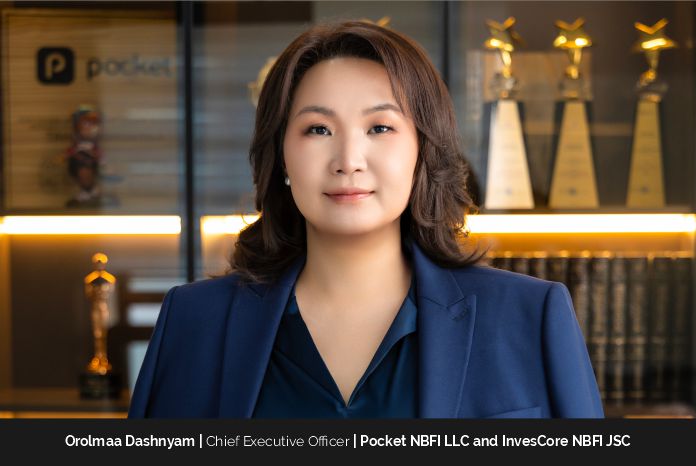
At the center is Mrs. Orolmaa Dashnyam, named one of “The 10 Most Innovative CEOs Making a Difference, 2026.” Her leadership is rooted in a rare, ground-up perspective.
“I began my career developing Loan Origination Systems (LOS) for a traditional lender, which allowed me to master the lending ecosystem from the inside out,” Orolmaa shares.
Having worked at the branch level, handling everything from credit checks to disbursements, she understands exactly where the manual friction exists. This hands-on approach ensures that growth relies on repeatable systems that remain flexible within institutional limits rather than bypassing them.
Leadership Built Around People and Process
As the platform scales, Orolmaa’s focus has shifted from the product to the people. “Rather than striving to be a ‘big company,’ we aim to be a ‘smart company,'” she remarks. With an average team age of 25, processes are designed for clarity, where responsibility is paired with explicit ownership.
This commitment to consistency is rooted in lessons learned from Japanese partners regarding “flawless execution” and the discipline of never overlooking small details. “We believe that sustainable growth is only possible when built on a stable and healthy culture,” she shares. Teams are encouraged to see the full lifecycle of their work, from logic to customer outcome, ensuring the organization moves quickly without breaking.
Care Designed into the System
Much of the platform’s social impact is structural. Orolmaa evaluates products based on whether they address real user needs, offer seamless accuracy, and create value for all stakeholders. Transparency serves as a safeguard; customers receive clear terms and financial education to ensure borrowing remains sustainable.
By embedding data protection and privacy into the platform itself, care moves from a goal to a method. This human-centric approach was recently reflected in the “Pocket – A Pocket Full of Smiles” campaign, which received nearly 5,000 messages from customers describing how the platform supported them, from planned milestones to midnight emergencies for young families.
Market Validation Through Shared Success
Pocket’s growth is a journey of “growing together” with its tenants, who view the platform as a foundational ally through every market cycle. This trust has translated into a profound shift in capital access: in 2025 alone, Pocket was responsible for approximately 11% of the total disbursements in the Mongolian NBFI market.
Financial performance follows this pattern of stability. Loans, assets, equity, and profits have grown steadily because the PaaS model is inherently scalable. High user adoption, the participation of top-tier NBFIs, and the backing of international capital all point to a validation that goes far beyond brand visibility.
Innovation Estimated by What Endures
Innovation in financial services is often framed in terms of disruption, but its real test is durability. Pocket’s PaaS model has reshaped the industry by building a shared infrastructure that expands access without adding risk.
“The ultimate measure of success is not the visibility of the leader, but the inclusivity of the ecosystem we leave behind,” Orolmaa concludes. “We are creating the conditions for the next generation to thrive in a financial world that is more accessible, transparent, and opportunity-rich.”
Looking Beyond Borders
After six years of rigorous testing and refinement in the competitive Mongolian market, Pocket is now ready to export its proven technological blueprint. The platform is no longer a local pilot; it is a mature, high-performance ecosystem poised for international scale.
The company is actively exploring opportunities to bring its operational expertise to new territories, with a strategic focus on Central Asia and Southeast Asia. For investors and strategic funders, this represents a rare, de-risked opportunity to back a mature fintech infrastructure that has already demonstrated its ability to capture a significant share of a national market.
As Pocket transitions from a domestic leader to a regional infrastructure provider, the invitation is open for partners to join in shaping the future of global finance.